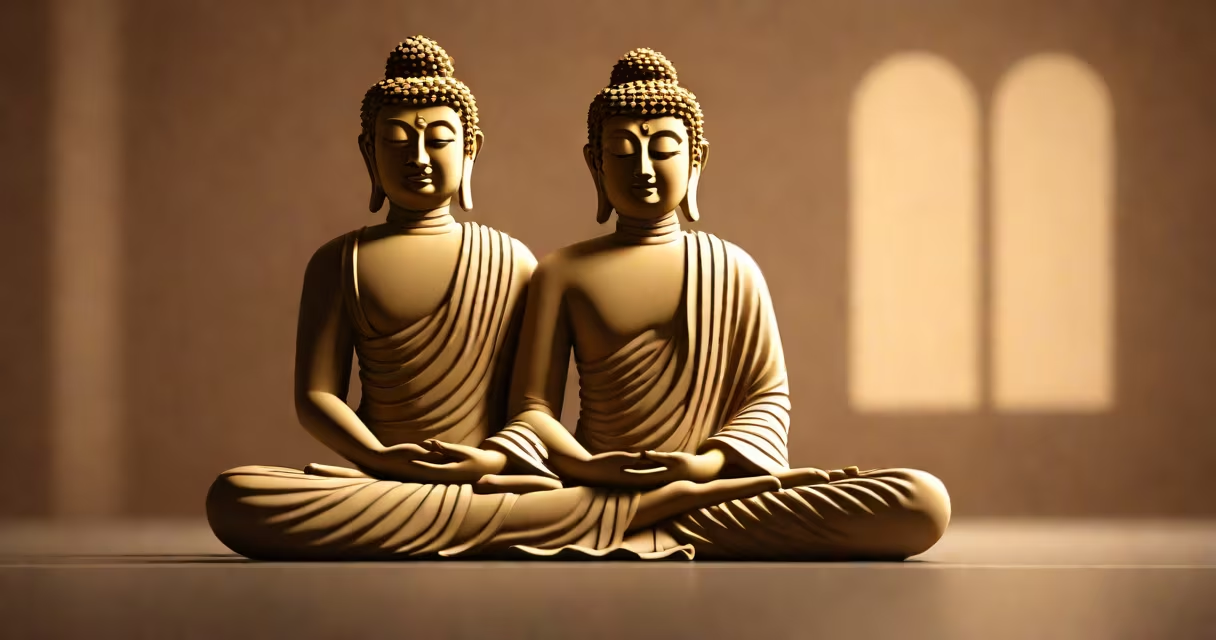
Buddha meditation for beginners is a practice rooted in ancient Buddhist traditions that emphasizes mindful breathing, present-moment awareness, and non-judgmental observation of thoughts and sensations. It requires no special equipment, only a quiet space and 5 to 10 minutes daily. This form of meditation aims to cultivate mental clarity, emotional balance, and inner peace through consistent, gentle attention.
The core of Buddha meditation lies in sitting still and observing the breath as it moves in and out of the body. Unlike visualization or chanting-based methods, this technique focuses on direct sensory experience. You sit upright, either on a cushion or chair, with spine aligned and eyes gently closed or lowered. Attention rests on the sensation of air entering and leaving the nostrils, or the rise and fall of the abdomen. When the mind wanders-which it inevitably does-you return to the breath without criticism.
This practice draws from the teachings of Siddhartha Gautama, who emphasized "sati" (mindfulness) and "upekkhā" (equanimity). Modern neuroscience confirms that regular engagement reduces activity in the default mode network-the brain's self-referential thinking center-leading to lower anxiety and improved concentration. A 2011 study published in *Psychiatry Research* found that participants practicing mindfulness meditation for eight weeks showed measurable decreases in gray matter density in the amygdala, the region linked to stress and fear responses.
Buddha meditation operates on the principle that suffering arises not from external events, but from our reactions to them. By training attention to stay with the present-especially the breath-you create space between stimulus and response. This gap allows you to observe thoughts as passing phenomena rather than truths to be acted upon.
For example, if you feel irritation during a meeting, the automatic reaction might be to snap at someone. With regular practice, you learn to notice the tightening in your chest, the rise of heat in your face, and the impulse to speak-but then pause. That pause is the moment of choice. Over time, this reduces reactivity and increases emotional regulation.
Each session begins with a few deep breaths to settle the nervous system. Then, you rest attention on the breath. When distraction occurs-whether it's a sound, a memory, or a physical itch-you acknowledge it ("I'm noticing a sound") and gently return to the breath. There is no goal beyond returning, again and again. The act of returning is the practice itself.
Buddha meditation for beginners typically involves four foundational elements: posture, breath awareness, non-judgmental observation, and consistency. Posture matters less than stability-sitting upright prevents drowsiness and promotes alertness. Breath awareness anchors attention in the body. Non-judgmental observation means accepting whatever arises without labeling it good or bad. Consistency-daily practice-even for five minutes-is more effective than occasional long sessions.
Common forms include:
A 2020 review in Frontiers in Psychology found that combining Samatha and Vipassanā led to greater reductions in rumination and depressive symptoms compared to control groups. Participants reported clearer thinking and better sleep after six weeks of daily 10-minute sessions.
Buddha meditation for beginners is widely used in clinical settings, schools, and workplaces. It appears in programs like Mindfulness-Based Stress Reduction (MBSR), developed by Jon Kabat-Zinn at the University of Massachusetts Medical School. MBSR uses Buddhist principles adapted for secular audiences, with structured eight-week courses that include daily home practice.
For example, a high school in Oakland, California, introduced a 15-minute morning Buddha meditation session for students. After one semester, teachers reported a 30% drop in classroom disruptions and improved test scores in math and reading. Students described feeling calmer and more focused during exams.
It's also used in corporate wellness programs. Google's "Search Inside Yourself" program, based on Buddhist mindfulness, trained over 10,000 employees in emotional intelligence and attention regulation. Internal surveys showed a 25% increase in job satisfaction and reduced burnout rates.
Many assume Buddha meditation requires emptying the mind. This is incorrect. The goal is not to stop thoughts but to observe them without getting caught in their narrative. Thoughts are like clouds passing through the sky-they appear, linger, and disappear. You don't have to chase them away.
Another myth is that you must meditate for hours to see benefits. Research shows that even five minutes per day yields measurable results. A 2018 study in NeuroImage demonstrated that participants who meditated for just 10 minutes daily over two weeks showed increased connectivity in brain regions associated with attention and emotional regulation.
Some confuse Buddha meditation with spiritual rituals involving mantras or deity visualization. These are distinct practices. Buddha meditation for beginners is secular in application, though it stems from religious roots. You don't need to adopt Buddhist beliefs to benefit from the technique.
Try this 5-minute session:
Do this once daily for seven days. Track your mood and focus level each evening. Most beginners report reduced mental chatter and improved patience within a week.
After a month, consider expanding to 10 minutes. Use a timer with a soft chime to avoid checking the clock. Apps like Insight Timer offer free guided sessions based on Buddhist teachings. Look for those labeled "beginner," "mindfulness," or "breath-focused."
Over time, you'll notice subtle shifts: fewer reactive impulses, better sleep, and a greater sense of calm during routine tasks. As the Visuddhimagga, a 5th-century Theravāda text, states: "The mind is difficult to master, but it can be trained."