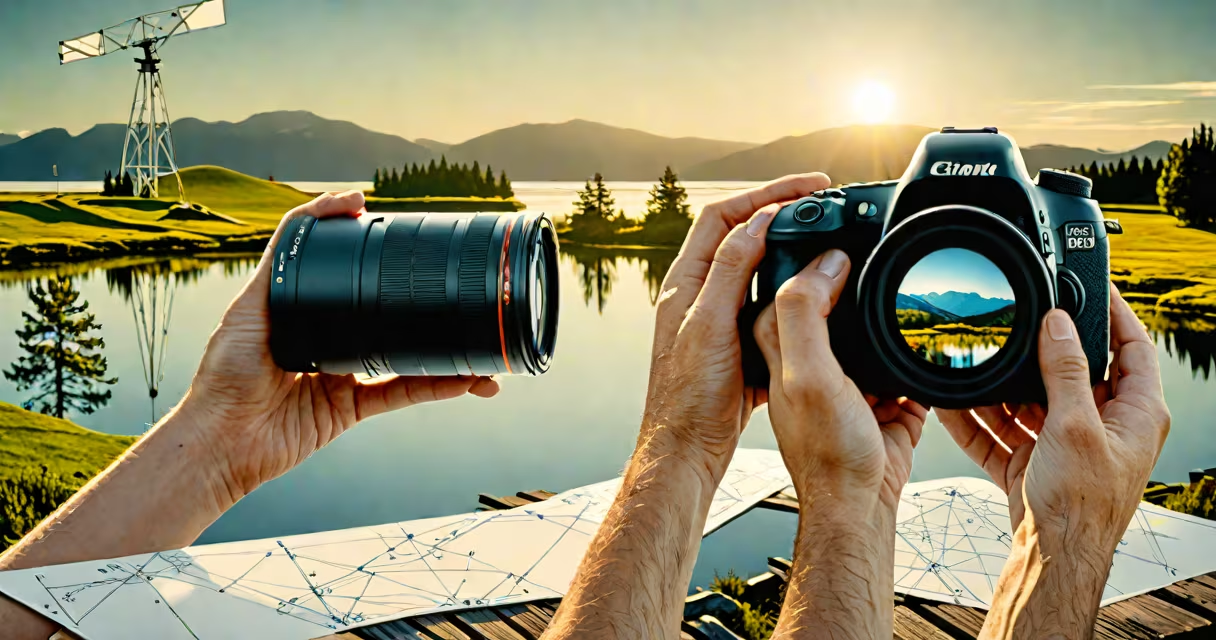
A polarising filter is a lens attachment that blocks certain orientations of light waves, reducing reflections and boosting contrast and color intensity in photographs. It works by filtering out scattered, reflected light that causes haze and glare, especially on water, glass, or shiny surfaces.
These filters are essential tools in photography, particularly for outdoor and field work. They don't alter focus or exposure directly but change how light enters the camera sensor. A standard polarising filter rotates to adjust the level of polarisation, typically offering 2 to 3 stops of reduction in brightness when fully engaged.
For clarity: a polarising filter is not the same as a neutral density (ND) filter, which reduces light intake without affecting wave orientation. While both affect exposure, only the polarising filter targets light wave alignment. According to the American Society of Media Photographers (ASMP), polarising filters are among the most effective tools for improving image quality in natural lighting conditions.
Light travels as transverse waves vibrating in multiple directions. When light reflects off surfaces like water, glass, or foliage, it becomes partially polarised-meaning the waves align along a single plane. A polarising filter contains a microscopic grid of aligned molecules that act like a shutter, allowing only light waves oriented in one direction to pass through.
Rotating the filter changes the angle of this grid. As you turn it, you see the effect in real time through the viewfinder or on the LCD screen: reflections fade, skies deepen to blue, and colors intensify. This happens because sunlight scatters in all directions, but reflected light tends to vibrate horizontally. The filter blocks horizontal components while letting vertical waves through.
For example, when photographing a lake at midday, reflections from the surface can obscure underwater details. With a polarising filter rotated correctly, those reflections vanish, revealing fish or submerged rocks. The effect is strongest at a 90-degree angle between the sun and the camera-commonly around 10 a.m. or 2 p.m., depending on location.
Polarising filters come in two main types: linear and circular. The difference lies in how they interact with a camera's autofocus and metering systems.
| Type | How It Works | Use Case | Camera Compatibility |
|---|---|---|---|
| Linear | Blocks light based on wave orientation only. | Older film cameras, manual focus systems. | May interfere with autofocus and TTL metering in modern DSLRs and mirrorless cameras. |
| Circular | First applies a linear polariser, then adds a quarter-wave plate to convert light into circular polarisation. | Modern digital cameras, autofocus systems. | Compatible with all current DSLR and mirrorless systems. |
Most photographers use circular polarising filters. Using a linear filter on a modern digital camera can cause autofocus failure or incorrect exposure readings. The camera's phase-detection system relies on consistent light polarization, and a linear filter disrupts this.
Non-obvious fact: even if a filter is labelled "circular," it may still degrade image quality slightly due to internal reflections or chromatic aberration. High-end brands like B+W and Hoya design their filters with multi-coated elements to reduce flare and ghosting. Test your filter at f/1.8 to f/2.8 to check for visible artifacts.
Use a polarising filter in conditions with high reflectivity. Common applications include:
For instance, a photographer shooting a mountain lake at sunrise in Banff National Park used a circular polarising filter at 11 a.m. The sky turned deeper blue, reflections vanished from the water's surface, and the green of trees became more vivid. Without the filter, the image had washed-out tones and distracting glint on the water.
Important limitation: polarising filters reduce light by 1.5 to 3 stops. You'll need longer exposures or higher ISO settings in low-light situations. On a sunny day, this can be beneficial-slowing shutter speed to blur motion in waterfalls-but in dimmer light, it forces compromises.
Many assume that a polarising filter improves image sharpness. It does not. Sharpness depends on lens quality, focus accuracy, and sensor resolution. The filter affects contrast and colour, not edge definition.
Another mistake is assuming that rotating the filter always improves results. The effect is directional. Rotating past 90 degrees from the light source reverses the impact. Always test rotation while viewing the scene through the camera's live view or optical viewfinder.
Some users try to stack filters-adding a polariser over a UV or ND filter. This increases the risk of vignetting, especially on wide-angle lenses. It also introduces more glass surfaces, increasing flare and ghosting. If you need multiple effects, use a filter holder system or choose a filter with dual functionality, such as a variable ND with polarising capability.
Firsthand observation: during a photo walk in Venice, I used a polarising filter on a 16-35mm f/2.8 lens. At 16mm, the filter caused noticeable corner darkening-vignetting-due to the wide angle and the filter's thickness. Switching to a thinner, high-quality filter resolved the issue. Always test your gear combination before critical shoots.
Size matters. Ensure the filter diameter matches your lens (e.g., 52mm, 77mm). Most filters are available in standard sizes. Use a filter thread adapter if needed, but avoid stacking adapters-they increase the chance of misalignment.
Quality varies. Cheaper filters often have uneven polarisation zones, leading to inconsistent results across the frame. Premium filters use uniform materials and precise alignment. According to a 2022 test by Digital Photography Review, B+W 77mm Circular Polarising Filters maintained consistent performance across the entire frame, while budget options showed up to 15% variation in polarisation strength near edges.
Consider a variable polarising filter if you want adjustable strength without rotating. These use two rotating plates and allow continuous adjustment from minimal to maximum effect. However, they can introduce colour shifts and reduced image quality compared to fixed-strength filters.
For most users, a high-quality circular polarising filter in the correct size is sufficient. If you're working with video, note that rotating the filter during a shot creates flickering in the image due to changing light levels. Use a fixed filter or stabilise the rotation manually.
Understanding how filters work in electronics-what is filter in electronics-helps clarify why a polarising filter is a type of signal filter, manipulating electromagnetic wave properties rather than altering image data after capture.
A polarising filter is not a post-processing tool. Its effect is physical, applied before the image reaches the sensor. This makes it a useful pre-capture enhancement. When used correctly, it transforms flat, washed-out scenes into rich, changing images.