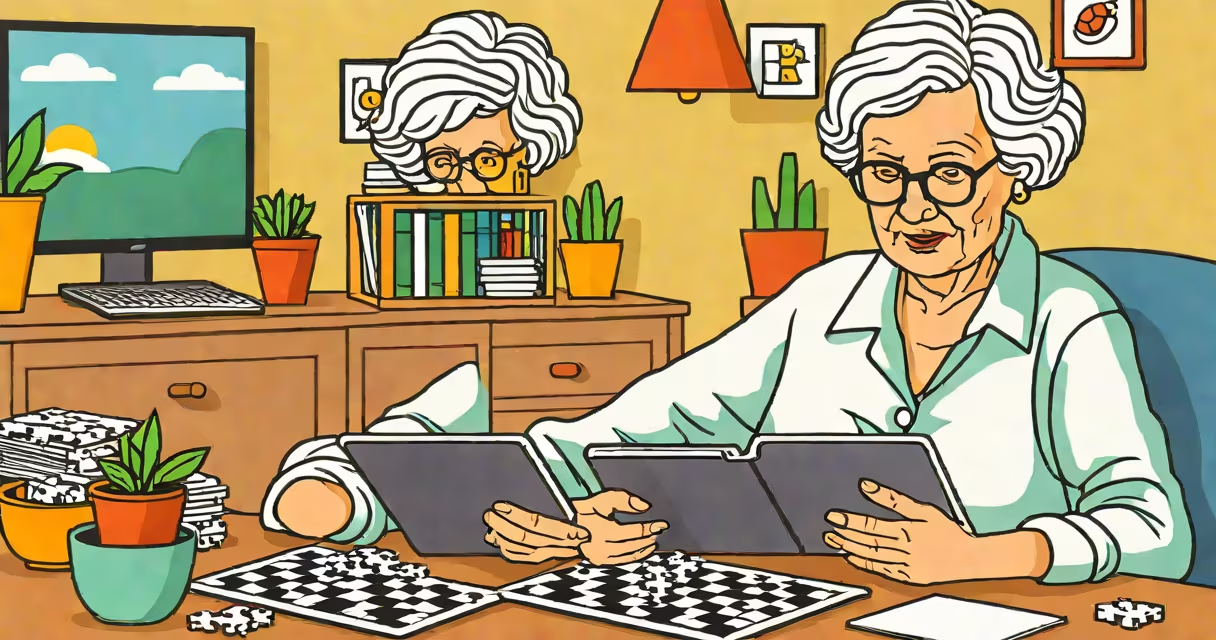
Brain games for seniors online are structured digital activities designed to challenge memory, attention, problem-solving, and processing speed in adults aged 60 and above. These games are accessible via web browsers or mobile apps and often include puzzles, memory drills, logic challenges, and pattern recognition tasks. They are backed by research showing measurable improvements in cognitive function when practiced regularly.
These tools work by activating neural pathways associated with executive function and working memory. When seniors engage in consistent, moderate-intensity cognitive tasks, the brain forms new synaptic connections and strengthens existing ones-a process known as neuroplasticity. A 2020 study published in *Nature Human Behaviour* found that older adults who completed 10 hours of targeted brain training over six weeks showed significant gains in processing speed and attention compared to a control group.
Most brain games for seniors online follow a progressive difficulty model. Players start with basic levels and advance as skills improve. Games often track performance over time, offering visual feedback on progress. This feature supports motivation and helps users recognize their own improvement, which is critical for long-term engagement.
Online brain games typically combine elements of psychology, neuroscience, and gamification. Core mechanics include timed responses, pattern matching, spatial reasoning, and verbal recall. For example, a common task involves remembering the location of symbols on a grid and then tapping them in reverse order-a test of short-term memory.
Games are built using JavaScript-based frameworks or native app development. They run on standard devices: smartphones, tablets, laptops, and desktops. No special hardware is required. Many platforms offer offline modes or downloadable versions for low-bandwidth environments.
A key design principle is minimizing cognitive load. Instructions are clear, navigation is intuitive, and distractions like ads or pop-ups are limited. Some sites use large fonts, high-contrast colors, and audio cues to support users with declining vision or hearing.
Brain games for seniors online fall into several categories based on the cognitive skill they target:
| Type | Focus Area | Example Game | Duration per session |
|---|---|---|---|
| Memory | Short-term recall, associative memory | "Simon Says" variants, card-matching | 5-10 minutes |
| Attention | Focus, sustained attention, filtering distractions | "Find the Odd One Out," color-shape matching | 5-8 minutes |
| Problem-Solving | Logical deduction, planning, strategy | Simple Sudoku, jigsaw puzzles | 10-15 minutes |
| Processing Speed | Reaction time, rapid decision-making | "Fast Click" games, symbol identification | 3-5 minutes |
Brain games for seniors online are used in homes, assisted living facilities, senior centers, and rehabilitation clinics. They serve both preventive and therapeutic purposes. Regular engagement may delay the onset of mild cognitive impairment (MCI), a condition affecting 10-20% of adults over 65, according to the Alzheimer's Association.
Research from the University of California, San Francisco, shows that older adults who played brain games for 15 minutes a day, five days a week, over eight weeks improved in multitasking and attention control. The study tracked participants using standardized assessments like the Trail Making Test and the Digit Span Backward task.
These games are especially useful for individuals managing chronic conditions like diabetes or hypertension, which increase dementia risk. A 2021 meta-analysis in *The Lancet Digital Health* found that cognitive training reduced cognitive decline by 18% over two years in people with vascular risk factors.
Many assume that brain games for seniors online are just digital versions of crossword puzzles or trivia. While those activities help, they don't provide the same level of cognitive challenge or adaptability. True brain games adjust in real time based on performance, ensuring the difficulty remains optimal-not too easy, not too hard.
Another misconception is that playing brain games prevents dementia outright. Current evidence does not support this claim. However, the American Psychological Association states that regular cognitive engagement reduces the rate of decline by up to 30% in at-risk populations. It's not a cure-it's a protective factor.
A lesser-known fact: some games are designed around dual-task paradigms. For example, a player might be asked to tap a sequence while simultaneously identifying a spoken word. These tasks train the brain's ability to divide attention, a skill that deteriorates with age. Few consumer platforms include these advanced models, but they're available through clinical research programs.
Consider Margaret, a 72-year-old retired teacher with early signs of memory lapses. She began using a free brain game platform called CogniFit, which offers 12 core exercises targeting attention, memory, and executive function. She played 10 minutes daily, five days a week, for six weeks.
Her baseline score on the Stroop Test (measuring interference control) was 72%. After six weeks, her score rose to 88%. Her doctor noted improved reaction times during routine checkups. Margaret reported feeling more confident in conversations and better able to remember appointments.
This outcome aligns with findings from a 2022 randomized controlled trial published in *Frontiers in Aging Neuroscience*. Participants who trained consistently for 40 minutes per week over 12 weeks showed measurable improvements in processing speed and working memory, with effects lasting up to six months post-training.
Brain games for seniors online are not a magic fix. But when used consistently and appropriately, they are a practical, low-cost tool to maintain mental sharpness. The most effective routines combine variety, consistency, and real-world application-like practicing mental math while shopping or recalling a list of items after leaving the house.