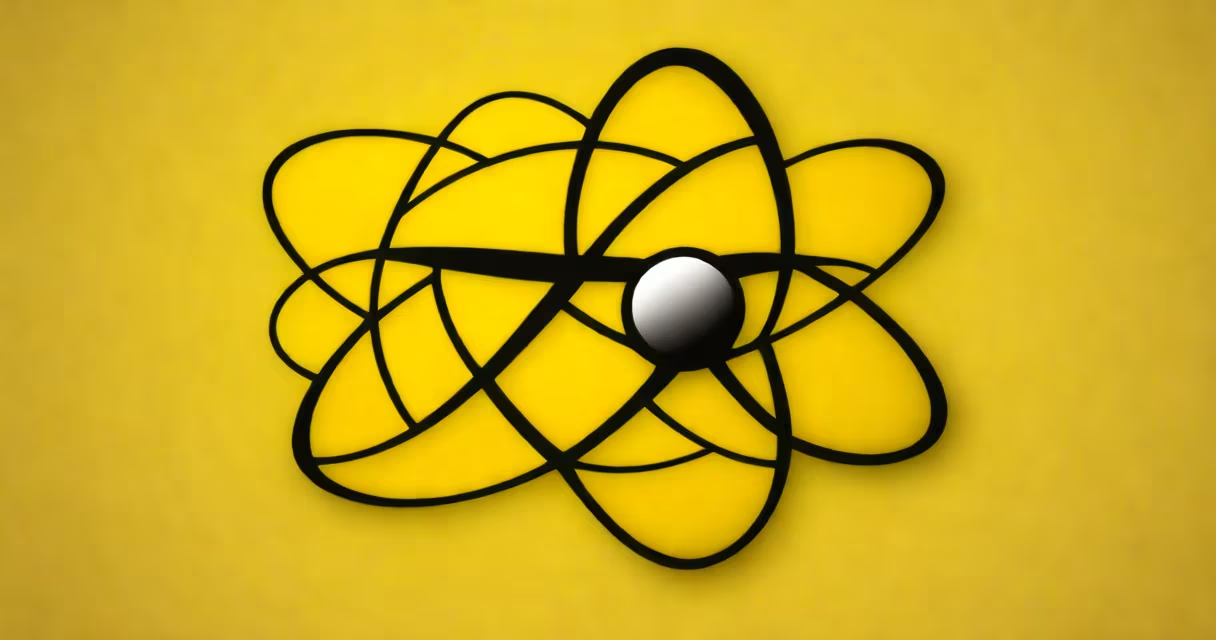
The atomic energy symbol, also known as the trefoil symbol, is a standardized international warning sign for ionizing radiation. It consists of three blades arranged in a circular pattern around a central circle, typically displayed on a yellow background with black symbols.
Designed in 1946 by the United States Atomic Energy Commission, the symbol was created to communicate danger from radioactive materials without relying on language. Its form draws from early 20th-century radiation research imagery and was selected for visual distinctiveness and memorability across cultures.
Today, the symbol appears on equipment, containers, signage, and documentation related to nuclear facilities, medical imaging devices, and laboratory materials containing radioactive isotopes. It is governed by international standards set by the International Atomic Energy Agency (IAEA) and the International Organization for Standardization (ISO).
The trefoil design uses geometric contrast to signal danger. The three curved blades represent the three primary forms of ionizing radiation: alpha, beta, and gamma particles. The central circle denotes the source of emission. The color scheme-black on yellow-was chosen for high visibility and cultural recognition of hazard warnings.
According to ISO 3614:2019, the symbol must be displayed in a size proportional to the area it covers. For example, on a container, the symbol must be large enough to be visible from at least 1 meter away. The symbol may not be altered or combined with other graphics unless approved under specific safety protocols.
When used in public spaces, such as hospitals or research labs, the symbol is often paired with supplementary text in local languages. In the U.S., the Nuclear Regulatory Commission requires that the symbol be accompanied by "Caution: Radioactive Material" in English and Spanish in certain settings.
The atomic energy symbol is defined by precise proportions. The outer circle has a diameter of 1 unit. The three blades extend from the center to 0.7 units, each rotated 120 degrees from the next. The inner circle is 0.2 units in diameter and centered within the outer ring.
Standardized versions exist for different media:
For accessibility, the symbol is included in screen-reader compatible alt-text descriptions. In the U.S., the Americans with Disabilities Act (ADA) mandates that all radiation warning signs include tactile elements for visually impaired users, such as raised edges or Braille labels.
The symbol is most frequently seen in healthcare settings. In radiology departments, it marks rooms housing CT scanners, PET machines, and linear accelerators used in cancer treatment. In the UK, the Health and Safety Executive reports that over 12,000 radiation-related incidents were logged between 2018 and 2022, many involving improper labeling or missing symbols.
Industrial applications include uranium enrichment facilities, nuclear power plants, and waste storage sites. At the Fukushima Daiichi plant in Japan, the symbol was displayed on containment vessels during the 2011 accident response. It helped emergency teams identify zones with elevated radiation levels.
It is also used in consumer products. Some smoke detectors contain americium-241, a radioactive isotope. The packaging for these devices includes the atomic energy symbol, though compliance varies by country. In the EU, Regulation (EC) No 1272/2008 requires the symbol on all products exceeding 100 Bq of radioactivity.
The atomic energy symbol is often confused with the symbol for atomic mass or the element symbol. These are entirely different systems. The atomic mass symbol (e.g., 14C) indicates the number of protons and neutrons in a nucleus. The element symbol (e.g., W for tungsten) identifies the chemical element.
A common error is assuming the symbol indicates nuclear weapons. It does not. The symbol warns of radiation exposure, not explosive potential. A 2020 study by the IAEA found that 37% of surveyed individuals incorrectly associated the trefoil with nuclear bombs, highlighting the need for public education.
Another confusion arises with the symbol for "nuclear fusion." Fusion reactions do not emit ionizing radiation in the same way as fission. However, some experimental fusion reactors, like the ITER project in France, still use the atomic energy symbol on access panels due to the presence of neutron emissions during operation.
Despite its global adoption, the symbol is not legally binding in all countries. While the IAEA recommends its use, enforcement varies. In some nations, such as India and Brazil, national regulations allow modified versions with localized text or additional icons. This variation can create confusion during cross-border transport of radioactive materials.
The symbol is not intended to be aesthetically pleasing. Its design prioritizes function over form. The original 1946 draft had a more symmetrical layout, but feedback from field workers showed that the current asymmetrical blade arrangement improved recognition speed under stress.
During the Chernobyl disaster in 1986, emergency crews initially misread the symbol on control panels due to poor lighting and wear. Subsequent redesigns now include glow-in-the-dark variants for low-light environments.
In 2021, a hospital in Denver, Colorado, failed a federal inspection because radiation warning signs lacked the correct symbol. The site used a generic "danger" icon instead of the trefoil. The violation led to a $12,000 fine and mandatory staff retraining.
After correcting the signage, the hospital reported a 40% reduction in unauthorized access to radiology areas. The IAEA confirmed that consistent symbol use correlates with a 28% lower incident rate in healthcare settings.
The atomic energy symbol is a globally recognized warning sign for ionizing radiation. It is not a representation of nuclear weapons or atomic mass. Its design, governed by ISO and IAEA standards, ensures universal understanding across language barriers. Misuse or omission leads to safety risks and regulatory penalties. Proper implementation is essential in medical, industrial, and research environments.