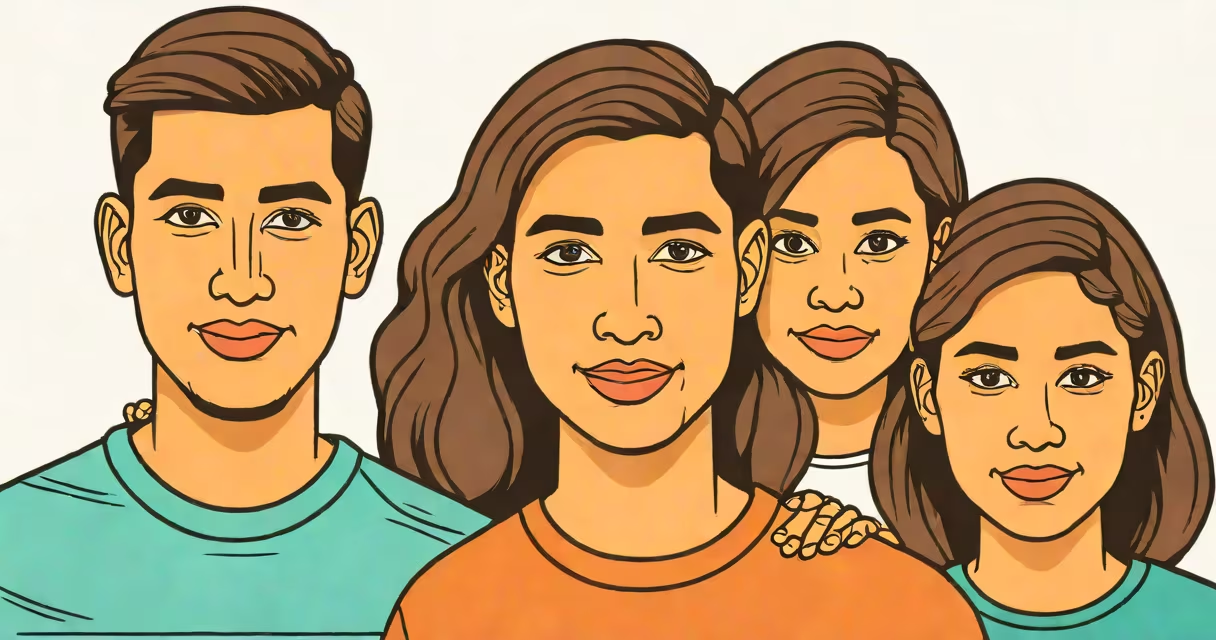
A 1st cousin is someone who shares one set of grandparents with you but has different parents. You and your 1st cousin have the same two grandparents but different mothers and fathers. This relationship forms through sibling lines-your parent and your cousin's parent are siblings.
Genetically, 1st cousins share approximately 12.5% of their DNA on average. This figure comes from the fact that each person inherits roughly half of their DNA from each parent. Since your parents and your cousin's parents are siblings, you inherit about 25% of your DNA from each grandparent. The overlap between you and your 1st cousin averages out to 12.5% due to random assortment during meiosis.
The term "1st cousin" applies regardless of whether the cousin is older or younger. Age doesn't affect the biological relationship. If your father's sister has a child, that child is your 1st cousin. If your mother's brother has a daughter, she is also your 1st cousin. The label depends solely on shared ancestry, not birth order or gender.
Family trees branch from common ancestors. When two siblings have children, those children are first cousins. For example, if Alice and Bob are siblings and Alice has a daughter named Clara, while Bob has a son named David, then Clara and David are 1st cousins. They share the same maternal and paternal grandparents, but their parents are unrelated beyond that.
This pattern holds across generations. If Clara later has a child named Emma, and David has a child named Liam, then Emma and Liam are 2nd cousins. Their parents (Clara and David) were 1st cousins, so their children are two steps removed from the original shared grandparents.
Genealogical software like Ancestry.com and MyHeritage uses this logic to map relationships. These tools calculate shared DNA segments and assign cousin levels based on expected inheritance patterns. A match showing 1,200-1,400 centimorgans (cM) of shared DNA typically indicates a 1st cousin relationship, though ranges vary slightly due to recombination.
While "1st cousin" is standard, some families use modifiers for clarity. A "half 1st cousin" shares only one grandparent with you-either through your mother's side or your father's side. Half cousins occur when one parent is a sibling to your parent, but the other parent is unrelated. For example, if your mother has a half-sister (same mother, different father), and that half-sister has a child, that child is your half 1st cousin.
Another variation is the "double 1st cousin," which arises when two siblings from one family marry two siblings from another family. Their children are both 1st cousins and share more DNA than typical 1st cousins-averaging around 25% instead of 12.5%. This occurs in endogamous communities or among closely related extended families.
| Type | Shared Grandparents | Avg. Shared DNA | Example |
|---|---|---|---|
| Full 1st cousin | Two | 12.5% | Same two grandparents on both sides |
| Half 1st cousin | One | 6.25% | Only one grandparent shared |
| Double 1st cousin | Four | 25% | Parents are siblings from two different families |
Many people assume that 1st cousins are genetically equivalent to siblings. This is incorrect. Siblings share about 50% of their DNA on average. 1st cousins share only 12.5%, which is less. While they may feel close due to shared family history, biologically, they are much more distantly related.
Another misconception is that 1st cousins are automatically close friends or confidants. Family bonds depend on upbringing, proximity, and personal connection-not genetics. Two people can be 1st cousins by blood yet grow up in different countries with no contact. Conversely, adopted siblings raised together may feel closer than biological 1st cousins who interact daily.
A lesser-known fact: in some cultures, especially in parts of Asia and the Middle East, 1st cousins are often encouraged to marry. In Saudi Arabia, for example, consanguineous marriages (between relatives) are legally permitted and culturally common. However, medical research shows that children born to 1st cousin couples have a 4% higher risk of congenital disorders compared to non-related couples, according to a 2018 study published in Human Reproduction.
Consider Maria and James. Maria's mother is Linda. James's mother is Sarah. Linda and Sarah are sisters. Therefore, Maria and James are 1st cousins. Their shared grandparents are Robert and Helen. Maria inherited 25% of her DNA from Robert and 25% from Helen. James did too. The overlapping portion-shared from both Robert and Helen-is approximately 12.5%.
When Maria took a DNA test via 23andMe, the results showed 1,320 cM of shared DNA with James. This falls within the typical range for 1st cousins (1,000-2,300 cM), confirming the relationship. The test also revealed that they share multiple DNA segments across chromosomes 1, 4, and 12, consistent with recent shared ancestry.
Even though they grew up in different states and met only twice in person, they maintain regular contact through video calls. Their bond stems from shared stories, photos, and holidays rather than biology. This illustrates that while 1st cousin meaning defines a genetic link, emotional closeness is shaped by life experiences.
Confusion sometimes arises between "1st cousin" and "second cousin." Second cousins share great-grandparents, not grandparents. The difference lies in generational distance. You and your 1st cousin are separated by one generation from the shared ancestor. You and your 2nd cousin are separated by two generations.
Another frequent mix-up is equating "1st cousin" with "nephew" or "aunt." A nephew is the child of your sibling. An aunt is your sibling's parent. These are distinct roles. A 1st cousin is not a sibling's child nor a parent's sibling-they are the child of your parent's sibling.
Understanding 1st cousin meaning helps clarify inheritance rights, medical history sharing, and social dynamics. It's not just a label-it's a structure for mapping human relationships across time and space.