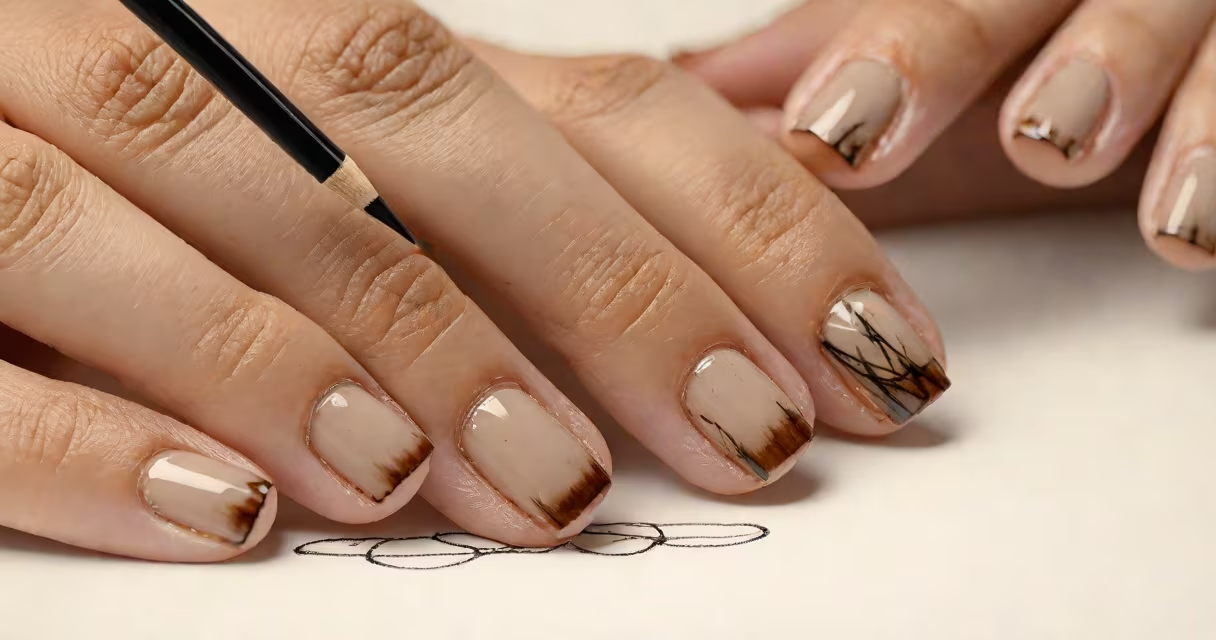
Brown nails result from pigment buildup, trauma, fungal infections, or systemic conditions affecting the nail bed or matrix. This discoloration can appear as streaks, spots, or full nail darkening and may signal a benign issue or require medical evaluation.
Nail color changes occur when melanin, iron, or other substances accumulate in the nail plate or underlying tissue. The nail matrix-the living tissue beneath the cuticle-is responsible for producing the nail's structure. When abnormal pigments form here, they get locked into the growing nail, causing visible brown hues. The condition can affect one or multiple nails.
While occasional brown spots may be harmless, persistent or spreading discoloration demands attention. According to the American Academy of Dermatology, 10% of nail pigmentations are due to melanoma, making early detection critical. A single brown streak running vertically down a nail-especially if it widens or changes color-should prompt a dermatologist visit.
Brown nails form when excess melanin is produced in the nail matrix or when blood, debris, or fungi infiltrate the nail layer. As the nail grows out, the pigment becomes visible. The rate of growth varies-fingernails grow about 3.5 mm per month-so discoloration may take weeks to emerge.
When trauma occurs-such as dropping a heavy object on a toe-the pressure can rupture small blood vessels under the nail. Blood pools and oxidizes, turning dark red or black. Over time, this breaks down into brown pigments. This is called subungual hematoma and often appears as a dark spot that moves toward the fingertip as the nail grows.
Fungal infections, particularly onychomycosis, can cause nails to turn yellow, green, or brown. These infections thrive in warm, moist environments and may begin with a small white or yellow spot before spreading. The fungus alters the keratin structure, leading to thickened, brittle, and discolored nails.
Several distinct causes explain brown nail discoloration. Some are temporary; others require treatment.
| Cause | Appearance | Duration | Medical Relevance |
|---|---|---|---|
| Subungual hematoma | Dark spot or streak, often near base of nail | 6-12 weeks (nail grows out) | Benign; resolves as nail grows |
| Onychomycosis (fungal infection) | Yellow-to-brown thickening, crumbling edges | Persistent without treatment | Requires antifungal therapy |
| Melanonychia | Vertical brown streaks; may affect one or several nails | Can persist indefinitely | Need monitoring-some cases are melanoma |
| Medication side effect | Uniform brown tint; often bilateral | May fade after stopping drug | Reversible upon discontinuation |
One non-obvious point: brown nails caused by medications are often overlooked. Drugs like certain chemotherapy agents (e.g., bleomycin), antimalarials (e.g., hydroxychloroquine), and some antibiotics (e.g., minocycline) can deposit pigments in tissues. Minocycline, for example, causes blue-gray or brown discoloration in up to 20% of long-term users, according to the National Institutes of Health.
A personal observation: during a routine skin check, I noticed a faint brown streak on my big toenail. It had been stable for six months. After consulting a dermatologist, a biopsy confirmed benign melanonychia. The doctor emphasized that stability over time reduces risk-but never assume. Any change in size, color, or shape warrants evaluation.
Not all brown nails are harmless. Melanoma of the nail unit-called subungual melanoma-can mimic a bruise. It affects fewer than 1 in 100,000 people annually but accounts for 1% of all melanomas. Early signs include a brown streak wider than 3 mm, asymmetry, or bleeding from the nail.
The ABCDE rule applies: Asymmetry, Border irregularity, Color variation, Diameter >6 mm, Evolution (change over time). If a brown streak meets two or more criteria, biopsy is recommended. The Mayo Clinic notes that delayed diagnosis leads to poorer outcomes-survival drops below 50% when melanoma spreads beyond the nail bed.
Other systemic conditions linked to brown nails include Addison's disease (adrenal insufficiency), which causes hyperpigmentation across the body-including nails-and hemochromatosis, a genetic disorder causing iron overload. Iron deposits in the nail bed can produce a grayish-brown hue. Blood tests confirm these diagnoses.
Brown nails are sometimes mistaken for dirt under the nail, especially in older adults or those with manual labor jobs. However, dirt doesn't grow out with the nail-it stays in place. True discoloration moves distally as the nail grows.
Another confusion: rust-colored stains from metal exposure. If you work with iron tools or handle rusty objects, iron oxide can embed in the nail surface. Unlike internal pigment, this stain can be removed with thorough cleaning and acetone. But if the discoloration persists after scrubbing, it's likely internal.
Some people confuse brown nails with leukonychia (white spots), but the colors differ sharply. White spots stem from minor trauma to the matrix and appear as opaque white dots. Brown nails involve deeper pigment deposition and are not related to calcium deficiency, despite common myths.
If you notice brown nails, start with a visual inspection. Note the pattern: Is it a single streak? Spotty? Widespread? Check for pain, swelling, or nail separation. If the discoloration is recent and follows an injury, it's likely a hematoma. Wait 6-8 weeks to see if it grows out.
For persistent or unexplained discoloration, consult a dermatologist. They may perform a dermoscopy-a high-powered magnification tool-to assess pigment patterns. If suspicion remains, a biopsy of the nail matrix is the gold standard. The American Academy of Dermatology recommends biopsy for any brown streak wider than 1 mm or that appears in a previously healthy nail.
Treatment depends on the cause. Fungal infections respond to oral antifungals like terbinafine (taken daily for 6-12 weeks). Subungual hematomas resolve on their own. Melanonychia requires monitoring; if suspicious, surgical removal of the nail and underlying tissue may be needed.
Prevention includes wearing protective gloves during household tasks, keeping nails clean and dry, and avoiding prolonged exposure to chemicals. If you're on medication and notice nail changes, discuss alternatives with your doctor.
Understanding why your nails are brown begins with observing the pattern and timeline. While many causes are harmless, some demand early intervention. Recognizing the difference between a bruise and a warning sign can prevent serious complications.
Knowing the root cause of brown nails ensures proper action. Whether it's a minor injury, a medication side effect, or a rare condition, accurate identification guides the right step forward.