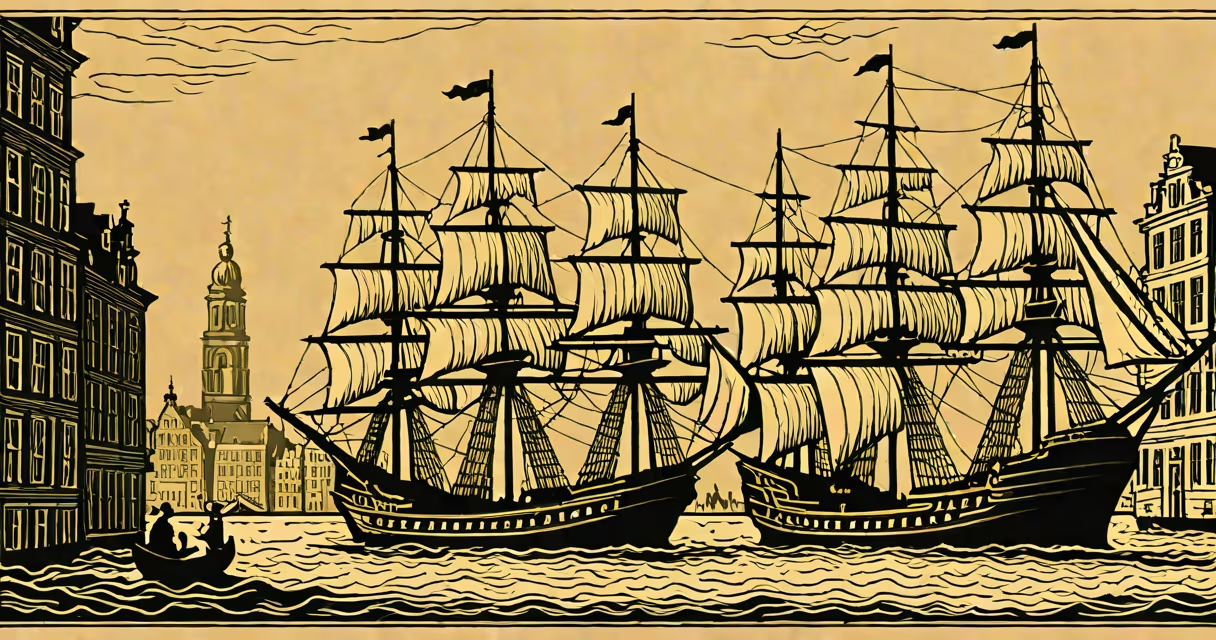
The concept of stocks originated in the early 1600s when the Dutch East India Company issued tradable equity shares to raise capital for long-distance trade ventures. This marked the first known use of ownership stakes in a company that could be bought, sold, and traded on a public market.
Before the 1600s, investment was limited to loans, land, or direct ownership of goods. The Dutch East India Company introduced a new model: investors pooled money to fund voyages, and in return, received certificates representing partial ownership. These were not bonds-they weren't promises to repay principal with interest. Instead, they represented actual equity in a business venture, with returns tied to profits.
By 1602, the company began issuing shares that could be transferred between individuals. These shares were traded on the Amsterdam Stock Exchange, established in 1602-the world's first formal stock exchange. Investors didn't just hold shares; they could sell them to others, creating liquidity and enabling price discovery based on supply and demand.
Each share represented a proportional stake in a voyage or a fleet of ships. For example, if an investor bought 100 shares out of 10,000 issued, they owned 1% of the company's assets and profits. Profits were distributed as dividends when ships returned with cargo-spices, textiles, and precious metals.
Unlike modern stocks, early shares had no fixed maturity date. They didn't expire. Instead, they remained valid as long as the company operated. Shareholders could sell their holdings to others, often at a premium if the company performed well. This created a secondary market where prices fluctuated based on news, weather, piracy risks, and trade routes.
A key innovation was the use of transferable certificates. Before this, ownership of investments was informal and hard to prove. The Dutch East India Company issued physical documents with unique serial numbers, signatures, and seals. These became the foundation for modern stock certificates and trading records.
While no single person "invented" stocks, key figures enabled their rise. Johan van Oldenbarnevelt, a Dutch statesman, supported the creation of joint-stock companies as tools for national economic expansion. His backing helped legitimize the model across the Netherlands.
Adriaan Pauw, a wealthy merchant and director of the Dutch East India Company, played a central role in structuring the share issuance process. He advocated for transparent accounting and regular profit reports to maintain investor trust-practices now standard in public companies.
According to the World Bank's historical analysis of financial systems, the Dutch East India Company's share structure was the first to meet all criteria for modern equity: divisible ownership, transferability, and profit-sharing. This set a precedent adopted by later institutions like the British East India Company (founded 1600) and eventually the New York Stock Exchange (founded 1792).
Many assume stocks were invented in the 18th or 19th century, during the Industrial Revolution. But the Dutch East India Company predates the steam engine and railroads. Its model was already mature by the time Benjamin Franklin was born.
Another myth is that stocks were created to fund wars. While governments later issued bonds for military spending, the original purpose of stocks was commercial enterprise-specifically overseas trade. The Dutch used shares to finance expeditions to the East Indies, not to wage war.
Some confuse stocks with bonds. Bonds are debt instruments. You lend money to a company or government and get interest payments back. Stocks are ownership. You become a partial owner. The Dutch East India Company offered both-bonds for predictable income and shares for growth potential.
The earliest form of stock was a share in a specific voyage or fleet. Later, the Dutch East India Company consolidated multiple ventures into a single company with perpetual shares. This evolved into the modern distinction between common and preferred stock.
| Early Type | Modern Equivalent | Key Feature |
|---|---|---|
| Voyage-specific shares | Project-based equity | Ownership tied to a single mission; no ongoing rights |
| Perpetual company shares | Common stock | Open-ended ownership; voting rights; dividend eligibility |
| Dividend-only shares | Preferred stock | Fixed payouts; priority in profit distribution; no voting rights |
I once stood in the Rijksmuseum's exhibition hall, holding a replica of a 1605 Dutch East India Company share certificate. The paper was thin, the ink faded. On it, a signature in Latin, a seal with a ship and a globe. The document listed the shareholder's name, number of shares, and a clause stating: "This share entitles the holder to a portion of the net profits from the voyage to Batavia."
That moment made clear: stocks weren't theoretical. They were practical tools for risk-sharing. The Dutch didn't just imagine a future of global trade-they built the financial infrastructure to make it possible.
The Dutch model spread rapidly. By 1613, the British East India Company began issuing shares. In 1792, American merchants formed the New York Stock Exchange after signing the Buttonwood Agreement under a buttonwood tree. Their goal: create a formal place to trade securities.
Today, over 40 million people in the U.S. alone own stocks through retirement accounts, mutual funds, or individual brokerage accounts. The mechanics remain rooted in the 17th-century innovation: pooling capital, dividing ownership, and distributing profits.
Understanding who invented stocks reveals more than history-it shows how human cooperation scaled beyond local limits. The ability to buy a piece of a distant company, trade it freely, and earn returns based on performance remains one of the most useful engines of economic growth ever devised.
Stocks were not invented by a single genius. They emerged from centuries of commerce, risk management, and institutional trust. The Dutch East India Company didn't just launch a business-it launched a financial system that still powers economies worldwide.