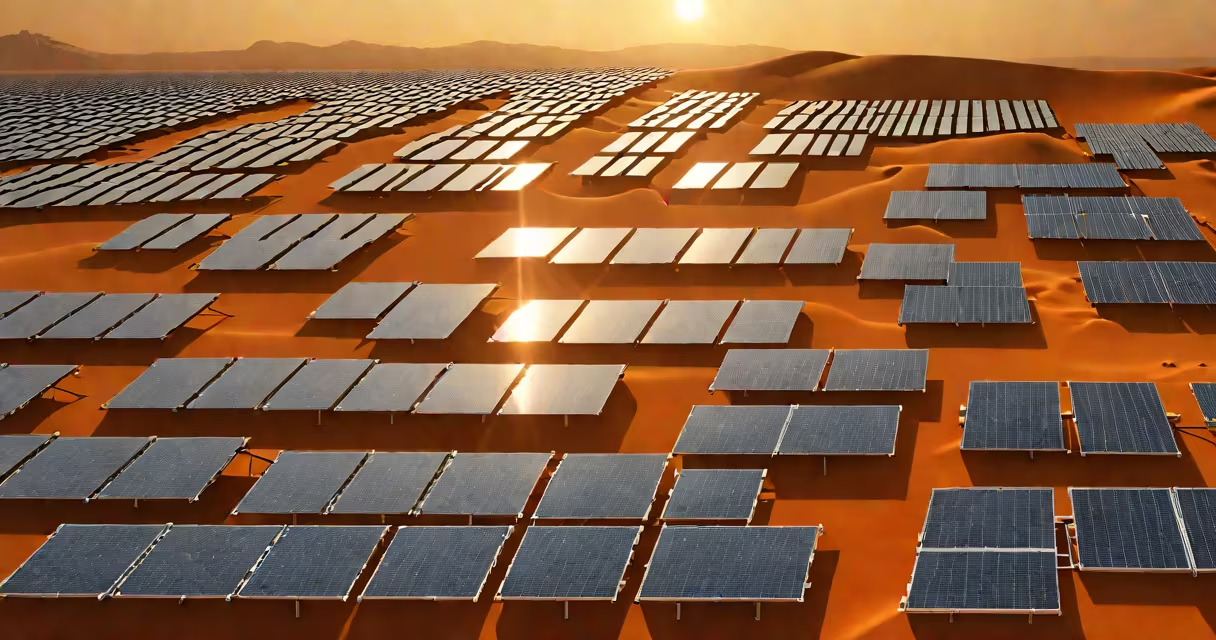
Solar energy is found in sunlight that reaches Earth's surface, captured through photovoltaic cells, solar thermal systems, and large-scale solar farms located in sun-rich regions such as deserts and subtropical zones.
Solar energy originates from nuclear fusion in the Sun's core, emitting electromagnetic radiation that travels 150 million kilometers to Earth. This radiation includes visible light, infrared, and ultraviolet wavelengths. Photons in this stream strike materials like silicon in solar panels, dislodging electrons and generating electric current-a process known as the photovoltaic effect. The energy is then converted into usable electricity via inverters and distributed through power grids or stored in batteries.
Geographic concentration determines where solar energy is most efficiently collected. Regions with high annual sunshine hours-such as the Mojave Desert in California, the Sahara in North Africa, and parts of India and Chile-host the largest solar installations. These areas receive between 2,000 and 3,000 hours of sunlight annually, making them ideal for utility-scale solar projects. In contrast, polar regions and heavily forested zones receive less usable solar input due to cloud cover and seasonal darkness.
Photovoltaic (PV) systems convert sunlight directly into electricity using semiconductor materials. Most residential and commercial installations use monocrystalline or polycrystalline silicon panels, which achieve 15%-22% efficiency under standard test conditions. For example, a typical 6-kW rooftop system in Arizona generates around 9,000 kWh per year-enough to offset average household consumption.
Solar thermal energy uses mirrors or lenses to concentrate sunlight onto a receiver, heating a fluid to produce steam that drives turbines. The Ivanpah Solar Electric Generating System in California, operating since 2014, uses 170,000 heliostats to focus sunlight on boilers atop three towers, producing 392 megawatts of power. This method is effective in dry, open environments where heat loss is minimized.
Portable solar chargers and off-grid systems rely on small PV arrays to power devices in remote locations. A backpack-mounted solar panel rated at 10 watts can charge a smartphone in 2-3 hours under direct sunlight, providing critical energy access in disaster zones or rural communities.
Not all solar energy sites are equal. The following table outlines major categories based on scale, location, and technical setup:
| Type | Location Examples | Capacity Range | Key Advantage |
|---|---|---|---|
| Rooftop solar | Suburban homes, urban buildings | 1-20 kW | On-site generation reduces grid dependence |
| Utility-scale solar farms | Mojave Desert, Rajasthan, Atacama Region | 50 MW - 1 GW | High output, low cost per kWh |
| Concentrated solar power (CSP) | Spain's Andalusia, Morocco's Ouarzazate | 50 MW - 200 MW | Can store heat for nighttime generation |
| Off-grid solar microgrids | Rural villages, island communities | 1-100 kW | Independent of national infrastructure |
Each type leverages different environmental conditions. Rooftop systems thrive in cities with moderate sun exposure, while CSP plants require clear skies and minimal wind to maintain mirror alignment. The National Renewable Energy Laboratory (NREL) estimates that CSP with thermal storage can supply 20% of U.S. electricity demand by 2050, especially in Southwest states.
Many assume solar energy is only viable in hot climates. This is incorrect. Germany, despite lower annual sunlight than Spain, leads Europe in solar capacity, with over 60 gigawatts installed-largely due to government incentives and high-efficiency panel deployment. In 2023, Germany generated 12% of its electricity from solar, exceeding the U.S. average of 4.5%.
Another misconception is that solar panels stop working during cloudy weather. They don't-they simply produce less power. Modern panels generate 10%-25% of rated output on overcast days. During winter months in northern latitudes, systems still contribute meaningfully to energy needs, especially when paired with battery storage.
A lesser-known fact: solar energy is not limited to Earth. Satellites and space stations use solar arrays to power onboard systems. The International Space Station's eight solar arrays, spanning 73 meters, generate up to 120 kilowatts-enough to run multiple experiments and life support systems. This demonstrates that solar energy is accessible wherever sunlight exists, not just on planetary surfaces.
California hosts over 30% of U.S. solar capacity. The Topaz Solar Farm in San Luis Obispo County spans 9.5 square kilometers and contains 9 million photovoltaic modules. It produces 550 megawatts annually-enough to power 180,000 homes. The site was built on former farmland, repurposing land with low ecological value to minimize habitat disruption.
During peak summer months, the facility operates at 85% of theoretical maximum output due to high irradiance levels. Data from the California Energy Commission shows that solar generation in the state exceeded 10 terawatt-hours in 2023, surpassing coal and gas contributions in several months.
I've visited the Topaz site during a field study and witnessed how automated tracking systems adjust panel angles every 15 minutes to follow the sun's path. This incremental adjustment increases daily yield by 12% compared to fixed-tilt systems. The site also features bird-safe glass coatings to reduce collision risks-an engineering solution addressing a common environmental concern.
Knowing where solar energy is found enables better infrastructure planning, policy development, and investment decisions. Governments and utilities prioritize regions with high solar insolation and low land competition. The U.S. Department of Energy's Solar Energy Technologies Office identifies 1.5 million square kilometers of unused land in the western U.S. suitable for solar development-enough to meet national demand many times over.
For individuals, choosing a home with optimal roof orientation (south-facing in the Northern Hemisphere) maximizes solar gain. Even in less sunny areas, combining solar with net metering allows homeowners to sell excess power back to the grid, improving return on investment.
Understanding where solar energy is found also clarifies its role in climate mitigation. According to the International Energy Agency (IEA), solar power accounted for 40% of global renewable capacity additions in 2022, outpacing wind and hydropower. As solar deployment expands, accurate geographic targeting ensures efficient resource use and faster decarbonization.
When evaluating solar energy potential, consider both natural factors-sunlight intensity, seasonal variation-and human-made systems-panel efficiency, storage integration, and grid connectivity. Solar energy is not uniformly available, but its distribution follows predictable patterns based on geography, time, and technology.