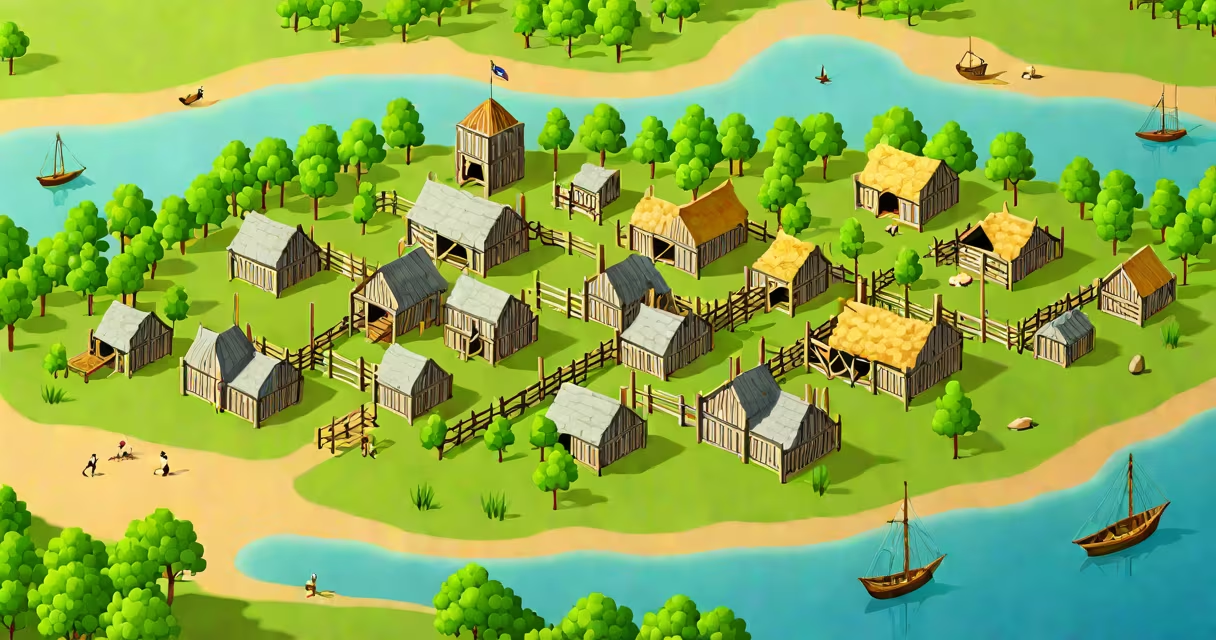
Jamestown was the first permanent English settlement in North America, founded in 1607 by the Virginia Company of London. Located on a narrow peninsula along the James River in present-day Virginia, it served as the capital of the Virginia Colony until 1699.
The settlement emerged from a joint-stock venture backed by investors seeking profit from American resources. Its founding marked the start of sustained English colonization in what would become the United States. Initial plans included mining gold and finding a northwest passage to Asia, but survival proved far more urgent than wealth.
By May 1607, 104 men and boys arrived on three ships-the Susan Constant, Godspeed, and Discovery-and began constructing a fortified settlement. They chose the site for its defensible position and access to fresh water, though they soon faced starvation, disease, and conflict with local Powhatan tribes.
Life in Jamestown operated under a rigid military structure. Settlers were assigned roles based on skill, and governance was managed by a council appointed by the Virginia Company. A representative assembly, the House of Burgesses, convened in 1619-making it the first legislative body in English North America.
Survival depended on food production, trade, and diplomacy. Early attempts at farming failed due to poor soil, lack of agricultural knowledge, and harsh weather. The settlers relied heavily on trade with Native Americans, especially during the winter of 1609-1610, known as the "Starving Time."
Records show that only 38 of the original 500 settlers survived that winter. Some accounts describe cannibalism among desperate colonists, a claim supported by archaeological evidence from 2012, when human remains were found with cut marks consistent with consumption. This grim reality underscores the extreme conditions faced by the first English settlers.
Jamestown's original fort was constructed from timber and earth. The palisade stood 12 feet high, with gunports and watchtowers. Inside, buildings were built using wattle-and-daub walls and thatched roofs. Most structures were temporary, designed to last only until a permanent town could be established.
Settlement layout followed a grid pattern, with designated areas for homes, storage, and defense. Archaeological digs have uncovered artifacts including clay pipes, glass beads, iron tools, and pottery fragments. These items confirm trade with both England and Native American groups.
A notable feature was the use of tobacco as a cash crop. Introduced by John Rolfe in 1612, tobacco became the colony's economic engine. By 1620, Virginia exported over 100,000 pounds of tobacco annually. This shift from speculative ventures to sustainable agriculture enabled long-term viability.
Jamestown was used as a base for English expansion into the interior of North America. Its location offered access to the Atlantic via the Chesapeake Bay and allowed control over river traffic. The settlement also served as a testing ground for colonial governance models.
Strategic value came from its proximity to Native American communities. The Powhatan Confederacy controlled much of the region, and interactions ranged from cooperation to violent conflict. The 1622 uprising killed 347 colonists-nearly a third of the population-prompting military retaliation and forced relocation of survivors.
Despite high mortality, Jamestown endured because of evolving strategies. The introduction of indentured servitude in the 1620s brought laborers willing to work four years for passage and land. This system helped stabilize the population and increase productivity.
| Type | Description | Example |
|---|---|---|
| Fortified Settlement | Defensive structure with palisades and bastions | Original 1607 fort, reconstructed at site |
| Plantation Economy | Tobacco-based agriculture with indentured labor | Rolfe's estate near Bermuda Hundred |
| Representative Government | First elected assembly in English colonies | House of Burgesses, 1619 |
Many assume Jamestown was a thriving community from the start. In reality, it nearly collapsed within months. The idea that settlers arrived with clear plans for success overlooks the chaos of early years.
Another myth is that the colony was founded solely for religious freedom. No Puritan or Pilgrim ideals guided the Virginia Company. Instead, profit motives drove the venture. Religious tolerance came later, and then only in limited form.
A lesser-known fact: the term "Jamestown" wasn't used by contemporaries. The settlement was referred to as "James Fort" or "the Fort at James River." The name "Jamestown" became standard only in the 18th century, reflecting later historical naming conventions.
In the winter of 1609-1610, the colony faced collapse. Food supplies ran out. Survivors resorted to eating leather, rats, and roots. Records from Captain John Smith indicate that "we had nothing to eat but the flesh of dogs and horses."
Archaeologists discovered the remains of a young woman, dubbed "Jamestown's Jane," in 2012. Her skull showed signs of trauma and cut marks consistent with dissection and consumption. DNA analysis confirmed she was from England, likely a servant or laborer. This discovery provides physical proof of the extreme measures taken to survive.
The event reshaped colonial policy. After the winter, leadership shifted toward more disciplined command and better resource management. The arrival of new supplies and settlers in 1610 stabilized the colony. Without that intervention, Jamestown may have vanished before becoming a lasting settlement.
I visited the reconstructed fort in 2019. Standing inside the palisade, I felt the weight of isolation. The narrow passages, low ceilings, and lack of windows made the space feel claustrophobic. A single well provided water, and the air carried the scent of damp wood and salt. That visit made me understand why so many died-not from enemy attack, but from hunger, disease, and despair.
What was Jamestown? It was the first permanent English settlement in North America, established in 1607. Its survival through famine, war, and mismanagement laid the foundation for future colonies. The lessons learned-about governance, labor systems, and adaptation-shaped the course of American history.