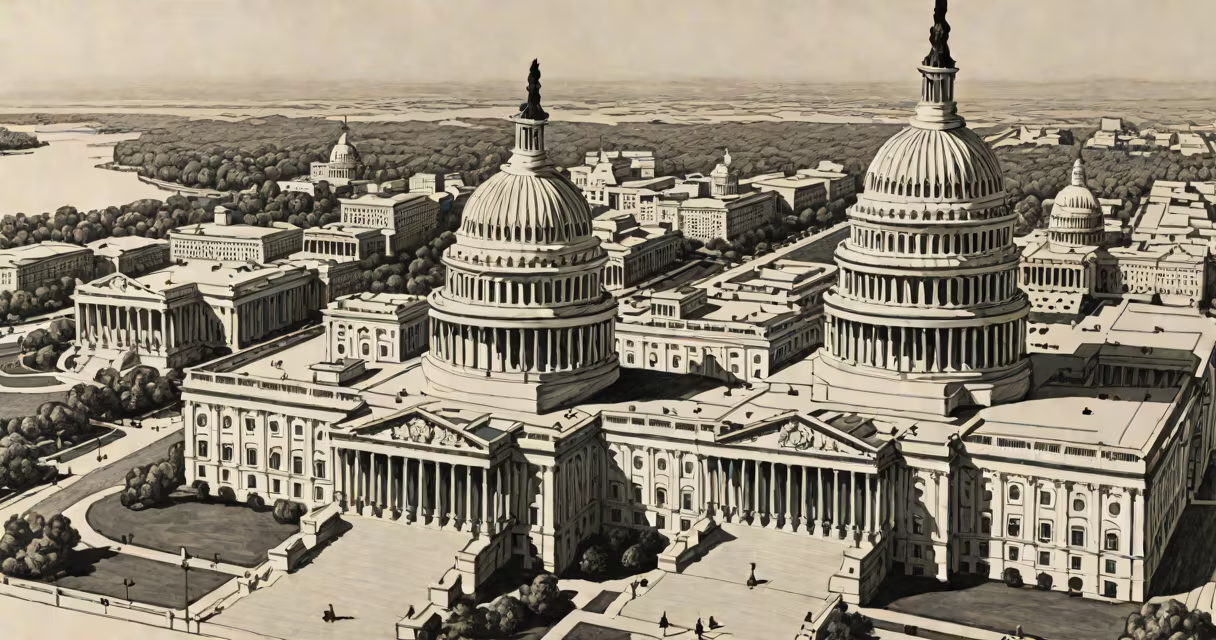
The United States of America (USA) is a federal republic comprising 50 states, a federal district (Washington, D.C.), and several territories. It operates under a written Constitution ratified in 1787, establishing a system of checks and balances among three branches of government: executive, legislative, and judicial.
The USA emerged from the Thirteen Colonies that declared independence from Great Britain in 1776. Its founding documents-the Declaration of Independence and the Constitution-form the legal and philosophical basis of its governance. The country spans 9.8 million square kilometers across North America, stretching from the Atlantic to the Pacific coasts and including Alaska and Hawaii.
As of 2023, the USA had a population of approximately 332 million people, making it the third most populous nation globally. It ranks as the world's largest economy by nominal GDP, with a diverse industrial base and significant influence in international trade, military alliances, and cultural production.
The federal structure divides power between national and state governments. The Constitution grants specific powers to the federal government-such as regulating interstate commerce, declaring war, and managing foreign policy-while reserving others for individual states, including education, local law enforcement, and intrastate business regulation.
The legislative branch consists of a bicameral Congress: the Senate (100 members, two per state) and the House of Representatives (435 members, apportioned by population). The President, elected every four years through the Electoral College, leads the executive branch and serves as head of state and commander-in-chief of the armed forces. The Supreme Court, appointed by the President and confirmed by the Senate, interprets the Constitution and reviews laws passed by Congress.
For example, in 2022, Congress passed the Inflation Reduction Act, which allocated $370 billion toward climate initiatives and healthcare reforms. The law was signed by President Joe Biden and later challenged in federal courts. The Supreme Court upheld its constitutionality in June 2023, affirming Congress's authority under the Taxing and Spending Clause.
The USA is not a single entity but a union of distinct political units. Each state has its own constitution, governor, legislature, and court system. State governments manage public education, driver licensing, and state parks, while federal agencies oversee national defense, immigration, and environmental protection.
| Type | Description | Examples |
|---|---|---|
| State | Self-governing jurisdiction with full representation in Congress | California, Texas, New York |
| Federal District | Not a state; governed directly by Congress | Washington, D.C. |
| Insular Area | U.S.-administered territories with limited self-rule | Puerto Rico, Guam, U.S. Virgin Islands |
One non-obvious distinction: Washington, D.C. is not a state and cannot vote in presidential elections. Residents pay federal taxes but lack voting representation in Congress. This status stems from Article I, Section 8 of the Constitution, which grants Congress exclusive jurisdiction over the District.
Many assume the USA is a democracy by default. It is not. It is a constitutional republic. Citizens elect representatives who make laws, rather than voting directly on legislation. Direct democracy exists only in limited forms, such as ballot initiatives in 26 states.
Another misconception is that the U.S. Constitution is immutable. It has been amended 27 times since 1787. The 13th Amendment abolished slavery in 1865; the 19th granted women the right to vote in 1920; the 26th lowered the voting age to 18 in 1971. These changes reflect evolving interpretations of liberty and equality.
A lesser-known fact: the USA has no official national language. While English is de facto the language of government and education, no federal law designates it officially. In contrast, Canada's Official Languages Act makes both English and French official nationwide.
The USA plays a central role in global institutions. It is a permanent member of the UN Security Council, a founding member of NATO, and a key participant in the World Trade Organization. Its military budget exceeds $800 billion annually-more than the next ten countries combined.
Technologically, the USA leads in innovation. Silicon Valley houses companies like Apple, Google, and Meta, which collectively generate over $1 trillion in annual revenue. The National Institutes of Health funds over 300,000 research projects yearly, contributing to breakthroughs in medicine and biotechnology.
For example, in 2021, the U.S. Department of Energy invested $1.2 billion in fusion energy research through the National Ignition Facility. A 2022 experiment achieved net energy gain-producing more energy from fusion than was required to initiate it-marking a milestone in clean energy development.
I once attended a town hall meeting in rural Iowa during a local election cycle. The event drew 60 residents, many of whom discussed proposed zoning changes affecting farmland. Their concerns centered on balancing agricultural preservation with infrastructure development-a decision made by county supervisors, not federal officials. This illustrated how state and local governments handle issues beyond federal reach.
Another example: in 2020, the U.S. Census Bureau reported that 13.7% of Americans identified as Hispanic or Latino. This demographic shift influenced redistricting in states like Texas and California, where congressional boundaries were redrawn to reflect population changes. The process is legally mandated under the Voting Rights Act of 1965.
Understanding the USA requires familiarity with its foundational texts. The Declaration of Independence asserts that "all men are created equal," though this principle was not applied universally until decades later. The Constitution's Preamble begins with "We the People," underscoring popular sovereignty.
The USA remains a complex, evolving federation. Its strength lies not in uniformity but in the balance between unity and diversity-between federal authority and state autonomy, between tradition and reform.