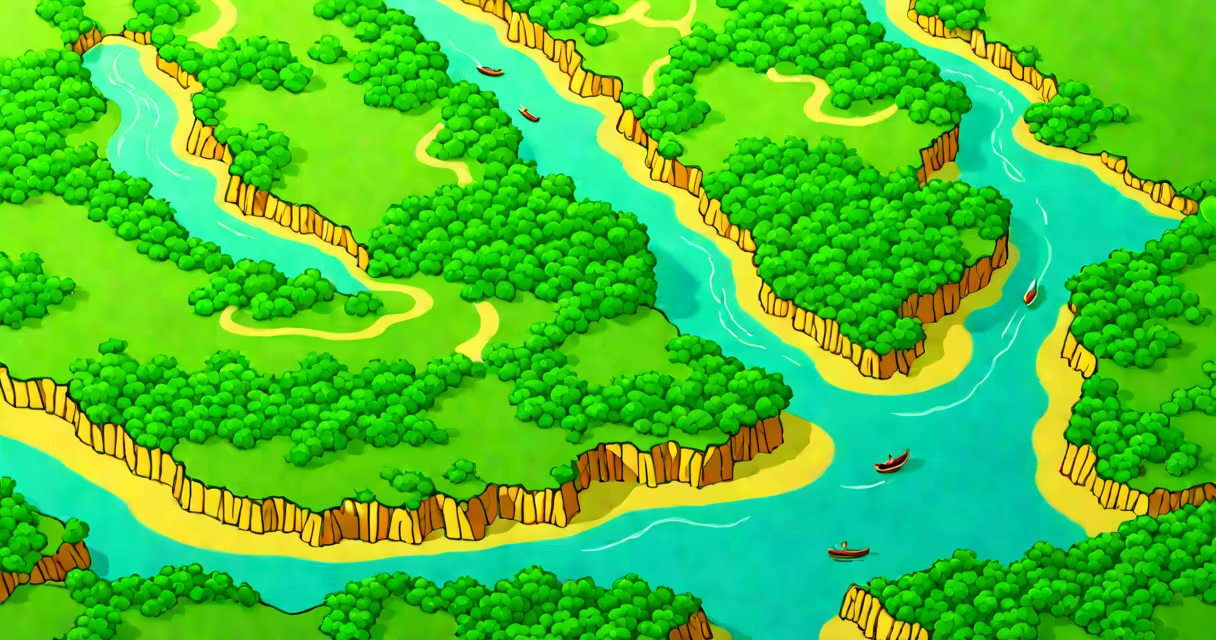
The longest river in South America is the Amazon River, measuring about 6,400 kilometers (3,977 miles) from its source in the Andes Mountains to its mouth in the Atlantic Ocean. It is the largest river by discharge volume and the second-longest river in the world, surpassed only by the Nile.
The Amazon originates in the Peruvian Andes at the Nevado Mismi peak, where glacial meltwater feeds into the Apurímac River, a tributary that eventually joins the Ucayali and then the Marañón before forming the main stem of the Amazon. This river system drains nearly 40% of South America's landmass, covering parts of Brazil, Peru, Colombia, Ecuador, Bolivia, Venezuela, Guyana, Suriname, and French Guiana.
Its flow averages 209,000 cubic meters per second-about 20 times greater than the Congo River and 10 times more than the Mississippi. This immense volume results from the region's high annual rainfall, averaging 2,000 to 3,000 millimeters annually across the basin.
The Amazon operates as a changing fluvial system shaped by seasonal flooding. During the wet season (typically December to May), water levels rise up to 12 meters in certain areas, submerging forests and creating flooded "igapó" and "várzea" zones. These seasonal inundations enrich soil fertility and support unique aquatic life cycles.
Floodplain forests, known as igapó, grow in acidic, blackwater rivers fed by slow-moving streams. Várzea forests, by contrast, develop in nutrient-rich whitewater rivers that carry sediment from the Andes. These differences create distinct habitats within the same river system.
Navigation along the Amazon is possible for large vessels up to 1,500 kilometers inland during high water. However, low-water seasons restrict access to smaller boats. The river's width varies from 1 to 10 kilometers in different stretches, with some channels exceeding 100 kilometers during flood events.
The Amazon basin includes several major river types based on water color, origin, and sediment load:
| Type | Water Color | Sediment Load | Origin | Example |
|---|---|---|---|---|
| Whitewater | Cloudy white | High | Andes Mountains | Ucayali River |
| Blackwater | Dark tea-like | Low | Weathered soils | Caqueta River |
| Clearwater | Transparent | Very low | Granite bedrock | Tapajós River |
Whitewater rivers dominate the Amazon's main channel due to their high sediment content. Blackwater rivers, though less voluminous, contribute significant organic acids that lower pH and limit fish diversity. Clearwater rivers have minimal suspended particles and support specialized species adapted to low-nutrient conditions.
One non-obvious fact: despite being called "blackwater," these rivers often appear dark brown due to dissolved tannins leached from leaf litter. This contrasts with the muddy appearance of whitewater rivers, which carry visible silt.
Many assume the Amazon is the longest river globally. That honor belongs to the Nile, which measures approximately 6,650 kilometers. The Amazon's length is debated due to measurement methods-some sources cite 6,400 km, others extend it to 6,600 km using alternative tributary paths.
Another misconception is that the Amazon flows backward. It does not. The river moves from west to east, driven by the Andes' elevation gradient. Gravity pulls water from the high Andes toward the Atlantic, with the river's average slope being less than 1 meter per kilometer.
Some confuse the Amazon with the Orinoco River, which flows through Venezuela and Colombia. While the Orinoco is longer than many South American rivers, it measures only 2,150 kilometers-less than a third the length of the Amazon.
In 2014, researchers from the Brazilian Institute of Geography and Statistics (IBGE) conducted a detailed survey using satellite imagery and GPS data. They traced the Amazon's longest continuous path from the Apurímac River in southern Peru to the Atlantic coast near São Luís, Maranhão.
They confirmed the river's length at 6,400 kilometers, accounting for meanders and tributaries. The study excluded speculative routes through minor streams, focusing only on navigable and hydrologically significant channels.
This measurement aligns with data from NASA's Shuttle Radar Topography Mission (SRTM), which mapped terrain elevations across South America. SRTM data verified the Andean source elevation at 5,597 meters above sea level, consistent with the river's steep initial gradient.
The Amazon River supports over 3,000 fish species, including the giant arapaima, which can reach 3 meters in length. Its floodplains host more than 400 mammal species, such as pink river dolphins and giant otters.
Indigenous communities rely on the river for food, transportation, and cultural identity. The Yanomami people live in the upper Amazon basin, where they depend on fishing and forest resources. Their territory spans over 96,000 square kilometers and includes protected areas managed under national law.
Human activity threatens the river's integrity. Deforestation rates in the Brazilian Amazon reached 11,088 square kilometers in 2022, according to INPE (National Institute for Space Research). This loss reduces watershed capacity and increases sedimentation, affecting both water quality and biodiversity.
For context, the Atlantic Forest of South America-one of the planet's most endangered biomes-once covered 1.3 million square kilometers. Today, less than 12% remains, mostly fragmented. Protecting the Amazon's tributaries is critical to preserving regional hydrology and climate stability.
Understanding the Amazon River's scale, structure, and ecological role clarifies why it holds the title of longest river in South America. Its influence extends far beyond water flow-it defines a continent's biological and climatic patterns.
The Amazon River is the longest river in South America, spanning 6,400 kilometers from the Andes to the Atlantic. Its massive discharge, diverse tributaries, and role in sustaining one of Earth's richest ecosystems make it a defining feature of the continent's geography.