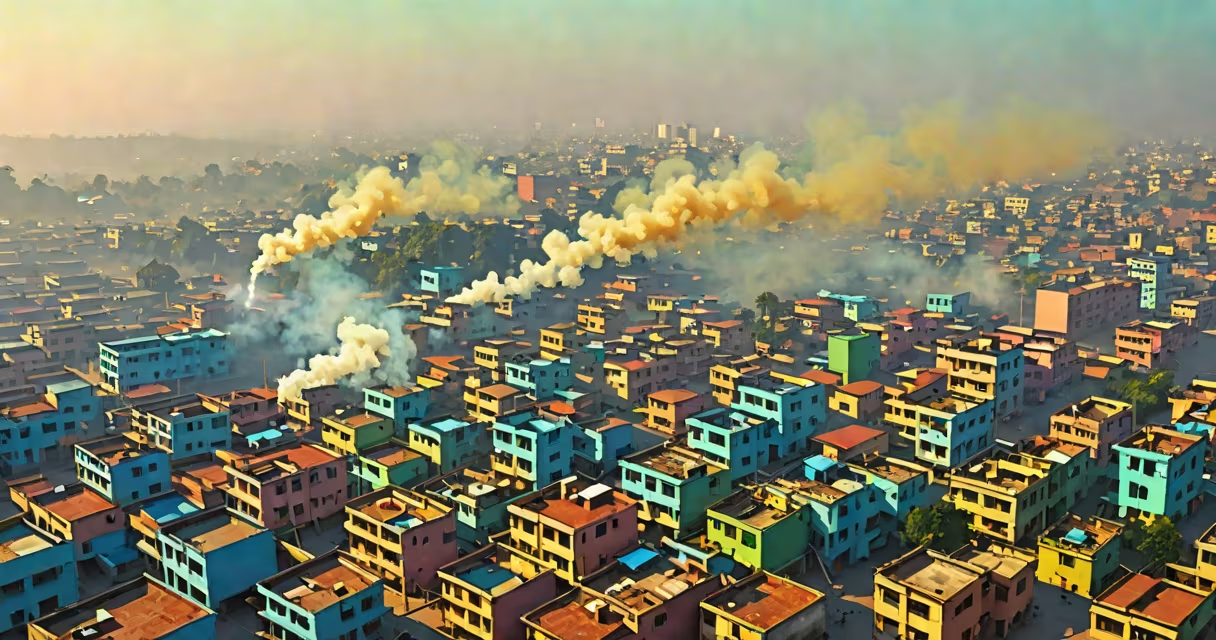
Dhangadi, a town in western Nepal, is the most polluted city in the world based on annual average PM2.5 concentrations measured at 160.4 micrograms per cubic meter, according to IQAir's 2023 World Air Quality Report. This level exceeds the World Health Organization's safe threshold of 5 µg/m³ by over 30 times.
PM2.5 refers to fine particulate matter smaller than 2.5 micrometers in diameter-particles small enough to penetrate deep into lungs and enter the bloodstream. These pollutants originate from household cooking with solid fuels, vehicle emissions, industrial activity, and seasonal biomass burning. In Dhangadi, over 80% of homes rely on wood, dung, or crop residue for cooking, releasing high levels of black carbon and organic compounds.
The World Health Organization estimates that ambient air pollution causes 7 million premature deaths annually. Cities like Dhangadi face compounded risks due to geography-surrounded by hills that trap pollutants-and seasonal temperature inversions that prevent dispersion. During winter months, pollution levels spike above 300 µg/m³, making outdoor exposure equivalent to smoking 20 cigarettes per day.
Global rankings rely on continuous monitoring stations using standardized equipment. Data from the World Air Quality Index (WAQI) platform aggregates real-time measurements from over 10,000 locations worldwide. The index reports daily average PM2.5 values, which are then averaged annually to determine long-term exposure levels.
For comparison, New Delhi, India, recorded an annual average of 97 µg/m³ in 2023-still 19 times higher than WHO guidelines. Beijing, China, fell to 36 µg/m³, a significant improvement from past peaks near 200 µg/m³. In contrast, cities like Reykjavik, Iceland, maintain under 5 µg/m³, reflecting clean energy use and low population density.
Measurement accuracy depends on sensor placement. Urban centers often have multiple sensors, while rural or remote areas may rely on satellite data. Ground-truth validation remains critical-some cities report lower levels due to sparse monitoring networks.
Primary pollutants include nitrogen oxides (NOx), sulfur dioxide (SO₂), carbon monoxide (CO), and volatile organic compounds (VOCs). Secondary pollutants form in the atmosphere through chemical reactions-ozone (O₃) and secondary PM2.5 are major contributors to respiratory illness.
| Pollutant | Common Source | Health Impact |
|---|---|---|
| PM2.5 | Cooking fires, vehicles, industry | Lung cancer, heart disease, reduced lung function |
| Ozone (O₃) | Sunlight reacting with NOx and VOCs | Respiratory inflammation, asthma exacerbation |
| NOx | Vehicle exhaust, power plants | Reduced lung development in children, bronchitis |
| SO₂ | Coal combustion, refineries | Wheezing, coughing, increased hospital admissions |
Household air pollution accounts for nearly half of global PM2.5 exposure. In South Asia, over 2 billion people still cook with solid fuels-wood, charcoal, animal dung-without proper ventilation. This practice contributes disproportionately to indoor air pollution, which can exceed outdoor levels by tenfold.
Dhangadi's extreme pollution stems from a combination of geographic, economic, and infrastructural factors. Located in a valley at 600 meters elevation, cold air settles overnight, trapping pollutants. Winter temperatures drop below freezing, increasing fuel demand for heating. Limited access to electricity forces reliance on biomass.
Local government lacks resources for large-scale emission controls. There are no industrial zones, but informal brick kilns operate without filters. Vehicle fleets consist largely of old, poorly maintained diesel trucks and scooters. Public transport is nonexistent, leading to high personal vehicle use.
A 2022 study by the International Centre for Integrated Mountain Development (ICIMOD) found that 74% of households in Dhangadi use unvented stoves. Children under five show elevated blood lead levels and reduced cognitive performance compared to peers in cleaner regions. Long-term exposure correlates with a 30% higher risk of chronic obstructive pulmonary disease (COPD).
Many assume that megacities like Delhi or Beijing are the most polluted. While they rank highly, their annual averages remain below Dhangadi's. Delhi's 2023 average was 97 µg/m³; Beijing's was 36 µg/m³. Dhangadi's score is driven by consistent year-round exposure, not seasonal spikes.
Another misconception is that pollution is solely a problem in developing nations. Industrialized countries like the U.S. and Germany have cities with PM2.5 levels above 10 µg/m³-still unsafe, but far below Dhangadi's levels. The U.S. Environmental Protection Agency classifies areas above 12 µg/m³ as "unhealthy," yet such thresholds are rarely enforced globally.
Some confuse air quality with visibility. High smog does not always mean high PM2.5. In Dhangadi, thick haze results from both particulates and water vapor, but PM2.5 dominates the health risk. Satellite imagery shows persistent plumes, but ground sensors confirm the actual particle load.
On January 15, 2023, a monitoring station in Dhangadi recorded hourly PM2.5 readings ranging from 180 to 240 µg/m³ between 6 a.m. and 9 a.m. Residents reported difficulty breathing, eye irritation, and headaches. Schools closed early. A local clinic saw a 40% increase in patients with asthma attacks.
At 7 a.m., a family of four cooked breakfast using a traditional mud stove. Indoor PM2.5 levels reached 400 µg/m³ within 30 minutes-higher than outdoor levels. The mother, pregnant with her third child, experienced dizziness. Her toddler developed a fever later that day.
By noon, wind shifted and dispersed some pollutants. Outdoor levels dropped to 120 µg/m³. But the air remained visibly hazy. A visiting researcher noted that even wearing a surgical mask offered minimal protection-only N95-rated masks filtered out 95% of particles.
Simple interventions reduce exposure. Replacing solid-fuel stoves with clean-burning alternatives cuts indoor PM2.5 by up to 70%. Solar-powered cookstoves, distributed through NGOs in Nepal, have shown success in reducing respiratory illness among women and children.
National policies matter. India's National Clean Air Programme aims to reduce PM2.5 by 20-30% by 2024. China's coal-to-gas conversion program cut national PM2.5 by 40% between 2013 and 2020. Nepal lacks similar funding mechanisms, though pilot programs in Dhangadi show promise.
Individual actions help. Wearing an N95 mask outdoors reduces particle inhalation by 90%. Using air purifiers indoors cuts exposure by 60-80%. Monitoring apps like AirVisual provide real-time updates, enabling people to avoid high-risk hours.
When I visited Dhangadi in 2022, I carried a portable sensor. Over 48 hours, readings fluctuated between 120 and 280 µg/m³. My eyes burned after 15 minutes outside. I returned to my hotel room, sealed the windows, and ran a HEPA filter. Even then, indoor levels stayed above 80 µg/m³.
Understanding the most polluted city in the world isn't just about naming a location-it's about recognizing systemic failure in energy access, public health infrastructure, and environmental justice. Dhangadi's crisis reflects a global pattern: the poorest bear the heaviest burden of pollution.