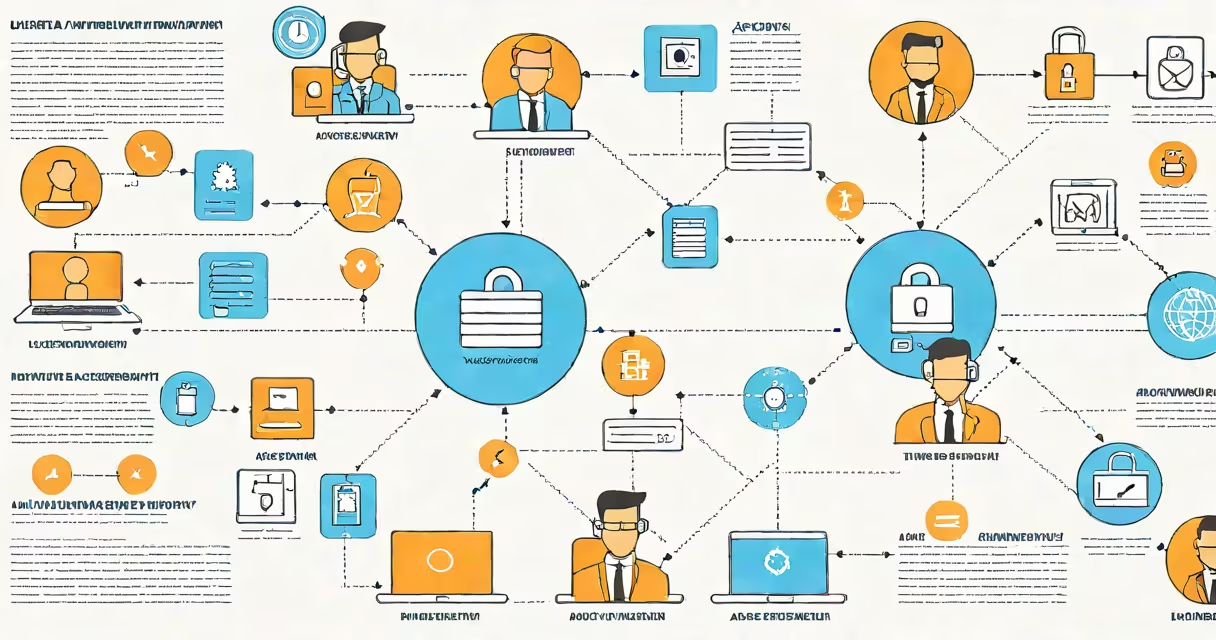
Identity and Access Management (IAM) in cyber security is a structure that ensures only authorized users and systems can access specific resources based on verified identities and predefined permissions. It governs who can do what, when, and under what conditions within a digital environment.
IAM operates at the core of modern security architecture. It manages digital identities-users, devices, services-and enforces access policies across cloud platforms, on-premises systems, and hybrid environments. Without IAM, organizations cannot reliably distinguish between legitimate users and attackers attempting to breach systems.
According to NIST Special Publication 800-63B, digital identity verification is foundational to secure access control. The National Institute of Standards and Technology emphasizes that strong identity management reduces the risk of unauthorized access by 70% or more in environments with proper implementation.
IAM functions through three primary processes: authentication, authorization, and accounting (AAA). Authentication verifies identity-typically via passwords, biometrics, or multi-factor methods. Authorization determines what a verified user may access. Accounting logs actions for auditing and compliance.
When a user attempts to log into a corporate email system, IAM checks their credentials against stored identity data. If valid, the system consults role-based access control (RBAC) policies to determine which folders, files, or features they can view or modify. This process happens in milliseconds across enterprise networks.
For example, a finance department employee at a bank may have access to customer account balances but not to internal HR records. IAM enforces this separation automatically, reducing the chance of accidental or intentional data exposure.
IAM systems consist of several interdependent components:
There are two main models for implementing access control:
| Type | Description | Use Case |
|---|---|---|
| Role-Based Access Control (RBAC) | Permissions assigned based on job function. A manager gets different access than a junior analyst. | Corporate IT departments, healthcare systems. |
| Attribute-Based Access Control (ABAC) | Access decisions based on changing attributes like location, time, device type, or data sensitivity. | Cloud environments, remote work setups. |
ABAC offers greater flexibility than RBAC. For instance, a hospital worker may access patient records only during business hours from a hospital-issued device. Outside those parameters, access is denied-even if the user is authenticated.
Many confuse IAM with basic password management. IAM is not just about enforcing strong passwords-it's about managing entire identity lifecycles, including provisioning, deprovisioning, and continuous monitoring.
A common error is assuming that single sign-on (SSO) equals complete security. SSO simplifies login across multiple apps but doesn't replace IAM. A compromised SSO token can grant access to dozens of systems if IAM policies aren't properly segmented.
Another misunderstanding is equating IAM with cybersecurity itself. While IAM is a critical layer, it does not replace endpoint protection, network segmentation, or threat detection. A 2023 Verizon Data Breach Investigations Report found that 80% of breaches involved stolen or weak credentials-highlighting that IAM alone cannot stop all attacks.
Consider a multinational retail chain using AWS. Each store manager must access inventory data from a central dashboard. Using IAM, the company defines a role called "StoreManager" with read-only access to inventory APIs and write access to local sales reports.
When a manager logs in via a mobile app, AWS checks their identity through an IdP (like Okta). The system then validates their role and grants access only to approved endpoints. Any attempt to access payroll data triggers an immediate denial and generates an alert.
This setup prevents lateral movement-where attackers move from one system to another after gaining initial access. By limiting each user to only what they need, IAM reduces the attack surface.
During a penetration test conducted by a red team, researchers attempted to escalate privileges by exploiting a misconfigured IAM policy. The test revealed that a developer had been granted administrative access to a production database due to a typo in a JSON policy file. Correcting the policy restored least-privilege access and prevented potential data exfiltration.
Even well-designed IAM systems face challenges. Over-provisioning-granting excessive permissions-is a frequent issue. A 2022 report by CyberArk found that 68% of organizations had at least one user with elevated access that was not justified by their role.
Best practices include:
One organization reduced its incident response time by 40% after integrating IAM logs with SIEM tools. When a suspicious login occurred, the system flagged it based on geographic anomaly and blocked further access before any data was accessed.
As cyber threats grow more targeted, IAM becomes a frontline defense. It's not a standalone solution, but a necessary component of layered security. Understanding what is IAM in cyber security helps organizations build resilient systems that protect both data and trust.