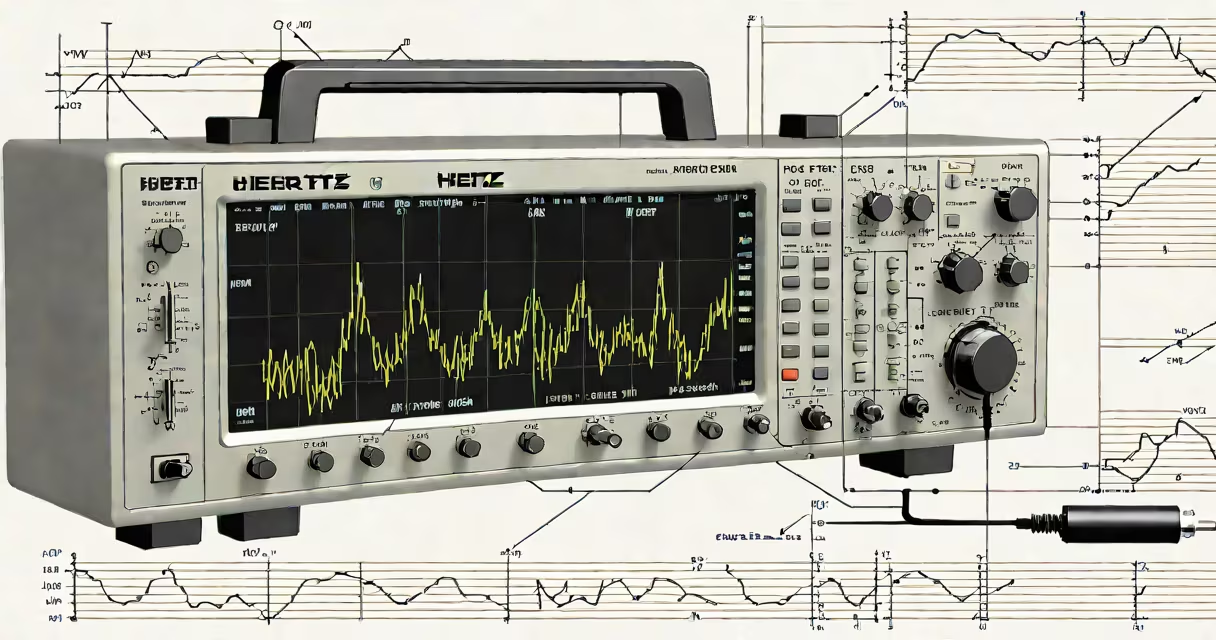
Hertz (Hz) measures the number of complete cycles of a periodic event that occur per second. It quantifies frequency in waves such as sound, radio signals, and light.
Frequency describes how often a repeating pattern happens. A cycle is one full oscillation-from peak to trough and back to peak. When something repeats 10 times in one second, it operates at 10 Hz. The unit is named after Heinrich Hertz, who confirmed the existence of electromagnetic waves in the 1880s.
One hertz equals one cycle per second. This applies to any regular motion: a pendulum swinging back and forth, a speaker cone vibrating, or electrons moving in a wire. The higher the hertz value, the faster the repetition.
Waves travel through space or materials by transferring energy. They have peaks and valleys that repeat at regular intervals. The distance between two consecutive peaks is the wavelength. The number of peaks passing a point each second is the frequency in hertz.
For example, a sound wave with a frequency of 440 Hz completes 440 full vibrations every second. This corresponds to the musical note A above middle C. The human ear detects frequencies between 20 Hz and 20,000 Hz. Sounds below 20 Hz are felt more than heard, while those above 20,000 Hz are inaudible to most adults.
In electronics, alternating current (AC) changes direction periodically. Standard household electricity in the U.S. runs at 60 Hz-meaning the current reverses direction 60 times per second. In Europe, it's 50 Hz. Mismatched frequencies can damage equipment.
Not all waves are visible or audible. Hertz applies across the electromagnetic spectrum, from radio waves to gamma rays. Each type differs in frequency and wavelength.
| Wave Type | Typical Frequency Range | Common Use |
|---|---|---|
| Radio waves | 3 kHz - 300 GHz | FM/AM broadcasting, Wi-Fi |
| Visible light | 430 THz - 750 THz | Human vision, fiber optics |
| Sound waves | 20 Hz - 20,000 Hz | Speech, music, ultrasound |
| Electrical AC | 50 Hz - 60 Hz | Power grids, appliances |
Light is electromagnetic radiation. While we see only a narrow band of wavelengths, all light travels at the speed of light-about 300,000 km/s. A red photon has a frequency around 430 terahertz (THz), or 430 trillion Hz. Blue light is higher, near 750 THz. These values are too high for human perception but measurable with instruments.
Ultrasound imaging uses frequencies above 20,000 Hz-well beyond human hearing. Medical devices emit pulses at 2 MHz to 15 MHz to create images of internal organs. The reflected echoes return at different times, allowing a computer to build a cross-sectional view.
People often confuse hertz with amplitude or intensity. Hertz measures how frequently a wave repeats-not how loud it is or how much energy it carries. A 100 Hz tone can be soft or loud depending on amplitude. Loudness depends on pressure variation, not frequency.
Another error is assuming all high-frequency waves are dangerous. Ionizing radiation like X-rays and gamma rays have very high frequencies and carry enough energy to break molecular bonds. But radio waves, even at high frequencies, lack the energy to ionize atoms. The FCC regulates broadcast frequencies to prevent interference, not because they're inherently harmful.
A less obvious point: hertz is not exclusive to physical waves. Digital clocks use clock signals measured in hertz. A 3 GHz processor performs 3 billion operations per second. The term "gigahertz" means billions of cycles per second. This usage extends the concept beyond physics into computing.
Consider a digital audio file sampled at 44,100 Hz. This means the system captures the sound wave 44,100 times per second. Each sample records the air pressure at that instant. After recording, software can analyze frequency content using Fourier transforms.
If a guitar string vibrates at 261.6 Hz (middle C), the audio file will show a repeating pattern every 1/261.6 seconds. Software can detect this frequency and isolate it from background noise. This process enables noise reduction, pitch correction, and vocal isolation in music production.
I once used a free audio editor to remove a hum from a recording. The hum was at 60 Hz-matching the local power line frequency. By applying a notch filter centered at 60 Hz, I eliminated the interference. The result was a clean track. This shows how hertz values guide technical fixes in real applications.
Understanding hertz allows engineers to design systems that avoid signal overlap. In wireless communication, channels are assigned specific frequency bands. For example, Wi-Fi uses 2.4 GHz and 5 GHz bands. Devices switch between them to reduce congestion.
The International Telecommunication Union (ITU) manages global frequency allocation. Without coordinated assignment, broadcasts would interfere. A TV station in one city cannot transmit on the same frequency as another nearby station without causing static.
Scientific research relies on precise frequency measurement. Particle accelerators like the Large Hadron Collider use microwave cavities tuned to 2 GHz to accelerate protons. The timing must be accurate to within nanoseconds. Frequency stability ensures particles stay on course.
According to the National Institute of Standards and Technology (NIST), atomic clocks define the second based on cesium-133 atom transitions at exactly 9,192,631,770 Hz. This standard underpins GPS, financial transactions, and internet synchronization worldwide.
When you adjust your smartphone's Wi-Fi channel or tune a radio, you're interacting with hertz-based systems. Even a simple task like setting a timer involves a clock running at a known frequency. Hertz is not abstract-it's embedded in daily life.