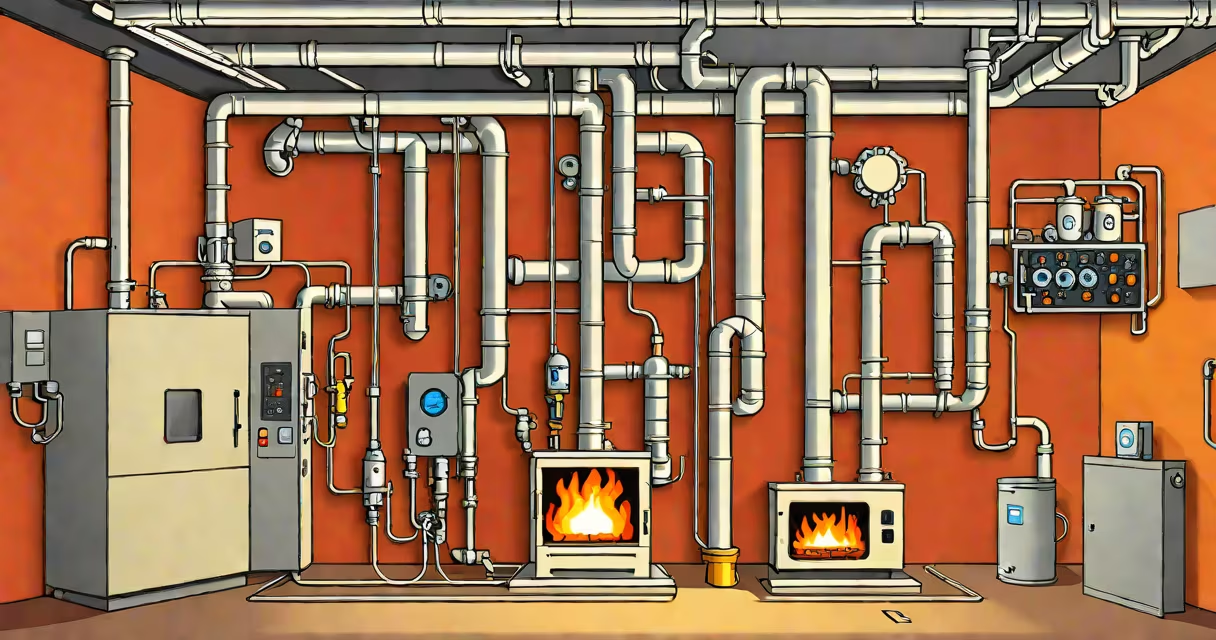
Forced heat is a central heating system that uses a furnace to heat air, which is then pushed through ducts into rooms via a blower fan. It's the most common residential heating method in North America, especially in colder climates.
The system begins when a thermostat detects indoor temperatures below the set point. It signals the furnace to ignite fuel-typically natural gas, oil, or electricity-and heat a metal heat exchanger. A blower motor draws cool air from return vents, passes it over the hot exchanger, and forces the warmed air through supply ducts into living spaces.
Once the desired temperature is reached, the furnace shuts off. The cycle repeats as needed. Unlike radiant or convective systems, forced heat moves air continuously, maintaining consistent room temperatures. It's distinct from baseboard heaters, which rely on convection and localized heating.
At its core, forced heat operates on a closed-loop principle: air is drawn from the home, heated, and redistributed. The process begins with a thermostat sending a signal to the furnace's control board. This activates the ignition sequence-gas valves open, burners light, and the heat exchanger warms up.
A blower fan then pulls air from return grilles, usually located near floor level. This air flows through a filter, removing dust and debris, before entering the furnace. The air passes over the heat exchanger, where it absorbs thermal energy. Once heated to the set temperature-typically between 110°F and 130°F-it exits through supply ducts into rooms.
As the air cools, it sinks and returns through return ducts, completing the loop. The entire cycle takes 30 to 60 seconds per run, depending on the system's capacity and outdoor temperature. Most furnaces operate in 10- to 15-minute intervals during winter.
Forced heat systems vary based on fuel source and efficiency rating. The primary types are gas, oil, and electric furnaces. Gas furnaces dominate U.S. homes, accounting for 65% of installations according to the U.S. Energy Information Administration (EIA).
| Fuel Type | Efficiency Range (AFUE) | Typical Annual Cost (U.S.) | Installation Cost |
|---|---|---|---|
| Gas | 80%-98% | $1,200-$1,800 | $4,000-$7,000 |
| Oil | 80%-90% | $2,000-$3,000 | $5,000-$8,000 |
| Electric | 95%-100% | $2,200-$3,500 | $3,000-$5,000 |
AFUE (Annual Fuel Utilization Efficiency) measures how much fuel becomes usable heat. A 95% AFUE furnace converts 95% of fuel into heat, losing only 5% through exhaust. High-efficiency models (90%+) use sealed combustion and condensing technology, capturing waste heat from flue gases.
Forced heat systems also differ in airflow design. Single-stage furnaces run at one speed-on or off. Two-stage models have a low setting for mild weather, reducing cycling and noise. Variable-speed blowers adjust fan speed based on demand, improving comfort and energy savings.
Forced heat is standard in single-family homes across the U.S., particularly in regions with cold winters. It's ideal for large homes needing even temperature distribution. Its ability to integrate with air conditioning makes it a staple in year-round HVAC systems.
According to the U.S. Department of Energy, 58% of U.S. homes use forced air for heating. It's preferred over radiant or baseboard systems because it heats entire buildings quickly and supports zoning with dampers in ducts. For example, a family can keep bedrooms cooler at night while warming the living area.
Forced heat also enables better indoor air quality when paired with high-efficiency filters. MERV 13 filters, recommended by the American Lung Association, capture 90% of airborne particles down to 0.3 microns-dust, pollen, mold spores. These filters reduce respiratory irritation, especially in allergy-prone households.
Many assume forced heat is less efficient than radiant systems. This is false. While radiant floors provide steady warmth, they take longer to raise room temperatures. Forced heat responds faster-within 5 minutes of thermostat activation-making it better for sudden cold snaps.
Another myth is that forced heat dries out air. While it does lower relative humidity, the effect is manageable. A 2021 study by the National Institute of Standards and Technology (NIST) found that average indoor humidity drops by 10-15% during furnace operation. Using a humidifier with a dew point sensor maintains levels between 40% and 60%, preventing dry skin and static shocks.
Some confuse forced heat with forced-air cooling. They're different phases of the same system. Cooling uses the same ducts and blower, but the furnace is replaced by an evaporator coil in the air handler. Cold refrigerant absorbs heat from indoor air, lowering temperature before being blown into rooms.
In a typical winter, a 2,200-square-foot home in Chicago relies on a gas furnace with 92% AFUE. The thermostat is set to 68°F. When the indoor temperature drops to 66°F, the furnace ignites. The blower starts after a 15-second delay to prevent cold air drafts.
Over 15 minutes, the furnace heats 1,200 cubic feet of air from 66°F to 72°F. The blower delivers 1,000 cubic feet per minute (CFM) through a network of 20 ducts. Supply registers in each room release warm air at 115°F. Return grilles pull in cooler air from corners and doorways.
After 12 minutes, the thermostat reaches 68°F. The furnace shuts off. The blower runs for 2 more minutes to clear residual heat. Over 24 hours, the system cycles 6 times, consuming 45 therms of natural gas. At $1.20 per therm, daily cost is $5.40. Annual heating cost: ~$1,970.
This example shows how forced heat balances performance, cost, and comfort. It's not perfect-some rooms may feel drafty-but with proper duct sealing and insulation, it performs reliably.