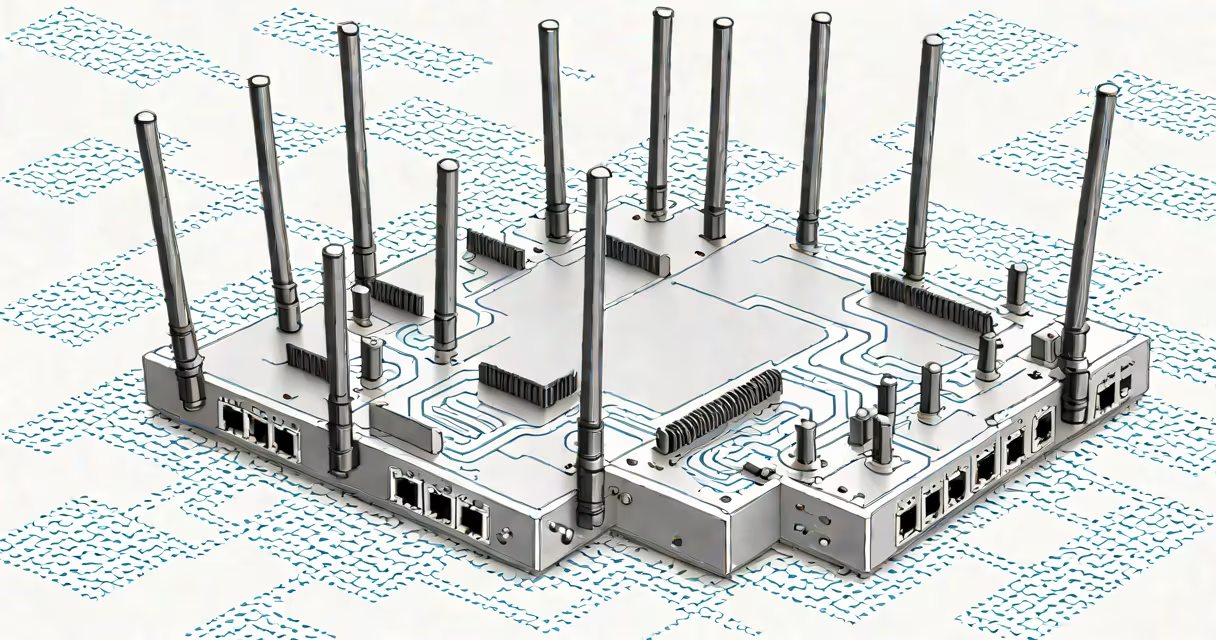
MIMO, or Multiple Input Multiple Output, is a wireless communication technology that uses multiple antennas at both the transmitter and receiver to improve data throughput and signal quality. It enables faster, more stable connections in Wi-Fi, 4G LTE, and 5G networks by exploiting signal reflections and spatial diversity.
Modern routers and smartphones rely on MIMO to deliver high-speed internet without dropping connections. Instead of sending a single data stream through one path, MIMO sends multiple streams simultaneously across different spatial channels. This increases capacity and reduces interference, especially in crowded environments like offices or stadiums.
The term was first introduced in academic literature in the late 1990s. By 2003, the IEEE 802.11n standard adopted MIMO as a core feature, marking its entry into mainstream consumer devices. Today, nearly every Wi-Fi 4 (802.11n) and later device supports MIMO.
MIMO operates by transmitting multiple data streams from separate antennas at the same time and frequency. These signals travel different paths due to reflections off walls, furniture, and other objects. At the receiving end, multiple antennas capture the overlapping signals, and advanced signal processing separates them into distinct data streams.
This process is known as spatial multiplexing. For example, a 2x2 MIMO system uses two transmit and two receive antennas. It can double the data rate compared to a single-antenna system without using more bandwidth. A 4x4 MIMO setup can quadruple throughput under ideal conditions.
Signal separation relies on algorithms like Zero Forcing, Minimum Mean Square Error (MMSE), and Successive Interference Cancellation. These methods analyze phase differences and timing delays between received signals to reconstruct the original data streams accurately.
Systems are classified by the number of transmit and receive antennas. Common configurations include:
| Configuration | Use Case | Throughput Gain |
|---|---|---|
| 1x1 | Basic Wi-Fi devices, older phones | Baseline (no gain) |
| 2x2 | Most home routers, mid-tier smartphones | Up to 2x speed increase |
| 4x4 | High-end routers, 5G base stations, gaming devices | Up to 4x speed increase |
| 8x8 | Enterprise-grade access points, 5G mmWave | Up to 8x speed increase |
Some systems also support beamforming, where signals are focused toward specific users. This enhances signal strength and reduces interference. Beamforming is often paired with MIMO in devices like the Apple AirPort Extreme and modern Samsung Galaxy phones.
A non-obvious distinction: MIMO is not the same as MIMO precoding. Precoding adjusts signal phases before transmission to improve reception. While both improve performance, precoding requires more computational power and is typically used in cellular infrastructure rather than consumer devices.
MIMO is essential in environments where high data rates and reliability are critical. It powers modern Wi-Fi standards including 802.11ac (Wi-Fi 5) and 802.11ax (Wi-Fi 6), which support multi-user MIMO (MU-MIMO). MU-MIMO allows a router to send independent data streams to multiple devices simultaneously, improving efficiency in homes with many connected gadgets.
In mobile networks, 4G LTE and 5G NR use MIMO extensively. 5G's use of massive MIMO-where base stations have dozens or hundreds of antenna elements-enables higher spectral efficiency and better coverage in dense urban areas. According to Ericsson's 2023 Mobility Report, 5G networks using 64T64R massive MIMO achieve average user speeds of 1.2 Gbps in urban deployments.
For example, a 5G smartphone with 4x4 MIMO can maintain a stable connection while moving at high speed through a city. The multiple antennas detect signal changes and adapt in real time, reducing dropped calls and buffering during video streaming.
Many assume MIMO increases range. That's incorrect. MIMO improves data rate and reliability within existing range. A 4x4 MIMO router doesn't reach farther than a 1x1 model-it just delivers more data faster when within range.
Another misconception is that more antennas always mean better performance. In practice, antenna placement matters more than count. Poorly positioned antennas can cause signal cancellation, reducing performance below that of a well-placed 2x2 system.
I once tested a 4x4 MIMO router in a small apartment. Despite having four antennas, signal strength dropped sharply behind a concrete wall. Moving the router to a central location improved results more than adding external antennas. This confirmed that spatial positioning and environment affect MIMO performance more than raw antenna count.
When comparing MIMO to technologies like OFDM (Orthogonal Frequency Division Multiplexing), remember they serve different roles. OFDM splits data across multiple frequencies to avoid interference. MIMO uses spatial dimensions. Together, they form the core of modern wireless standards-OFDM handles frequency efficiency, MIMO handles spatial efficiency.
Understanding what MIMO means clarifies why modern devices perform better than older ones-even when using the same network provider. It's not just about speed-it's about smarter use of available space and signal paths.