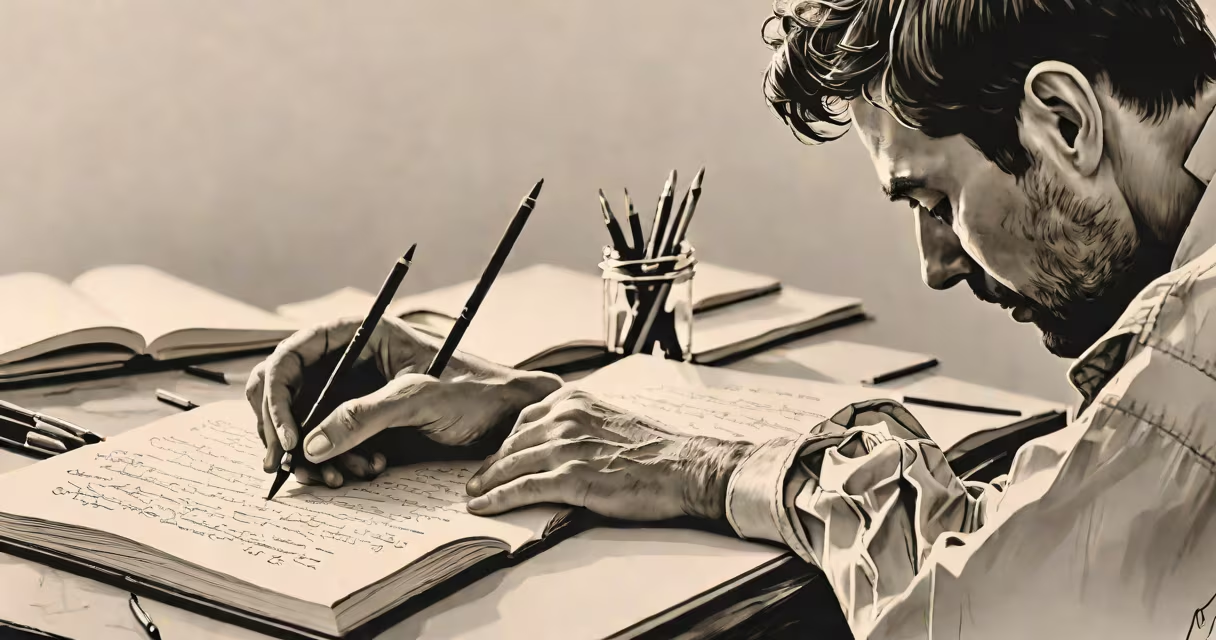
An autobiography is a first-person narrative of a person's life, written by that person. It recounts key events, experiences, and reflections from birth to the present, often emphasizing personal growth, identity, and key moments. Unlike fiction, it relies on real memory and documented facts.
The term comes from Greek roots: "auto" meaning self, and "bios" meaning life. Together, they form "life of the self." This genre emerged in the 1st century BCE with Roman senator Cicero's letters, but the modern form solidified in the 18th century through figures like Benjamin Franklin and Mary Wollstonecraft.
Autobiographies differ from biographies, which are written by others. They also contrast with memoirs, which focus on specific themes or periods rather than a full life arc. An autobiography covers the entire timeline; a memoir may skip decades to explore trauma, travel, or a single event.
They follow a chronological or thematic structure. Most begin with early childhood, trace education and career paths, and conclude with current perspectives. The author controls tone, detail level, and emphasis-shaping how readers perceive their life.
For example, Maya Angelou's *I Know Why the Caged Bird Sings* opens with her traumatic childhood in rural Arkansas. She uses lyrical prose to convey emotional truth, not just facts. Her narrative includes racism, sexual assault, and resilience-all presented through her lived lens.
Some autobiographies include interviews, letters, or archival documents. These add credibility. For instance, Barack Obama's *Dreams from My Father* blends personal recollection with historical context, including interviews with his Kenyan relatives and references to U.S. civil rights history.
Core elements include a clear narrative arc, introspection, and authenticity. The author must balance honesty with self-preservation-some omit controversial details or reshape events for privacy or protection.
Structure varies. Some use chapters by life stage: "Childhood," "College Years," "Marriage and Career." Others adopt a non-linear format, jumping between memories. Maxine Hong Kingston's *The Woman Warrior* mixes autobiography with myth and dream sequences, blurring lines between fact and imagination.
Modern autobiographies often incorporate multimedia. Digital editions may include photos, audio clips, or embedded videos. For example, Prince's *The Beautiful Ones* combines handwritten notes, rare images, and excerpts from his unfinished manuscript.
Not all first-person life stories are autobiographies. Here's how they differ:
| Type | Scope | Focus | Example |
|---|---|---|---|
| Autobiography | Full life span | Identity and process | Malcolm X's *Autobiography of Malcolm X* |
| Memoir | Specific period or theme | Emotional truth, not completeness | Cheryl Strayed's *Wild* |
| Biography | Life of another person | Third-party perspective | Robert Caro's *The Power Broker* |
| Confessional writing | Single event or emotion | Psychological insight | Virginia Woolf's *A Room of One's Own* |
A common mistake is calling any personal essay an autobiography. A short piece on losing a job or moving cities is not an autobiography-it lacks the full life arc. The genre requires sustained reflection over time.
Another confusion: autobiographies aren't always truthful. Authors may misremember, exaggerate, or omit. Researcher James Olney notes in *Tell Me a Story* that "the self in autobiography is constructed, not discovered." Memory is selective. What matters is narrative coherence, not absolute accuracy.
They appear in literature, politics, science, and entertainment. Public figures use them to shape legacy. Nelson Mandela's *Long Walk to Freedom* presents his prison years as both personal endurance and political metaphor.
In academia, autobiographies help document social change. The *American Autobiography Project* at the University of Michigan archives over 3,000 personal narratives from diverse backgrounds, preserving voices often excluded from mainstream history.
One non-obvious fact: many famous autobiographies were ghostwritten. The author provides the story, but a professional writer shapes the prose. For example, *The Diary of a Young Girl* by Anne Frank was edited and published posthumously by her father, Otto Frank, who removed sensitive passages. The version we read today is a curated reconstruction.
Even when written by the subject, editing changes tone and emphasis. Oprah Winfrey's *The Path Made Clear* underwent multiple drafts to balance spiritual insight with commercial appeal. Publishers often request edits to improve readability or marketability.
Consider *The Autobiography of a Flea* by Charles Godfrey Leland (1881). Though fictional, it mimics the form of a real autobiography. Written in first-person, it follows a flea's life from birth to death, describing human hosts, battles with cats, and existential dread.
This work is not a true autobiography-it's satire. But it reveals how the genre functions: first-person narration creates intimacy, even when the narrator is absurd. The book critiques Victorian morality and class by projecting human traits onto an insect.
It shows that the form's power lies in perspective. Whether real or imagined, the "I" in an autobiography makes the reader feel present. That's why audiences connect deeply with such texts-even when the subject is a parasite.
I once read a student's draft autobiography during a creative writing workshop. They described a summer spent working at a farm, using sensory details-smell of hay, calluses on hands, the sound of cows at dawn. The rawness of the voice made the story feel real. Later, the student admitted they'd altered one scene for dramatic effect. The audience didn't care-the emotional truth held.
When you ask "what do you mean by autobiography," you're asking about a genre rooted in identity, memory, and storytelling. It's not just a record of events. It's a performance of self.