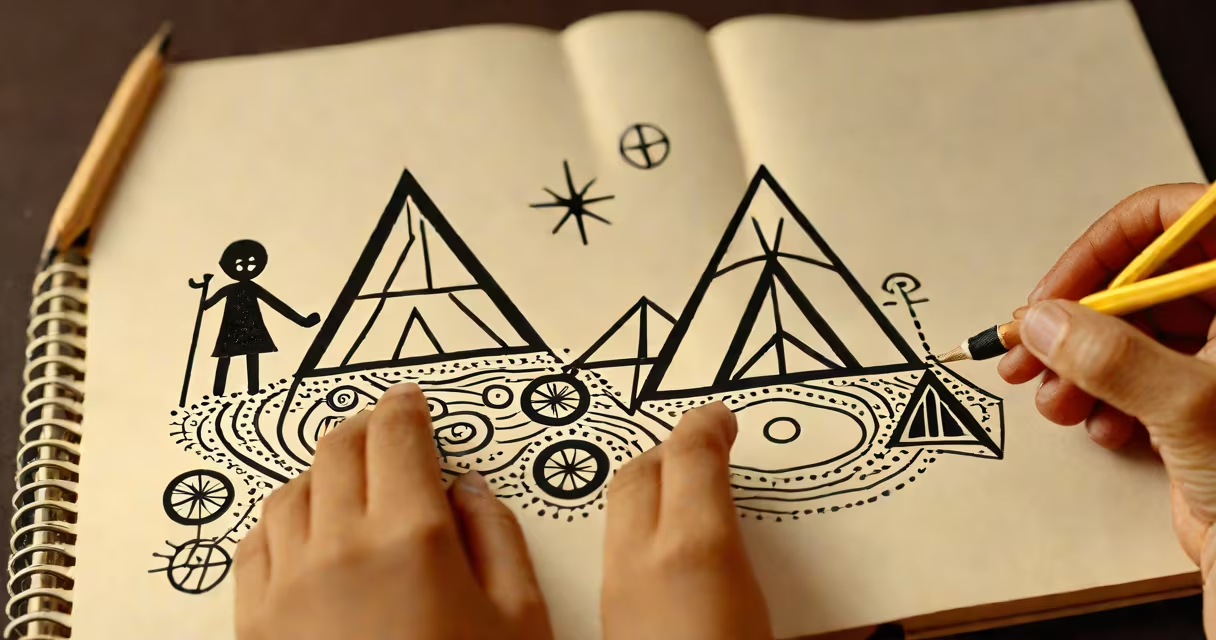
Warli art for kids is a traditional Indian folk art form originating from the Warli tribe in Maharashtra, using simple geometric shapes-circles, triangles, and lines-to represent people, animals, and daily life. It's designed for young learners to explore culture, creativity, and storytelling through minimalistic visuals.
This art style uses only three primary shapes: the circle (for the head), the triangle (for the body), and the line (for limbs). These forms are arranged in stylized compositions that depict farming, dancing, hunting, and family rituals. Because it relies on abstraction rather than realism, it's accessible to children ages 5 and up who are developing fine motor skills and visual recognition.
Warli art for kids is often taught in schools and art workshops as a way to introduce cultural heritage without requiring advanced technique. Its simplicity makes it ideal for classroom projects, craft sessions, and home-based creative play. The medium is typically white paper or cloth with black or red pigment, though modern versions use markers, crayons, or paint.
Warli art for kids functions through symbolic abstraction. Instead of drawing a human with detailed features, artists use a triangle for the torso, a circle for the head, and thin lines for arms and legs. This approach teaches children to focus on essential elements and understand how complex ideas can be simplified into universal forms.
The composition follows a grid-like structure. Figures are placed side-by-side or stacked vertically, often in groups to show movement or activity. For example, a row of five triangular figures with small circles for heads represents a group of people walking. A large circle with smaller circles around it may symbolize a village or a festival.
Each piece tells a story. A single figure holding a stick near a circle might mean a man hunting. Two figures facing each other with joined hands suggest celebration. Children learn narrative thinking by creating sequences-like a farmer planting seeds, then harvesting, then sharing food-using only basic shapes.
Traditional Warli art uses natural materials. The base is usually mud or cloth treated with lime wash. Pigments come from crushed plants, charcoal, or chalk. The most common color is black, applied with fingers, sticks, or brushes. Red and white are used in ceremonial pieces.
Modern warli art for kids uses accessible supplies: white paper, black markers, colored pencils, or acrylic paint. Some teachers use washable paints to reduce mess. Digital tools like tablets with drawing apps also allow kids to experiment with scale and repetition.
A typical project begins with a blank sheet. Children draw a central figure-a triangle standing upright, a circle on top, and two lines extending down for arms and legs. They add details like a dot for eyes or a curved line for a smile. Then they build context: a house (two triangles forming a roof), a tree (a vertical line with a circle on top), or a sun (a large circle with rays).
| Type | Shapes Used | Common Themes | Best Age Group |
|---|---|---|---|
| Basic Figure | Circle, triangle, line | People, animals, family | 5-7 years |
| Scene Composition | Multiple figures, added shapes | Farming, festivals, dance | 8-10 years |
| Story Sequence | Repeating figures, arrows | Life cycles, journeys | 9-12 years |
Warli art for kids appears in elementary school curricula across India, especially in states like Maharashtra, Gujarat, and Madhya Pradesh. It's included in art education standards because it supports cognitive development, spatial reasoning, and cultural literacy.
Teachers use it to teach math concepts like symmetry, patterns, and geometry. A single figure drawn with mirrored arms demonstrates reflection. Repeating patterns of triangles create tessellations. Students learn to count shapes, compare sizes, and identify relationships between forms.
Outside classrooms, warli art for kids is used in parenting resources, homeschooling kits, and summer camp programs. It's popular in multicultural events, Diwali celebrations, and school fairs. The art's low barrier to entry makes it inclusive for children with varying skill levels, including those with learning differences.
I once led a workshop at a community center where a 6-year-old boy drew a Warli scene of his family eating dinner. He used three triangles for people, circles for plates, and wavy lines for steam. His mother later told me he'd never drawn before but felt proud. That moment showed how useful simple forms can be in expressing identity and emotion.
Warli art for kids is often mistaken for other Indian folk art styles like Madhubani, Pattachitra, or Kalamkari. While all are traditional, they differ in origin, materials, and symbolism. Madhubani uses complex patterns and natural dyes; Pattachitra features mythological scenes with bright colors; Kalamkari involves resist-dye techniques on cotton.
Another confusion is equating Warli art with abstract expressionism. Though both use simplified forms, Warli art is rooted in storytelling and ritual. Abstract art focuses on emotion and form; Warli art centers on community and daily life. A Warli piece shows a man plowing a field-not just a shape-but a purpose.
A lesser-known fact: Warli art was nearly lost during colonial rule. British administrators dismissed it as "primitive" and discouraged its practice. It resurged in the 1970s when artists like Bhau Padhye brought it into urban galleries. Today, it's recognized by UNESCO as part of India's intangible cultural heritage.
Step 1: Take a sheet of white paper. Draw a horizontal line across the middle-this is the ground.
Step 2: Draw a large circle at the top center. This is the sun.
Step 3: Below it, draw a triangle pointing downward. This is a person. Add a small circle on top for the head.
Step 4: Draw two thin lines from the sides of the triangle for arms. Extend two lines downward for legs.
Step 5: Add a second person nearby, slightly smaller. Connect them with a line to show they're talking.
Step 6: Draw a small triangle below the first person's feet-this is a basket. Add a circle inside for grain.
Step 7: Around the scene, draw three small circles for birds flying. Use a wavy line to show wind.
Final result: A simple, expressive scene of two farmers discussing harvest. All elements are formed from basic shapes. No shading, no detail-just meaning.
For more on integrating cultural traditions into early learning, biology for kids offers cross-disciplinary connections, such as how animal behavior in folk tales mirrors real-world ecology.