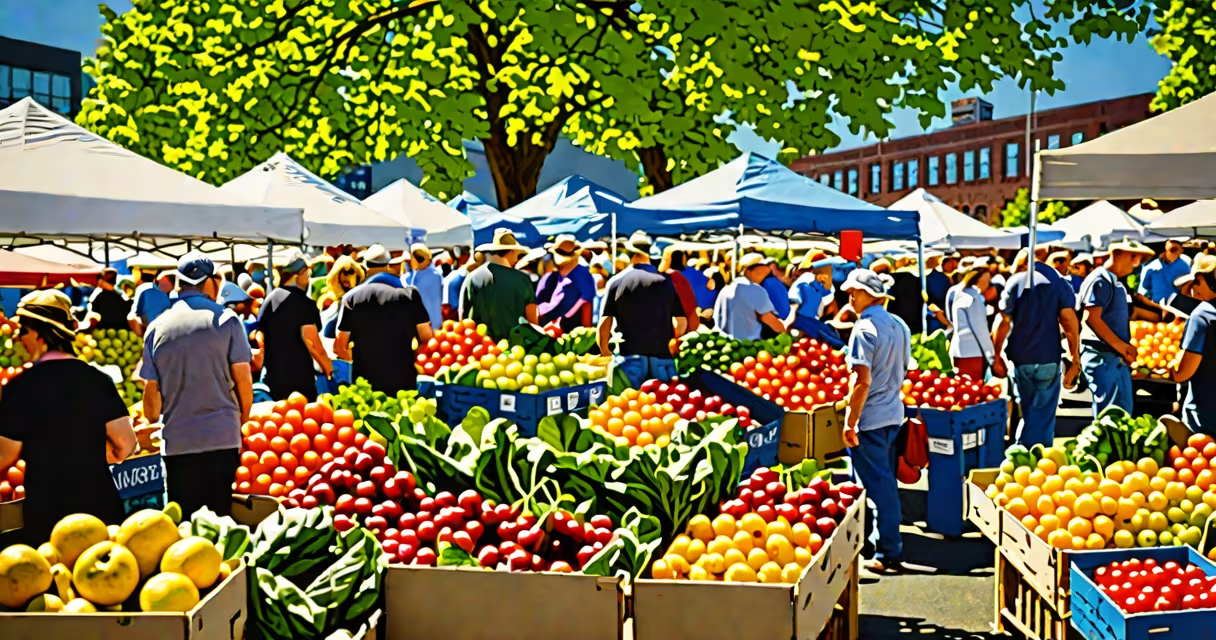
WA Market Place is a network of seasonal, community-based farmers markets across Washington State that connect local producers, artisans, and consumers. These markets operate weekly during growing seasons and feature fresh produce, baked goods, dairy, meats, and handcrafted items from nearby farms and small businesses.
Each WA Market Place event is hosted in a public space-often a city park, town square, or community center-and runs on a set schedule, typically from late spring through early fall. Vendors must meet eligibility criteria, including sourcing at least 75% of their products locally within a 100-mile radius. This ensures authenticity and supports regional agriculture.
For example, the Tacoma WA Market Place, held every Saturday at 11th Avenue and A Street, features over 60 vendors. In 2023, it served more than 1,200 visitors per week, with 83% of vendors reporting they sourced ingredients from within Washington State. The market operates from May through October, aligning with peak harvest times for apples, berries, and root vegetables.
Markets follow a standardized operational model. Organizers secure permits, arrange vendor spaces, manage parking and signage, and ensure compliance with health and safety codes. Vendors apply through a central portal and undergo vetting based on product origin, business registration, and insurance requirements.
Consumers attend to buy directly from growers, reducing supply chain steps and lowering costs. A tomato sold at the Bellingham WA Market Place in July 2023 was harvested the morning before and priced at $3.50 per pound-$1.20 less than supermarket equivalents. This price difference reflects reduced transportation and storage overhead.
Some markets offer additional services. The Olympia WA Market Place includes a free mobile food pantry on Tuesdays, distributing surplus produce to low-income residents. This integration of food access and commerce exemplifies the dual mission of many WA Market Place events: economic support for small producers and nutritional equity for communities.
WA Market Place venues host a mix of certified organic farms, micro-dairies, beekeepers, bakers, and craft artisans. The following table outlines common vendor categories and their typical offerings:
| Vendor Type | Common Products | Typical Location |
|---|---|---|
| Farmers | Heirloom tomatoes, heirloom potatoes, seasonal berries | Spokane, Wenatchee, Yakima Valley |
| Bakers | Artisan sourdough, gluten-free pastries, seasonal fruit pies | Seattle, Bellevue, Redmond |
| Dairy Producers | Raw milk cheese, grass-fed butter, goat yogurt | Port Townsend, Ellensburg, Centralia |
| Artisans | Handwoven baskets, beeswax wraps, herbal salves | Leavenworth, Port Angeles, Lake Chelan |
One non-obvious rule: no vendor may sell processed foods unless they are made on-site. This prevents large-scale commercial operations from dominating. For instance, a vendor selling apple cider must press the apples at the market-no bottled or pre-made versions allowed.
Markets are concentrated in urban and suburban areas with high foot traffic. Major hubs include Seattle's Pike Place Market (though not officially branded as WA Market Place), the University District in Seattle, and downtown Spokane. Smaller towns like Mount Vernon and Darrington also host weekly markets.
Operating hours vary by location but generally run from 9 a.m. to 2 p.m. on weekends. Most markets are closed during winter months due to low crop availability and poor weather conditions. Exceptions exist-some coastal markets in the Olympic Peninsula remain open year-round with indoor setups and heated tents.
A key distinction: WA Market Place is not a single entity. It is a decentralized network of independently managed markets. Each site sets its own rules, vendor fees, and hours. The state does not fund or operate them. Instead, local nonprofits, city departments, or volunteer collectives organize each event.
Many assume WA Market Place is a statewide chain or government-run program. It is not. There is no central store, website, or app for all locations. Each market maintains its own social media presence and vendor list.
Another misconception: all products are organic. While many vendors are certified organic, others use sustainable practices without certification. The Washington State Department of Agriculture confirms that "certification is not required for participation," though transparency about farming methods is encouraged.
I once attended the Everett WA Market Place in August 2022 and spoke with a berry farmer who grew heritage varieties like 'Tayberry' and 'Marion'-not available in grocery stores. He emphasized that his goal wasn't profit but preserving regional plant diversity. His stand sold out by noon. That experience underscored how WA Market Place serves both economic and cultural roles beyond food exchange.
These markets strengthen local food systems. According to a 2022 study by the University of Washington's Center for Urban Horticulture, 68% of WA Market Place customers reported eating more fresh produce after regular attendance. Another study by WSU Extension found that 71% of participating farmers increased sales volume by 25% or more during market season.
They also build community. Weekly visits create informal social networks. Shoppers often return to the same vendor, leading to personal connections. A survey of 300 attendees at the Bremerton market showed that 54% said they felt more connected to their neighborhood since joining.
WA Market Place is not a retail outlet. It is a living system of exchange-economic, ecological, and social-anchored in place, time, and trust. It thrives because it remains rooted in local reality, not branding or scalability.