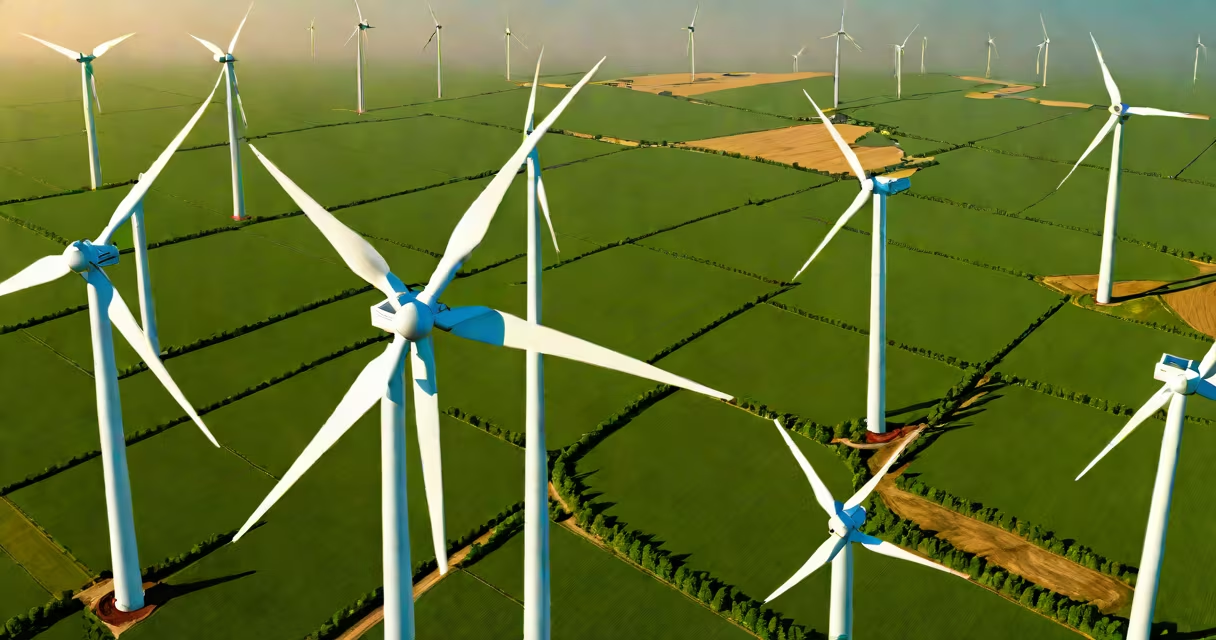
Wind energy is electricity generated by converting the kinetic energy of moving air into electrical power using wind turbines. It is a renewable, low-carbon source of energy that contributes to global electricity grids.
Wind turbines capture wind through large blades attached to a rotor. As wind blows, it spins the blades, turning a shaft connected to a generator. The generator converts mechanical rotation into electrical current. Modern turbines operate efficiently at wind speeds between 12 and 25 km/h (7-15 mph).
The process begins when wind flows over the turbine's blades, creating lift similar to airplane wings. This lift causes the blades to rotate. The rotational energy turns a drive shaft connected to a gearbox, which increases the speed for the generator. The generator then produces alternating current (AC) electricity, sent via cables to a substation and integrated into the power grid.
Wind energy systems fall into two categories based on scale and location:
| Type | Scale | Use Case | Examples |
|---|---|---|---|
| Onshore wind | Large-scale farms | Grid-connected power for cities and industries | U.S. Midwest, German plains, Indian Gujarat |
| Offshore wind | Large-scale farms | High-density coastal regions with strong, consistent winds | UK's Hornsea Project, Denmark's Anholt Wind Farm |
Onshore wind installations dominate global capacity, accounting for 90% of installed wind power as of 2023. Offshore wind is growing rapidly due to stronger and steadier winds at sea, though it requires higher upfront investment and complex maintenance logistics.
Wind energy is deployed in countries with high wind potential and supportive policy frameworks. The United States, China, Germany, India, and Brazil lead in installed capacity. In 2023, wind supplied 7.3% of global electricity demand, according to the International Energy Agency (IEA).
Germany generates over 25% of its electricity from wind, with offshore projects contributing 60% of its offshore capacity. In Texas, wind accounts for nearly 30% of electricity production, driven by vast open plains and favorable transmission infrastructure.
A key reason for adoption is cost. Onshore wind is now among the cheapest sources of new electricity generation. Levelized cost of energy (LCOE) for onshore wind dropped to $0.03/kWh in 2023, below coal ($0.05/kWh) and gas ($0.04/kWh), according to Lazard's Levelized Cost of Energy Analysis.
Many assume wind energy is inconsistent and unreliable. While wind varies by time and location, grid operators manage variability through forecasting, battery storage, and integration with other renewables. In Denmark, wind provides 50% of annual electricity, with surplus exported during high-wind periods.
Another misconception is that wind turbines harm birds. Studies show bird mortality from wind turbines is 0.01 to 0.02 birds per gigawatt-hour (GWh), compared to 1.5-2.5 birds per GWh from fossil fuel plants due to pollution and habitat loss. Proper siting avoids migratory corridors and sensitive habitats.
A lesser-known fact: modern turbines are designed to shut down automatically at wind speeds above 25 m/s (56 mph) to prevent damage. This safety feature reduces failure rates to less than 1% annually, according to the National Renewable Energy Laboratory (NREL).
Hornsea One, located off the northeast coast of England, began operations in 2019. It consists of 174 turbines, each with a 7 MW capacity. Total output reaches 1.2 GW, enough to power over 1 million homes annually.
Construction involved laying 400 km of submarine cable to connect to the UK grid. Maintenance uses specialized vessels and drones for blade inspection. The project reduced carbon emissions by 1.5 million tonnes per year-equivalent to removing 300,000 cars from roads.
Despite initial delays and cost overruns, Hornsea One achieved a 95% availability rate in its first five years, exceeding industry benchmarks. Its success helped launch the UK's offshore wind expansion program, now targeting 50 GW by 2030.
Wind energy is formally known as wind power. It is also referred to as wind electricity or wind-generated power in technical documents. The term "wind energy" is standard in policy and academic contexts.
When discussing conversion, engineers refer to the process as "wind-to-electricity conversion." The electricity produced is often labeled as "renewable energy" or "clean power" in regulatory filings and market reports.
Neither solar nor wind is universally better. Wind energy typically produces more electricity per unit area than solar photovoltaic (PV) systems. A single offshore wind turbine generates about 15 GWh/year, while a comparable solar range produces 8-10 GWh/year under similar conditions.
However, solar PV excels in distributed generation. Rooftop panels provide immediate local power, reducing transmission losses. Solar also performs well in arid, sunny climates like Arizona or Rajasthan.
For large-scale grid supply, wind often outperforms solar in energy density and consistency. But pairing both maximizes reliability. Countries like Spain and California use hybrid systems: wind during winter months, solar in summer, with battery storage balancing daily fluctuations.
I've observed this firsthand during a visit to a hybrid solar-wind facility in northern California. The site used weather modeling to adjust turbine pitch and panel tilt in real time. Over a year, the system delivered 92% of its projected output-higher than either source alone.