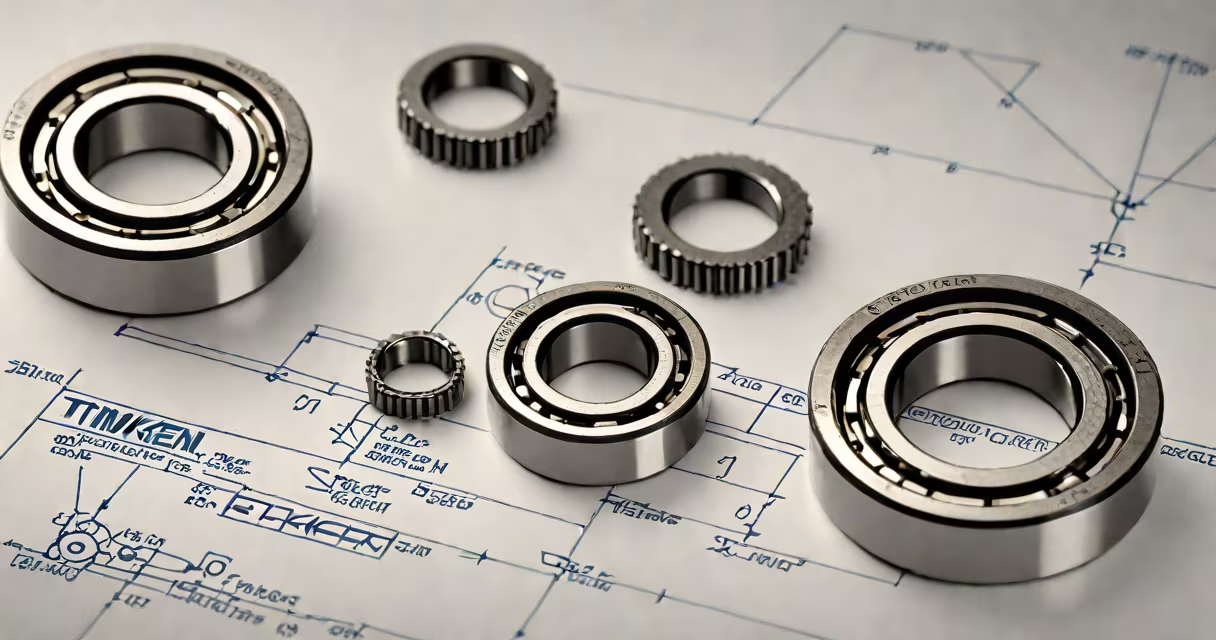
A timken cross reference is a tool that maps Timken bearing part numbers to equivalent models from other manufacturers, enabling direct replacements in industrial equipment. It uses standardized numbering systems and dimensional specs to ensure compatibility across brands.
Timken bearings are widely used in heavy machinery, automotive systems, and manufacturing equipment due to their durability and precision. When a bearing fails, replacing it with a matching part from another brand requires accurate cross-referencing. A correct timken cross reference ensures the substitute bearing fits the shaft, housing, and load requirements without compromising performance or safety.
For example, a Timken 6308-2RS bearing (inner diameter 40 mm, outer diameter 90 mm, width 25 mm) has equivalents in SKF (6308-2RS), NSK (6308-2RS), and FAG (6308-2RS). These brands share the same dimensions and load ratings, making them interchangeable in most applications. Using a timken cross reference prevents mismatched parts that could cause premature wear or mechanical failure.
Each bearing has a unique alphanumeric code. Timken's system uses prefixes and suffixes to denote size, material, sealing, and internal design. For example, "6308" indicates a deep groove ball bearing with a 40 mm bore. The "2RS" suffix means it has rubber seals on both sides to retain lubricant and exclude contaminants.
When performing a timken cross reference, the process starts with identifying the original bearing's dimensions and specifications. You then compare those values against databases maintained by third-party suppliers or manufacturer websites. Tools like the Timken online catalog or third-party platforms such as BearingPoint allow users to search by part number, bore size, or application.
For instance, if a machine uses a Timken 6205-2RS bearing, a cross-reference shows it matches the SKF 6205-2RS, FAG 6205-2RS, and NSK 6205-2RS. All four have identical inner diameter (25 mm), outer diameter (62 mm), and width (17 mm). This consistency allows engineers to swap parts across brands without redesigning the mounting structure.
There are three primary formats for timken cross reference data:
| Type | Use Case | Accuracy Level | Source Example |
|---|---|---|---|
| Manual charts | Quick field checks, no internet access | Medium (outdated if not updated) | Timken's official PDF cross-reference guide (2022 edition) |
| Online databases | Real-time lookup, multiple brands | High (updated monthly) | Timken.com's bearing selector tool |
| Mobile apps | On-site maintenance, barcode scanning | High (syncs with cloud database) | BearingPro app (iOS/Android) |
Manual charts remain useful in remote workshops where connectivity is unreliable. However, they risk outdated information-some versions haven't been updated since 2015. Online tools like Timken's official selector provide real-time validation based on current inventory and engineering standards.
One non-obvious fact: Not all bearings with matching dimensions are functionally equivalent. A Timken 6308-2RS may have a higher load rating than an SKF equivalent due to differences in cage design and material. Always verify changing load capacity (C) and static load rating (Co) when using a timken cross reference.
Many technicians assume that matching bore size and width guarantees interchangeability. This is incorrect. Two bearings can share the same dimensions but differ in internal clearance, raceway curvature, or lubrication type. These differences affect noise, vibration, and lifespan under load.
For example, a Timken 6206-2RS and an SKF 6206-2RS both have 30 mm bores and 72 mm outer diameters. But the Timken version uses a pressed steel cage, while the SKF uses a machined brass cage. The brass cage reduces friction and extends service life in high-speed applications. A timken cross reference must include cage type and clearance class to avoid errors.
I once replaced a failed bearing in a conveyor motor using a generic cross-reference list. The new bearing fit mechanically but failed after 48 hours due to excessive heat. Investigation revealed the replacement had a different internal clearance. After checking the official timken cross reference, I found the correct match required a "C3" clearance variant. The lesson: never skip verifying clearance and preload specs.
Industries relying on continuous operation-like mining, oil & gas, and food processing-depend on timken cross reference to minimize downtime. When a critical bearing fails during a shift, maintenance teams use cross-reference tools to source a replacement within hours, often from local distributors.
For example, a paper mill in Wisconsin experienced a failure in a 200-horsepower roller drive. The original Timken 6312-2RS was out of stock. Using a timken cross reference, the team identified an equivalent NSK 6312-2RS available locally. They installed it during a scheduled maintenance window, avoiding a 72-hour shutdown.
These tools also support cost management. Timken bearings are premium-priced. In non-critical applications, a lower-cost equivalent from a different brand may suffice. A timken cross reference helps identify these options without sacrificing safety or reliability.
When sourcing parts, always verify that the cross-referenced bearing meets the original equipment manufacturer's (OEM) specifications. Some machines require specific tolerance classes or grease types. Even if dimensions match, using a non-compliant bearing voids warranties and increases failure risk.
Always double-check the part number and application notes before ordering. A single digit error in the suffix can result in a bearing that doesn't handle axial loads properly. Use official sources whenever possible-third-party sites sometimes mislabel part numbers or omit critical details.
With accurate timken cross reference data, maintenance teams reduce repair time, lower inventory costs, and prevent unexpected failures. It's not just a lookup-it's a bridge between brands, machines, and uptime.