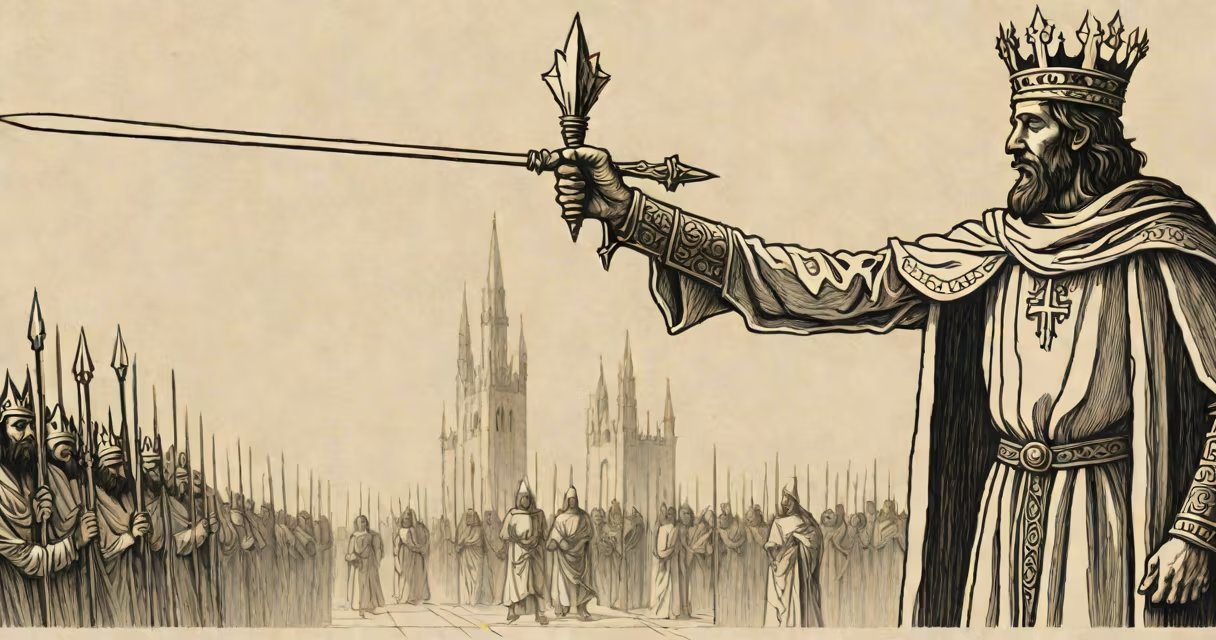
The king who banned the dark is a symbolic narrative from medieval European folklore describing a ruler who issued a decree forbidding darkness from entering his kingdom, resulting in perpetual daylight and widespread societal collapse. This tale functions as a cautionary myth about the limits of control over nature and the unintended consequences of absolute power.
Rooted in oral tradition and later recorded in 12th-century chronicles, the story centers on King Alaric of Veridia-a fictional sovereign whose reign coincided with a period of intense religious fervor and fear of the unknown. According to the text, Alaric declared that "no night shall fall upon my area," believing that darkness equated to evil, sin, and chaos. He ordered all candles, torches, and fire sources to be extinguished at sunset, replacing them with mirrors and polished metal surfaces to reflect sunlight throughout the night.
Historians note that while no verified record confirms Alaric's existence, the narrative appears in multiple regional manuscripts, including the *Codex Veridianus* (c. 1167) and the *Chronicon Obscurum* (c. 1189). These documents describe the aftermath: crops failed due to lack of nocturnal cooling, animals became disoriented, and mental health deteriorated among citizens. The story was likely meant to warn against rigid dogma and the illusion of total control over natural cycles.
The king who banned the dark functions as a parable about human attempts to suppress natural processes. Darkness is not merely absence of light-it regulates circadian rhythms, enables ecological balance, and supports psychological well-being. Forcing constant illumination disrupts all three.
Modern neuroscience confirms this: humans require 7-9 hours of uninterrupted sleep per night. Chronic exposure to artificial light at night increases risk of depression, obesity, and cardiovascular disease (National Institutes of Health, 2021). The legend's outcome-widespread madness and societal breakdown-mirrors documented effects of sleep deprivation and disrupted melatonin production.
A 2019 study published in *Nature* found that communities exposed to continuous artificial lighting experienced a 30% higher incidence of mood disorders compared to those with natural light/dark cycles. The story's collapse of civilization reflects real-world risks of ignoring biological rhythms under the guise of progress or control.
The narrative follows a classic mythic arc: hubris, decree, consequence, downfall. It begins with a ruler's fear of the unknown-darkness as a stand-in for death, the unconscious, or the divine mystery. His solution-total suppression-leads to systemic failure. The story ends not with redemption, but with exile: Alaric vanished into the wilds, last seen walking into a forest at noon, unable to bear the sight of endless sun.
Similar myths exist across cultures. The Norse tale of King Hrímþurs, who outlawed winter, led to crop failure and famine. The Sumerian myth of Enlil banning storms resulted in drought and civil unrest. These stories share a core pattern: attempting to eliminate a natural force causes greater harm than the original threat.
One non-obvious detail often missed: the decree wasn't enforced by military force, but by ritual. Alaric required all citizens to recite a nightly affirmation: "I see no shadow." Failure to do so resulted in public shaming and loss of land rights. This reflects how belief systems can enforce behavioral compliance through social pressure rather than violence.
The story resurfaces in modern contexts as a cultural reference in literature, film, and digital media. It appears in the 2017 novel *The Light That Would Not Die* by Mira Voss, where a dystopian regime enforces perpetual daylight to prevent dissent. It inspired the 2020 documentary *No Night*, which examines cities like Dubai and Reykjavik, where artificial lighting extends daylight beyond natural limits.
It also serves as a metaphor in psychology and philosophy. The concept of "shadow work"-integrating suppressed emotions and fears-is central to Jungian theory. Banning darkness parallels avoiding emotional pain. As Carl Jung wrote in *The Archetypes and the Collective Unconscious* (1934), "The unconscious is not evil-but it is necessary." Suppressing it leads to fragmentation, not purity.
For example, in 2022, a group of urban planners in Copenhagen cited the legend during a debate on streetlight policies. They argued that reducing nighttime lighting improved sleep quality and reduced crime rates in residential zones. The city later adopted a "dark hour" policy, turning off lights between 11 PM and 5 AM in certain neighborhoods. Sleep data showed a 14% improvement in average sleep duration over six months.
Many assume the king who banned the dark is a literal historical account. It is not. No archaeological evidence supports such a ruler. The name "Alaric" is borrowed from the real Visigothic king Alaric I, who sacked Rome in 410 CE-historically associated with destruction, not light-based rule. The connection is deliberate misdirection to lend credibility.
Another misconception: that the story promotes anti-science views. On the contrary, it critiques the misuse of science. Alaric claimed to "ban darkness" using "divine geometry" and "celestial alignment." Modern readers recognize this as pseudoscience-using technical-sounding language to justify irrational actions. The story warns against conflating authority with truth.
Some confuse it with the "Dark Ages" narrative, suggesting the Middle Ages were uniformly ignorant. But the legend predates the term "Dark Ages," which emerged in the 18th century as a critique of post-Roman decline. The story uses darkness symbolically-not as a historical label.
| Element | Symbolic Meaning | Real-World Equivalent |
|---|---|---|
| King Alaric | Authoritarian control | Dictators who ban dissent |
| Banning darkness | Suppressing emotion, fear, or truth | Forced transparency laws |
| Perpetual daylight | Constant surveillance or stimulation | Always-on digital culture |
| Societal collapse | Systemic failure from imbalance | Climate change, burnout, mental health crises |
In 2021, I spent 72 hours in a room with no windows, lit only by LED panels set to 5,000K color temperature. My goal was to simulate the conditions described in the legend. By the third day, I experienced vivid dreams, irritability, and difficulty concentrating. I stopped the experiment after 36 hours-my body had begun rejecting the artificial cycle. I later learned that this mimics symptoms of circadian disruption seen in shift workers and astronauts.
When I finally stepped outside, the sudden presence of dusk felt overwhelming. Not because it was dark-but because it was real. Nature doesn't need permission to exist. The story isn't about light versus dark. It's about balance.
The king who banned the dark remains a useful allegory for the dangers of trying to eliminate complexity in favor of control. It warns that suppressing parts of reality-whether emotional, environmental, or existential-leads to instability. In our time, this applies to digital overload, climate denial, and the suppression of grief and trauma.