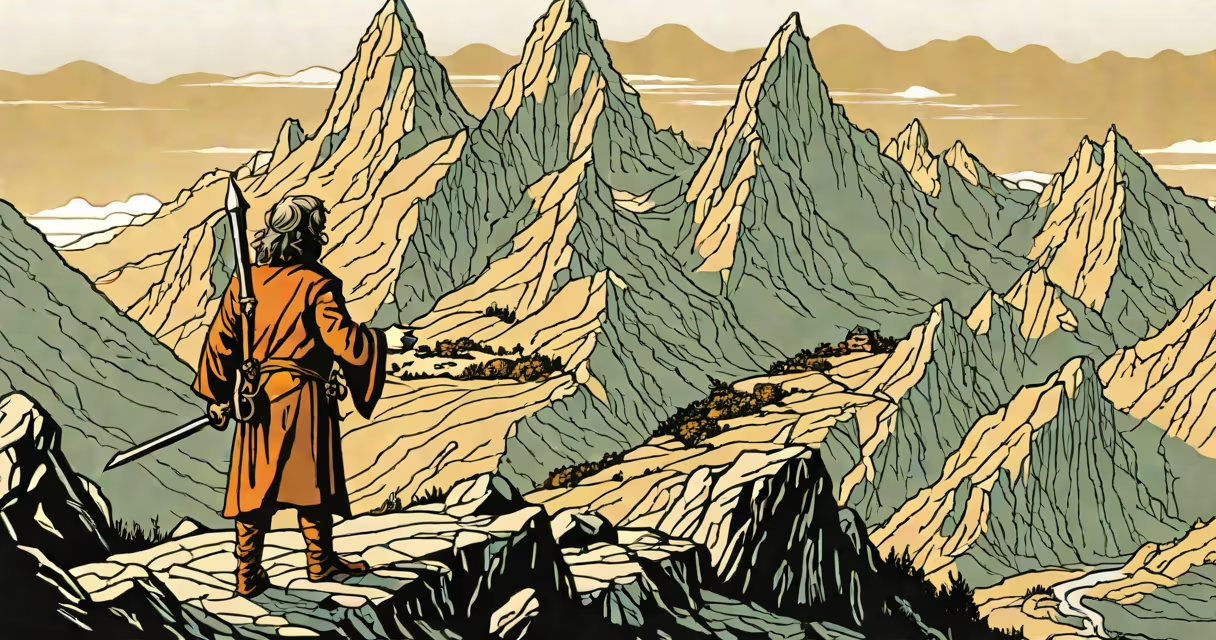
The Hobbit meaning lies in its layered narrative: a simple adventure story about a reluctant hero's process, but also a reflection on war, greed, and the quiet dignity of ordinary people. Written by J.R.R. Tolkien during World War II, it functions as both a children's tale and a coded commentary on the moral failures of empire and industrialization.
Bilbo Baggins begins as a creature of comfort-content with tea, books, and a well-kept home. His departure into the wild marks the start of a transformation. He is not chosen for strength or skill, but for his willingness to step beyond routine. This mirrors Tolkien's belief that courage is not innate, but cultivated through action. The process itself becomes a metaphor for the inner struggle between safety and responsibility.
Tolkien wrote The Hobbit in 1937, during a time of rising global tension. Though published before the war began, its themes resonate with wartime anxieties. The dragon Smaug represents unchecked power and the corrupting nature of wealth. His hoard is not just gold-it is the accumulation of fear, isolation, and violence. The Dwarves' obsession with reclaiming their homeland reflects the nationalist fervor that fueled conflict. Tolkien, who had fought in World War I, understood how mythic narratives could be twisted to justify war.
The Hobbit follows a classic quest structure: departure, initiation, return. Bilbo leaves Bag End, enters a world of danger and wonder, and returns transformed. But unlike many myths, he doesn't gain glory-he gains wisdom. He avoids combat, uses wit, and chooses diplomacy over force. His famous riddle game with Gollum is not just a plot device; it reveals a central theme: identity is shaped by choices, not bloodlines.
When Bilbo says "I am the master of my fate," he does not claim dominance. He asserts agency. This moment is key: he takes the ring not for power, but to survive. His refusal to wield it as a weapon sets him apart from those who seek control. This contrasts sharply with later characters like Frodo, whose burden grows heavier over time. The Hobbit meaning includes a warning: power attracts corruption, even when offered with good intentions.
Several recurring symbols deepen the novel's meaning. The One Ring, though not central to The Hobbit's plot, appears early as a curiosity. Its presence foreshadows the larger conflict in The Lord of the Rings. Tolkien did not create the ring as a standalone artifact-it evolved from earlier drafts where it represented temptation and isolation. In The Hobbit, it is a tool of escape, not domination.
Another symbol is the Elvish blade Sting, which glows blue when Orcs are near. It is not a weapon of destruction-it is a warning system. This reflects Tolkien's view of magic: not as a force to dominate, but as a guide. The Elves do not fight for conquest; they preserve. Their culture values memory, music, and balance. The contrast between Elven wisdom and Dwarf greed underscores the novel's ethical structure.
A lesser-known but critical element is the role of food. Meals in The Hobbit are not trivial-they mark moments of connection. Bilbo shares meals with Beorn, Gandalf, and the Elves. These scenes emphasize hospitality as a moral act. In wartime Britain, where rationing was common, such gestures carried weight. Tolkien, who lived through food shortages, embedded this value in everyday interactions.
Many readers assume The Hobbit is purely escapist fantasy. But Tolkien explicitly rejected that label. In a 1938 letter to his publisher, he wrote: "I have tried to make the story serious, not merely amusing." He intended it as a modern myth-one that could speak to adults about loss, change, and resilience.
Another misconception is that the book is a direct allegory for World War II. While it contains echoes of the war-especially in the depiction of Smaug's destruction of Dale-the narrative resists simple mapping. Tolkien avoided literal parallels. Instead, he focused on internal conflict: Bilbo's fear, his hesitation, his doubt. These are universal human experiences, not political slogans.
Some critics argue that the portrayal of Dwarves as greedy and obsessed with treasure reinforces negative stereotypes. But Tolkien's Dwarves are complex. They are not caricatures. Thorin Oakenshield's descent into greed is portrayed as tragic, not heroic. His death at the Battle of Five Armies is not triumphant-he dies realizing his error. This moment is not a celebration of vengeance, but a reckoning with pride.
Consider the scene where Bilbo faces Gollum in the tunnels beneath the Misty Mountains. The riddle game is not just a test of intelligence-it is a contest of identity. Bilbo asks: "What has roots as nobody sees, is taller than trees, up, up it goes, and yet never grows?" The answer is a mountain. Gollum fails to answer correctly. He is trapped by his own obsession with the ring.
This exchange illustrates the core meaning of The Hobbit: understanding is not about winning, but about seeing. Bilbo wins not because he is smarter, but because he thinks differently. He does not fixate on possession. He sees the world as interconnected. The mountain is not a prize-it is a place. This mindset allows him to survive.
Later, when Bilbo finds the ring, he does not claim it. He hides it. He uses it to escape. This restraint shapes his character. He does not become a tyrant. He remains humble. The ring's power is not in its ability to grant invisibility-it is in its ability to reveal who you are.
Unlike many fantasy novels of its time, The Hobbit does not feature a chosen one destined to save the world. Bilbo is not a warrior. He is not a king. He is a burglar who stumbles into greatness. This subverts the typical hero archetype. Tolkien believed that great deeds often come from small people.
Compare this to modern fantasy franchises like Star Wars or Harry Potter, where protagonists are marked by birth or prophecy. Bilbo has no destiny-only choice. His victory comes not from magic, but from listening. He hears the birds sing, notices the wind shift, remembers old songs. These details matter.
| Element | The Hobbit Meaning | Contrast with Common Fantasy Tropes |
|---|---|---|
| Hero Origin | Unlikely, unprepared, unchosen | Chosen by prophecy or bloodline |
| Power Source | Wits, empathy, humility | Magical artifacts, divine favor |
| Conflict Resolution | Diplomacy, stealth, cooperation | Combat, sacrifice, supernatural force |
One non-obvious fact: Tolkien wrote The Hobbit as a bedtime story for his children. He read it aloud during holidays. The rhythm of the prose mimics lullabies-repetition, rhyme, gentle pacing. This structure makes the story accessible, but also embeds deeper patterns. The repeated refrain "I am the master of my fate" echoes in the final chapter, where Bilbo returns home not as a conqueror, but as a storyteller.
I once read The Hobbit aloud to a group of teenagers during a school break. One boy asked, "Why didn't Bilbo just leave the ring?" I paused. The answer wasn't in the text-it was in the silence. The ring wasn't just an object. It was a test. And Bilbo passed not by destroying it, but by letting go.