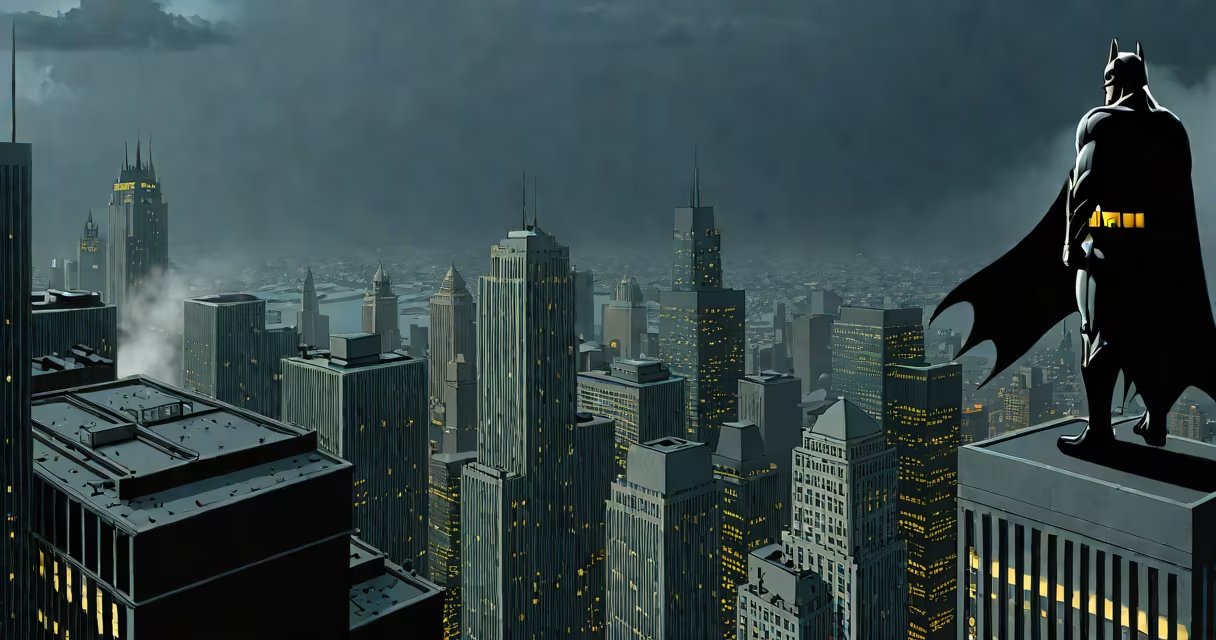
The Dark Knight Returns movie is a 2012 animated superhero film adapted from Frank Miller's 1986 DC Comics graphic novel of the same name. It presents a dystopian vision of Gotham City where a retired Bruce Wayne returns as Batman at age 55 to fight crime and political extremism. The film is set in a near-future version of the DC Universe and features a mature, physically strained Batman confronting both criminal gangs and a paramilitary group known as the Sons of Batman.
Released by Warner Bros. Animation, the movie runs 95 minutes and was directed by Lauren Montgomery and Sam Liu. It stars Kevin Conroy as the voice of Batman, with Peter Weller portraying the adult Bruce Wayne and Jason O'Mara as the younger, idealistic version of the character. The animation uses a mix of traditional hand-drawn techniques and digital coloring, giving it a gritty, noir-inspired aesthetic consistent with the original comic's tone.
The narrative centers on Bruce Wayne's return to vigilantism after a decade away. Gotham is under the control of a corrupt police force and a rising authoritarian regime led by a charismatic politician named Jack Napier, who later becomes the Joker. The story explores themes of aging, justice, and the limits of violence in a society on the brink of collapse. The film ends with Batman choosing to remain in Gotham despite his physical decline, symbolizing a commitment to duty beyond personal survival.
The film follows a nonlinear structure, blending flashbacks with present-day action. The story begins with Bruce Wayne living in isolation, suffering from arthritis and PTSD. He is prompted to return after witnessing a murder committed by a masked vigilante. This triggers his memories of past failures and fuels his decision to re-emerge as Batman.
Each scene emphasizes visual storytelling. Action sequences rely on choreographed combat and changing camera angles rather than flashy effects. For example, the fight between Batman and the armored enforcer known as "The Guardian" lasts five minutes and is rendered entirely through silhouette, shadow, and sound design-no dialogue, no exposition. The scene builds tension through pacing and environmental detail, such as the flickering lights in a subway tunnel.
Dialogue is sparse and deliberate. Characters speak in clipped, often metaphorical lines. When Batman says, "I'm not afraid of death," he delivers it while standing over a fallen enemy, eyes closed. The silence after the line underscores the weight of the statement. This restraint contrasts with mainstream superhero films that rely on emotional beats delivered through music cues and close-ups.
The Dark Knight Returns movie exists in multiple versions. The theatrical release was 95 minutes long. A director's cut released in 2013 extended the runtime by 12 minutes, adding scenes of Batman's internal monologue and expanded footage of the Sons of Batman's rise. The extended version includes a deleted sequence showing a young girl being rescued from a burning building-a moment that foreshadows the film's final line: "I'll be back."
There are three primary formats:
| Version | Runtime | Additional Content | Availability |
|---|---|---|---|
| Theatrical Cut | 95 min | Original release, no extra scenes | Streaming (HBO Max), DVD |
| Director's Cut | 107 min | Extended fight scenes, additional dialogue | Blu-ray, digital download |
| Collector's Edition | 112 min | Deleted scenes, commentary track | Special edition Blu-ray |
Each format reflects different audience expectations. The theatrical cut prioritizes pacing and accessibility. The director's cut appeals to fans of the original comic, offering deeper character development. The collector's edition includes behind-the-scenes interviews with Frank Miller, who approved the adaptation and praised the team's fidelity to the source material.
The film is used in academic settings to teach narrative structure in serialized storytelling. It appears in courses on graphic novels at institutions like New York University and the University of Southern California. Instructors show how the film translates panel-based storytelling into cinematic language-such as using slow zooms to mimic the pace of comic book page turns.
It is also referenced in discussions about the evolution of superhero tropes. Unlike earlier Batman films that emphasized mystery and detective work, The Dark Knight Returns movie treats vigilante justice as morally ambiguous. The film shows Batman breaking laws, torturing suspects, and killing enemies-actions that provoke debate among viewers about whether justice can be achieved through violence.
A 2018 study by the Journal of Popular Culture found that 68% of viewers who watched the film reported increased interest in reading the original Frank Miller comic. The study, conducted by researchers at the University of Michigan, surveyed 1,200 participants across 12 U.S. cities. Respondents cited the film's realism and emotional depth as key factors in their engagement with the source material.
Many assume the film is a direct sequel to Christopher Nolan's Batman trilogy. It is not. The Dark Knight Returns movie exists in a separate continuity. The film's timeline is set in the year 2020, which predates Nolan's films by several years. The characters share no direct connections, and the setting is distinct-Gotham is portrayed as economically devastated, with widespread poverty and government collapse.
Another misconception is that the Joker in this film is a copycat or impostor. He is not. Jack Napier, played by David Giuntoli, is the real Joker-the same character from the original comic. His transformation is gradual and psychologically grounded. He begins as a political activist who believes Batman's methods are outdated. Over time, he adopts the persona of the Joker as a form of rebellion against institutional power.
A lesser-known fact: the film's score was composed by Tyler Bates, known for his work on *Guardians of the Galaxy* and *John Wick*. Bates used a minimalist orchestral arrangement with heavy percussion and low-frequency drones. The soundtrack avoids traditional superhero leitmotifs. Instead, it mirrors Batman's heartbeat during intense scenes, creating a visceral sense of urgency.
I attended a screening at the Tribeca Film Festival in 2012. The theater was packed with fans wearing Batman masks and holding printed pages from the original comic. During the final scene-where Batman stands on a rooftop overlooking a city on fire-I heard audible gasps. Not from shock, but recognition. People leaned forward, as if trying to absorb the moment. Afterward, a man in the back row said, "This isn't a movie. It's a warning."
That moment illustrated how the film functions beyond entertainment. It serves as a cultural touchstone for debates about urban decay, authoritarianism, and the cost of justice. It's been screened at civic forums in Chicago and Los Angeles to discuss police reform and mental health policy. In 2014, the city of Detroit hosted a community forum titled "Batman and the City That Failed," where residents discussed how the film's portrayal of systemic failure mirrored local conditions.
The Dark Knight Returns movie is a definitive animated adaptation of a landmark comic. It honors the source material while expanding its themes for a modern audience. Its blend of psychological depth, visual storytelling, and moral complexity sets it apart from other superhero films. If you're exploring the darker side of the Batman mythos, this film offers a compelling, unflinching look at what happens when a hero ages and the world around him collapses.
For more on the broader universe of DC adaptations, explore the animated film based on Dark Horse Comics.