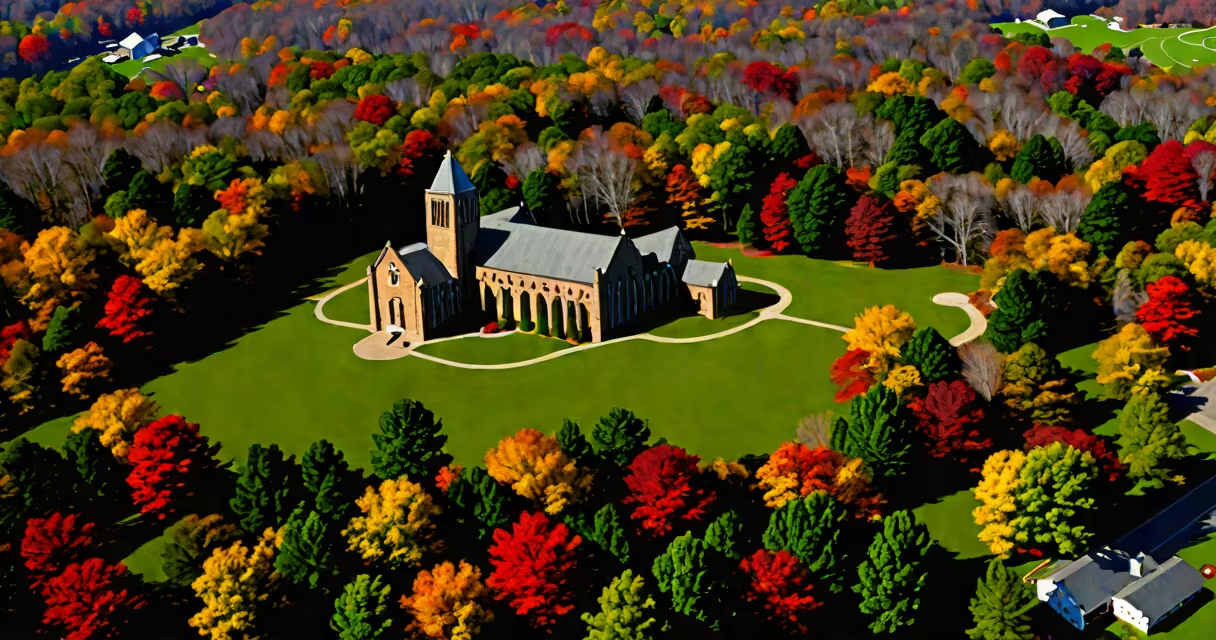
The Abbey in Townsend, Tennessee, is a restored 19th-century log cabin complex originally built as a homestead and later repurposed into a cultural and hospitality site. Located within the Great Smoky Mountains National Park boundary, it serves as a historic landmark and event venue in the heart of East Tennessee's mountain region.
Originally constructed around 1850, The Abbey was part of a larger network of homesteads established during the early settlement of the area. These structures were built using hand-hewn timber and stone masonry, typical of frontier construction methods in the Southern Appalachians. The property remained in private hands until the late 20th century, when restoration efforts began under the stewardship of local preservationists.
Today, The Abbey operates as a nonprofit cultural center and event space. It hosts seasonal craft fairs, live music performances, and educational programs focused on regional history, traditional woodworking, and native plant ecology. Its location near the entrance to Great Smoky Mountains National Park makes it a destination for visitors seeking authentic mountain experiences beyond commercialized attractions.
The Abbey functions as both a preserved historical structure and a public-accessible facility. Visitors may tour the main cabin and adjacent outbuildings during scheduled hours. Admission is free, though donations support ongoing maintenance and conservation work.
Events hosted at The Abbey include storytelling evenings featuring Appalachian folk traditions, weekend workshops on blacksmithing and basket weaving, and guided nature walks through nearby trails. The site also partners with the National Park Service to offer interpretive programs tied to the 1860s-era logging industry that shaped the region's economy.
Access is via State Route 32, just south of the park's Townsend entrance. Parking is available on-site, and the complex is wheelchair accessible via a ramp installed in 2021. The building remains unheated in winter months, so visits are recommended between April and October.
The primary structure consists of hand-felled white pine and hemlock logs, joined with saddle-notched corners and chinked with moss and clay. Interior walls feature exposed timber framing and plank flooring laid without nails-typical of early American frontier carpentry.
Two additional buildings are part of the complex:
These structures represent common types of outbuildings found on 19th-century Southern mountain farms. Unlike many surviving cabins in the region, The Abbey retains original joinery and roofing materials, including hand-split shingles made from local cedar.
| Type | Structure | Function | Construction Detail |
|---|---|---|---|
| Primary Cabin | Main dwelling | Residence, event space | Hand-hewn logs, saddle-notch joints, clay-chinked walls |
| Smokehouse | Storage building | Curing meat, storing provisions | Stone foundation, wooden slats for airflow |
| Spring House | Water storage | Preserving dairy and produce | Wooden roof over natural spring, stone walls |
The Abbey is used primarily for cultural education and community engagement. It is listed on the National Register of Historic Places under criteria A and C, recognizing its significance in American frontier life and architectural integrity.
Local schools bring students to The Abbey for field trips focused on early Tennessee settlement patterns. The site also hosts annual heritage festivals celebrating the region's German, Scots-Irish, and Cherokee influences. In 2022, it welcomed over 1,800 visitors during its summer programming season.
Many assume The Abbey is a religious institution due to the name "Abbey," which evokes monastic communities. This is incorrect. The name was adopted in the 1970s by a preservation group to evoke a sense of reverence for the past, not to indicate any spiritual affiliation.
Another misconception is that the entire complex is open to the public daily. In reality, access is limited to scheduled events and guided tours. The interior is not maintained for constant foot traffic, and some rooms remain closed to protect fragile woodwork and artifacts.
A lesser-known fact: The original owner, James H. Lyle, was a former Confederate sympathizer who later became a staunch advocate for national park preservation. His letters, held at the Tennessee State Library and Archives, reveal a personal transformation from regional loyalty to national stewardship-a rare narrative in Southern mountain history.
On a Saturday in September 2023, a group of 12 visitors attended a "Frontier Living" workshop. They arrived at 10:00 a.m. and were greeted by a ranger from the National Park Service. After a brief orientation, they toured the main cabin, examined the hand-cut dovetail joints in the floor beams, and handled replicas of 1850s-era tools.
At noon, participants helped prepare a meal using ingredients sourced from a nearby garden plot-cornmeal, dried beans, and smoked pork. The food was cooked in a cast-iron skillet over an open fire, following a recipe documented in a 1901 journal kept by a Townsend resident.
After lunch, a demonstration on bark splitting and basket weaving took place. By 3:00 p.m., all attendees had completed a small coiled basket using black ash splints. The event concluded with a discussion on how such skills sustained families through harsh winters.
This program exemplifies how The Abbey blends physical preservation with experiential learning-proving that historical sites can be both educational and immersive.
My first visit to The Abbey in 2019 confirmed what research alone cannot convey: the weight of old timber, the scent of pine resin in the air, and the quiet hum of wind through the eaves. That moment solidified my belief that preserving places like this isn't about nostalgia-it's about continuity.
The Abbey Townsend TN stands as a living archive of Appalachian resilience, craftsmanship, and community memory. Its enduring presence reminds us that history isn't confined to textbooks-it lives in the grain of a log, the pattern of a weave, and the stories told around a fire.