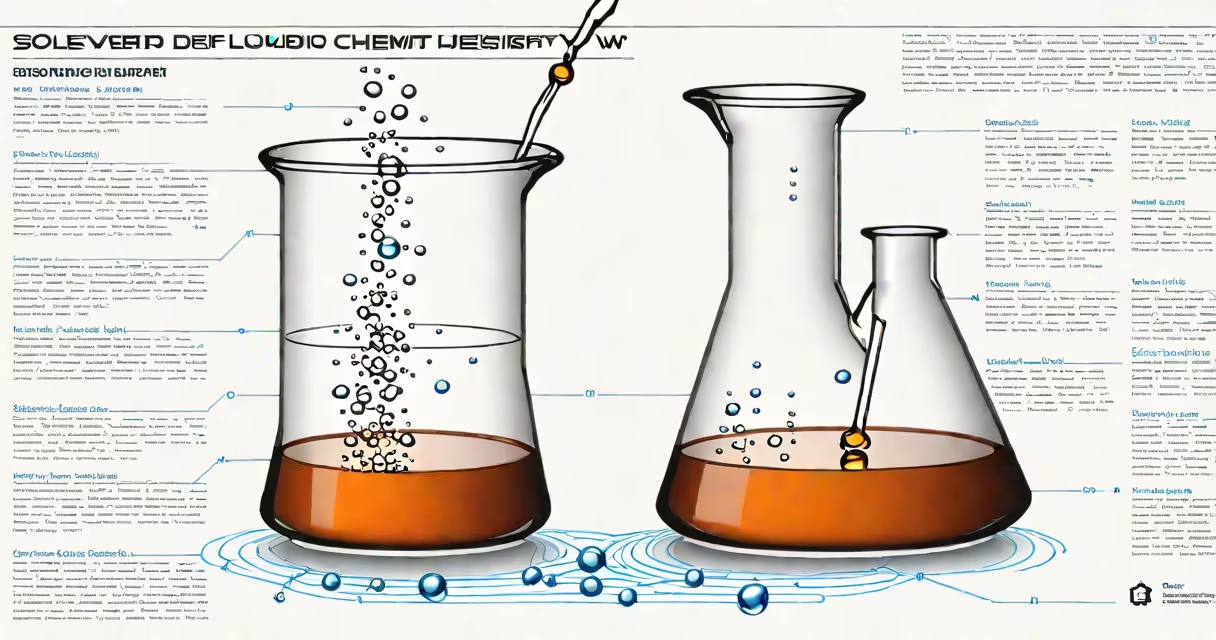
In chemistry, a solvent is a substance that dissolves a solute to form a homogeneous mixture called a solution. Solvents are typically liquids, though gases and solids can serve this role under specific conditions. The most common solvents are water, ethanol, acetone, and hexane.
Solvents work by surrounding solute particles through intermolecular forces such as hydrogen bonding, dipole-dipole interactions, or London dispersion forces. These forces overcome the attractions between solute particles, allowing them to disperse evenly throughout the solvent. The process is governed by the principle "like dissolves like"-polar solvents dissolve polar solutes, and nonpolar solvents dissolve nonpolar solutes.
For example, when sodium chloride (NaCl) dissolves in water, the partially negative oxygen atoms in water molecules attract the Na⁺ ions, while the partially positive hydrogen atoms attract Cl⁻ ions. This hydration shell stabilizes the ions in solution. Without a suitable solvent, many chemical reactions cannot proceed efficiently.
Solvents enable molecular dispersion by breaking apart solute particles and stabilizing them via attractive forces. The strength and type of interaction depend on the solvent's polarity and structure. Water, with its bent shape and high dielectric constant, effectively separates charged species. Organic solvents like diethyl ether or chloroform rely on dipole moments or pi-electron systems to stabilize nonpolar or weakly polar compounds.
Temperature and pressure influence solvent efficiency. Increasing temperature generally enhances solubility by increasing kinetic energy, which helps disrupt solute lattice structures. Pressure matters most for gaseous solutes-higher pressure increases gas solubility in liquids, as described by Henry's Law.
A practical example: dissolving sugar in tea. Hot water acts as the solvent. The hydroxyl groups in sucrose form hydrogen bonds with water molecules. As the tea cools, the solubility decreases, and excess sugar may crystallize out-a phenomenon known as supersaturation.
Solvents are broadly classified by polarity. The table below outlines major categories, their characteristics, and common uses.
| Type | Polarity | Examples | Common Uses |
|---|---|---|---|
| Protic | High (can donate H⁺) | Water, ethanol, methanol | Reactions requiring proton transfer, biological systems |
| Aprotic | Variable (cannot donate H⁺) | Acetone, DMSO, acetonitrile | Organic synthesis, chromatography |
| Nonpolar | Low | Hexane, benzene, carbon tetrachloride | Extraction of oils, cleaning agents |
Some solvents are hazardous. Benzene, once widely used in labs, is now restricted due to its carcinogenicity. Modern alternatives include toluene or cyclohexane for similar applications. Regulatory bodies like the EPA and OSHA classify solvents by toxicity, flammability, and environmental persistence.
One non-obvious fact: not all solvents are liquids. Supercritical CO₂, used in decaffeination and dry cleaning, functions as a solvent at high pressure and temperature. Its density resembles a liquid, but its viscosity is near-gas levels, enabling rapid diffusion into materials.
People often mistake solvents for reactants. A solvent participates in the medium but does not undergo chemical change in most cases. For instance, in the reaction between sodium metal and ethanol, ethanol acts as both solvent and reactant. However, in typical dissolution processes like salt in water, water remains chemically unchanged.
Another error is assuming all solvents mix with each other. Oil and water don't mix because their intermolecular forces differ too greatly. This leads to phase separation. The immiscibility of hexane and water prevents contamination in extraction procedures unless emulsifiers are added.
Even the term "solvent" can be misleading. In polymer science, a solvent is used to dissolve polymers to create solutions for coating or casting. But during drying, the solvent evaporates, leaving behind a solid film. This is not a chemical reaction-just physical removal.
Pharmaceutical manufacturing relies heavily on solvent selection. Drug compounds must be purified using recrystallization, where a solvent is chosen based on solubility differences at varying temperatures. Ethanol-water mixtures are common for isolating antibiotics like penicillin.
In industrial settings, acetone is used to clean glassware and remove adhesives. Its low boiling point (56°C) allows quick evaporation, minimizing residue. In contrast, dimethyl sulfoxide (DMSO) is used in lab experiments to deliver small molecules across cell membranes due to its ability to penetrate lipid bilayers.
I once observed a failed experiment where a researcher used water to dissolve a hydrophobic dye. The dye didn't dissolve because water's polarity couldn't stabilize the nonpolar aromatic rings. Switching to ethanol-polar enough to interact with some functional groups but nonpolar enough to accommodate the ring system-resolved the issue. This illustrates how solvent choice directly affects outcome.
The solvent definition in chemistry centers on a substance that dissolves another to form a uniform solution. Polarity determines compatibility. Common solvents include water, ethanol, acetone, and hexane. Misunderstandings arise when solvents are mistaken for reactants or assumed to mix universally. Real applications span pharmaceuticals, materials science, and analytical techniques. Choosing the right solvent ensures successful dissolution, reaction, and analysis.