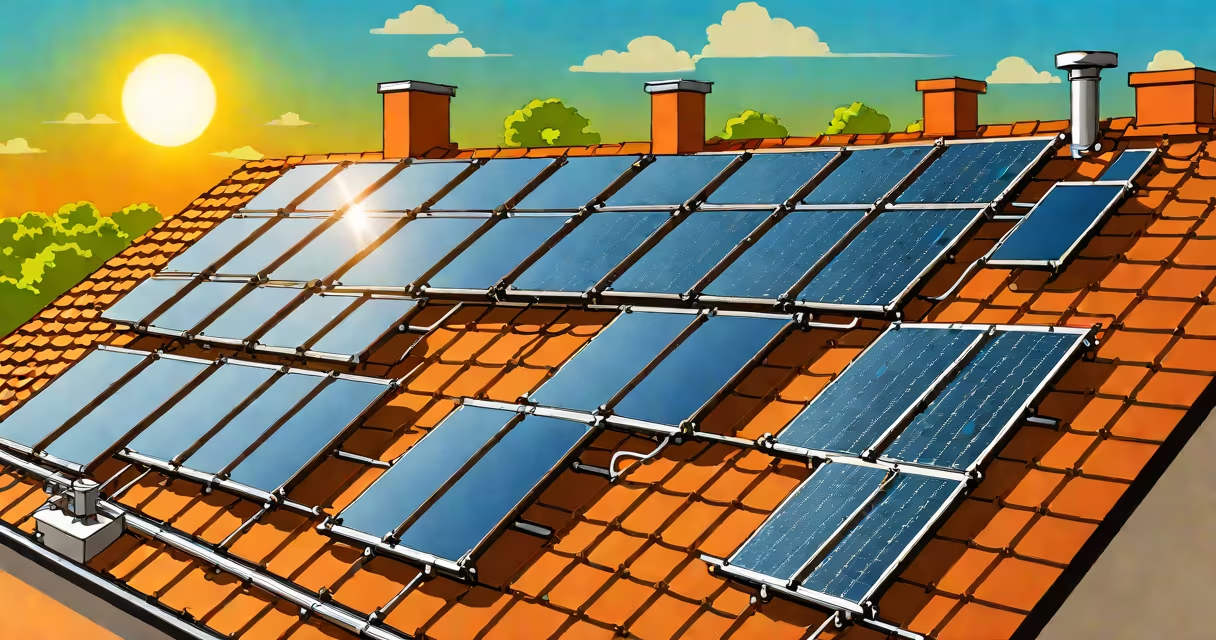
A solar collector is a device designed to capture and convert sunlight into usable thermal energy, typically for heating water or air. It functions by absorbing solar radiation and transferring the resulting heat to a fluid or air stream, which then moves the energy to storage or usage points.
Solar collectors are central components in solar thermal systems. They differ from photovoltaic panels, which convert sunlight directly into electricity. Instead, solar collectors focus on capturing heat, making them ideal for space heating, domestic hot water, and industrial process heat.
According to the U.S. Department of Energy, solar collectors can achieve efficiency levels between 60% and 80% under optimal conditions, depending on design and environmental factors. The National Renewable Energy Laboratory (NREL) notes that proper orientation and tilt impact performance, with maximum output when facing true south and angled at latitude degree.
Solar collectors operate through direct absorption of solar radiation. Sunlight strikes a dark-colored absorber surface, which heats up rapidly due to high solar absorptance and low emissivity. This heat transfers to a working fluid-typically water, glycol, or air-circulating through tubes or channels attached to the absorber.
The heated fluid then flows to a storage tank or heat exchanger. In closed-loop systems, a heat transfer fluid circulates through a sealed loop, transferring heat to a secondary fluid without mixing. Open-loop systems use potable water directly, requiring freeze protection in colder climates.
For example, a residential solar water heater in Arizona may use a flat-plate collector with copper tubes bonded to a black-anodized aluminum absorber. During peak sun hours, the system delivers hot water at 60°C (140°F) with minimal auxiliary heating needed.
Three primary types exist: flat-plate, evacuated tube, and concentrating collectors. Each suits different temperature ranges and application scales.
| Type | Operating Temperature Range | Efficiency at 50°C | Best Use Case |
|---|---|---|---|
| Flat-plate | 30-100°C | 60-70% | Domestic hot water, space heating |
| Evacuated tube | 50-150°C | 70-80% | High-performance hot water, colder climates |
| Concentrating (parabolic trough) | 200-400°C | 40-50% | Industrial process heat, utility-scale power generation |
Flat-plate collectors are the most common in residential installations. They consist of a metal absorber plate, transparent cover (usually glass), insulation, and a frame. Their simplicity makes them cost-effective and easy to maintain.
Evacuated tube collectors have better thermal performance in cold or cloudy conditions. Each tube contains a vacuum layer that minimizes convective and conductive heat loss. They are modular and perform well in northern latitudes, such as in Canada or northern Europe.
Concentrating collectors use mirrors or lenses to focus sunlight onto a small receiver. Parabolic troughs track the sun throughout the day, maintaining high concentration ratios. These systems require precise alignment and are used in large-scale solar thermal power plants, such as the SEGS facilities in California.
Solar collectors are often confused with solar panels. While both capture sunlight, solar panels (photovoltaic modules) produce electricity. A solar collector produces heat. Confusing the two leads to incorrect system sizing and performance expectations.
Another misunderstanding is that solar collectors work equally well in all climates. In reality, performance drops in regions with frequent cloud cover or low solar insolation. For example, a flat-plate collector in Seattle generates about 30% less annual energy than the same unit in Phoenix, according to NREL's PVWatts calculator.
It's also incorrect to assume that all solar thermal systems require complex controls. Basic passive systems, such as thermosiphon designs, rely on natural convection and do not need pumps or sensors. These systems are simpler and more reliable in off-grid settings.
In 2021, a 12-panel flat-plate solar collector range was installed on a school in Boulder, Colorado. The system supplied 70% of the building's hot water demand during winter months. Each panel had a 2 m² surface area and achieved an average efficiency of 65%. Over one year, the system reduced natural gas consumption by 3,200 kWh.
During testing, the collector's outlet temperature reached 58°C (136°F) at noon on a clear day, while ambient temperature was 5°C (41°F). The system maintained stable performance despite wind speeds up to 15 km/h, thanks to effective insulation and low-emissivity glazing.
One non-obvious fact: solar collectors degrade slowly over time. A study by the Fraunhofer Institute found that absorber coatings lose 1-2% of their solar absorptance per decade due to oxidation and dust accumulation. Cleaning every six months maintains near-optimal performance.
Solar collectors are distinct from solar insolation, which measures the amount of solar energy received per unit area over time. Solar insolation values determine how much energy a collector can expect to harvest. For example, a location with 5.5 kWh/m²/day of insolation supports higher collector output than one with 3.8 kWh/m²/day.
While solar collectors generate heat, active solar energy systems use mechanical components-like pumps and fans-to move fluids or air. A solar collector is a component within an active system. For instance, a solar domestic hot water system using a pump to circulate fluid is an active system, but the collector itself is passive in function.
When evaluating a system, consider the difference between collector efficiency and system efficiency. A collector may be 70% efficient, but system losses from piping, storage, and control reduce net gain. A well-designed system accounts for these losses during planning.
I once installed a solar collector range on a rural cabin in Montana. The system used a single 4 m² flat-plate collector with a 150-liter insulated tank. After two winters, the system delivered consistent hot water, reducing wood stove use by 40%. The only maintenance required was flushing the system annually to prevent mineral buildup.
Understanding the solar collector definition clarifies its role in renewable energy systems. It is not a standalone solution but a critical element in thermal energy harvesting. When paired with proper design, insulation, and maintenance, it provides reliable, low-carbon heat for homes and industries alike.