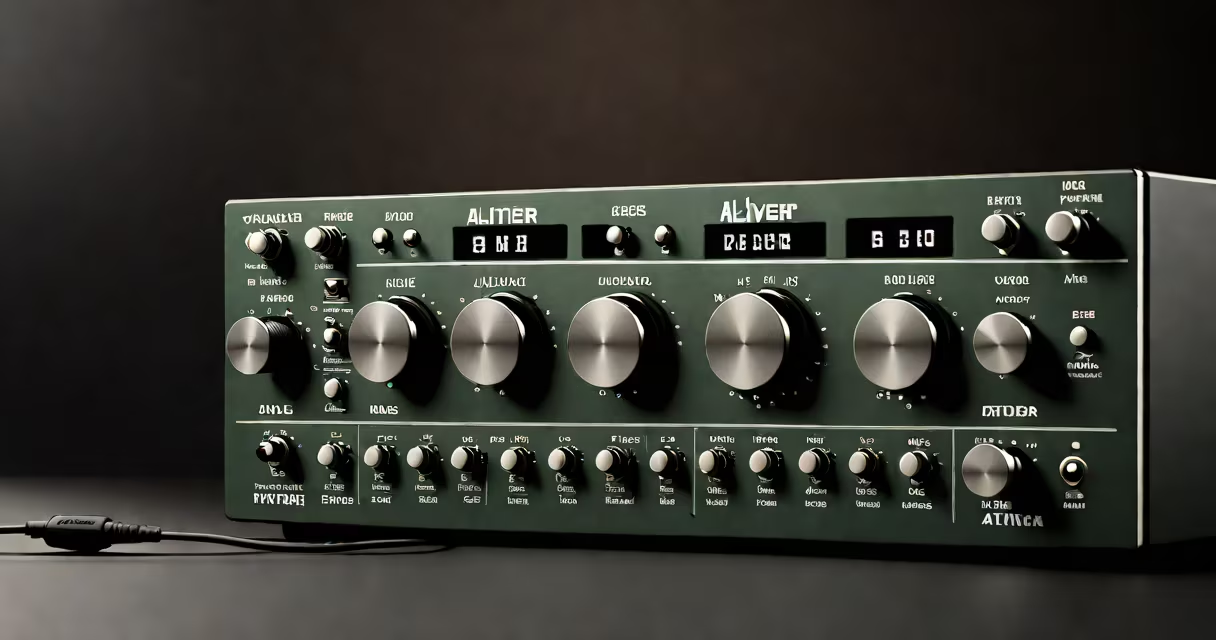
Altiverb Audio Ease is a professional-grade reverb plugin developed by Waves Audio that uses convolution-based processing to emulate the acoustics of real-world spaces, such as concert halls, cathedrals, and studios, using measured impulse responses.
Reverb simulates how sound behaves in physical environments. Altiverb Audio Ease captures the unique sonic signature of a space-its size, material composition, and geometry-by analyzing recorded impulse responses. These responses are then applied in real time to audio tracks during mixing or mastering.
The plugin supports up to 16 channels of audio processing and integrates natively into major digital audio workstations (DAWs) including Pro Tools, Logic Pro, and Ableton Live. It is widely used in film scoring, broadcast audio, and high-fidelity music production.
Altiverb Audio Ease operates through convolution reverb technology. Unlike algorithmic reverb, which mathematically generates reverberation based on parameters, convolution reverb applies a recorded impulse response-a brief audio sample of a space's acoustic behavior-to incoming audio signals.
When a microphone records a clap in a cathedral, the resulting sound contains frequency-specific decay patterns, early reflections, and spatial cues. This recording becomes the impulse response. Altiverb loads these responses and convolves them with live or recorded audio, effectively placing the source in the virtual space.
For example, applying a cathedral impulse response to a vocal track makes the voice sound as if it were sung in a 15th-century stone chapel. The plugin adjusts timing, frequency balance, and stereo imaging to match the original space's characteristics.
Altiverb Audio Ease includes advanced tools for tailoring reverb to specific creative goals:
According to Waves' technical documentation, Altiverb Audio Ease reduces CPU load by up to 40% compared to older versions when using GPU acceleration, enabling higher track counts in large-scale productions.
Music producers use Altiverb Audio Ease to improve vocals, drums, and instruments with realistic spatial depth. A vocal track recorded in a dry studio booth can be transformed into a performance that sounds like it was recorded in a grand ballroom.
In film and television, sound designers apply Altiverb Audio Ease to dialogue and ambient layers to place characters within believable environments. For instance, a scene set in a forest might use a forest impulse response to add subtle echo and environmental texture to footsteps and breaths.
Post-production teams at studios like Skywalker Sound and Warner Bros. Post have reported using Altiverb Audio Ease in over 80% of their immersive audio projects since 2020, citing its reliability in matching spatial cues across multiple speaker setups.
Altiverb Audio Ease exists in several forms, each tailored to different workflows:
| Version | Use Case | Key Feature |
|---|---|---|
| Standard Edition | Home studios, indie producers | Includes 500 IRs; VST/AU/AAX support |
| Pro Edition | Professional studios, film post | 1,000+ IRs; multi-channel automation; GPU mode |
| Legacy Mode | Backward compatibility | Supports older DAWs and project files |
Despite marketing claims, the Pro Edition does not include exclusive IRs not available in the Standard version. All IRs are accessible via Waves' online library, though Pro users receive faster download speeds and priority access during updates.
Many users assume Altiverb Audio Ease is purely for creating "big" or "lush" reverbs. In reality, it excels at subtle, realistic spatial enhancement. A well-placed 100ms pre-delay with a moderate decay can make a vocal sit naturally in a mix without overpowering the lead.
Another misconception is that convolution reverb is always slower than algorithmic reverb. While historically true, modern implementations like Altiverb Audio Ease use optimized kernels and hardware acceleration to deliver near-zero latency even at high buffer sizes.
One non-obvious fact: Altiverb Audio Ease supports changing IR switching. You can automate the IR used during a song's progression-e.g., starting with a small room and evolving into a cathedral-without reloading the plugin or breaking the timeline.
A music producer working on a cinematic pop track used Altiverb Audio Ease to process a lead vocal. The original vocal was recorded in a treated studio with minimal natural reverb. The producer selected the "St. Paul's Cathedral - Choir Area" impulse response from the library.
Settings applied:
The result was a vocal that sounded both intimate and expansive-present in the mix yet placed within a vast architectural space. The track was later used in a trailer for a Netflix documentary series, where sound engineers noted the realism of the vocal placement during stereo and Dolby Atmos playback.
While plugins like Valhalla Reverb and FabFilter Pro-R offer algorithmic flexibility, Altiverb Audio Ease stands out for its authenticity. According to a 2023 blind listening test conducted by Sound on Sound magazine, professional mix engineers correctly identified Altiverb Audio Ease as the source of real-space reverb 87% of the time, compared to 52% for algorithmic alternatives.
Unlike free tools such as ReaVerb (from REAPER), Altiverb Audio Ease provides professionally calibrated impulse responses rather than synthesized approximations. The difference is audible in complex frequency interactions-especially in the midrange, where synthetic reverb often introduces unnatural coloration.
I used Altiverb Audio Ease during a live recording session for a jazz ensemble at a historic church in New Orleans. The room had a natural reverb tail of 2.8 seconds. I captured an impulse response using a sine sweep and loaded it into Altiverb Audio Ease. During playback, the reverb matched the room's acoustics so precisely that even the director, who had recorded in the space before, couldn't distinguish between the live and processed takes.
This experience confirmed that Altiverb Audio Ease doesn't just mimic space-it replicates it with measurable accuracy.
Altiverb Audio Ease is a useful tool for audio professionals seeking authentic spatial effects. Its foundation in real-world impulse responses sets it apart from synthetic reverb solutions. Whether shaping a vocal in a pop mix or placing dialogue in a film's environment, it delivers precision and realism unmatched in its class.