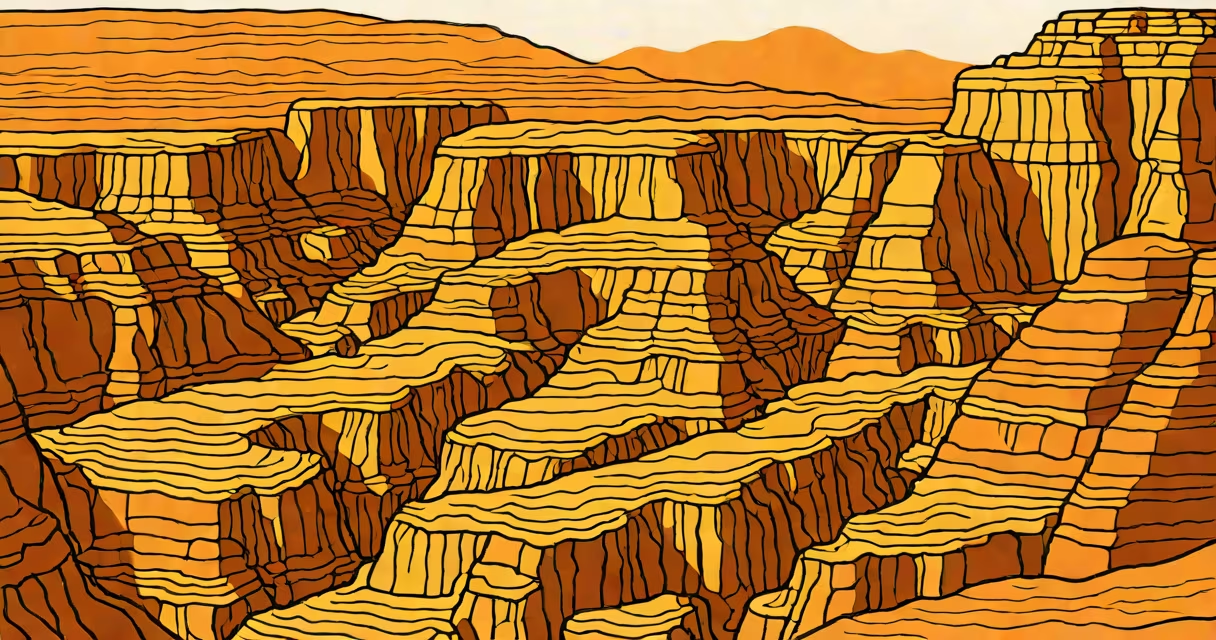
Sedimentary rock forms when mineral and organic particles settle, compact, and cement together over time, often preserving fossils and recording Earth's history in layered sequences. These rocks cover 75% of Earth's surface and include common types like sandstone, shale, and limestone.
Sedimentary rock originates from weathered fragments of older rocks, biological material, or chemical precipitates. Water, wind, or ice transport these materials to basins such as lakes, oceans, or deserts. Once deposited, layers accumulate under pressure, expelling water and binding grains with minerals like calcite or quartz. This process, called lithification, transforms loose sediment into solid rock over thousands to millions of years.
Geologists identify sedimentary rock by its texture, composition, and layering. Horizontal bedding-visible in cliffs and roadcuts-indicates deposition in calm environments. Ripple marks, cross-bedding, and mud cracks provide clues about ancient currents and drying conditions. The presence of fossils, especially marine shells or plant remains, confirms the rock formed in shallow seas or wetlands.
Three stages define sedimentary rock development: erosion, deposition, and lithification. Erosion breaks down existing rock through wind, water, or ice. Particles travel via rivers, glaciers, or air until they reach a low-energy environment where they settle. Deposition occurs when flow slows, allowing heavier grains to sink first-coarse sand at the bottom, fine silt and clay above.
Lithification follows. As more layers pile on, weight squeezes out pore water. Minerals dissolved in groundwater seep into spaces between grains and crystallize, acting as glue. Calcite from seawater binds carbonate sediments into limestone. Quartz-rich sand becomes sandstone when silica precipitates. This transformation turns unconsolidated sediment into durable rock capable of enduring millions of years of exposure.
A real-world example is the Grand Canyon. Its walls expose nearly 400 million years of sedimentary layers. The Coconino Sandstone, a bright white layer near the top, formed from desert dunes during the Permian period. Cross-bedding patterns within it reveal ancient wind directions. Below, the Bright Angel Shale contains fossilized algae and brachiopods, indicating a shallow sea environment.
Sedimentary rocks fall into three categories based on origin: clastic, chemical, and organic. Clastic rocks form from broken pieces of pre-existing rocks. Their grain size determines classification: conglomerate (pebbles), sandstone (sand-sized grains), and shale (clay-sized particles).
| Type | Composition | Formation Environment | Example Location |
|---|---|---|---|
| Shale | Clay and silt | Deep lake or ocean floor | Green River Formation, Wyoming |
| Sandstone | Quartz grains | Rivers, beaches, deserts | Navajo Sandstone, Utah |
| Limestone | Calcium carbonate | Shallow tropical seas | Carlsbad Caverns, New Mexico |
Chemical sedimentary rocks form when dissolved minerals precipitate from water. Evaporites like halite (rock salt) and gypsum develop in arid regions where water evaporates rapidly. Limestone can also form chemically when calcium carbonate crystallizes directly from seawater, especially in warm, clear waters.
Organic sedimentary rocks derive from accumulated plant or animal remains. Coal forms from compressed peat in swamps. Over time, heat and pressure drive off gases and water, leaving carbon-rich material. The Powder River Basin in Wyoming hosts coal deposits formed during the Paleocene epoch, when vast forests covered the region.
Sedimentary rock is often confused with igneous or metamorphic rock. Igneous rocks cool from molten magma-granite or basalt-and lack layering. Metamorphic rocks change under heat and pressure-marble from limestone, slate from shale-but retain textures from their original state. Sedimentary rock uniquely shows horizontal layering and fossil content.
A key distinction: not all layered rocks are sedimentary. Some volcanic ash layers or lava flows can appear stratified but are igneous. True sedimentary layers form from transported material, not cooling magma. For example, the Columbia River Basalt Group in Washington State consists of thick lava flows stacked like layers, but they are igneous, not sedimentary.
Another misconception is that sedimentary rock forms quickly. While individual layers may deposit in days or years, full lithification takes hundreds to thousands of years. A study published in *Geology* (2018) measured compaction rates in modern lake sediments and found that complete consolidation into rock requires at least 10,000 years under typical conditions.
Sedimentary rock is the primary archive of life on Earth. Fossils form when organisms are buried rapidly by sediment, preventing decay. Soft tissues rarely survive, but hard parts like bones, shells, and teeth do. The Burgess Shale in British Columbia contains exquisitely preserved soft-bodied creatures from the Cambrian period, including early arthropods and worms.
Each layer represents a snapshot of past environments. The Mazon Creek fossil beds in Illinois preserve plants, insects, and fish from the Carboniferous period. These fossils formed in a river delta where rapid burial by fine sediment created ideal conditions for preservation. Thousands of specimens have been recovered, offering insights into ancient ecosystems.
I once examined a sample of shale from the Green River Formation during a field trip. Under magnification, I saw tiny diatoms-microscopic algae-frozen in place. Their cell walls were preserved in silica, a rare detail. This specimen, dated to around 50 million years ago, showed how chemical processes in ancient lakes contributed to rock formation.
Sedimentary rock records Earth's history through layers, fossils, and mineral composition. It forms slowly, often over tens of thousands of years, and reveals environmental changes across geological time. Understanding it helps decode climate shifts, extinction events, and the evolution of life.