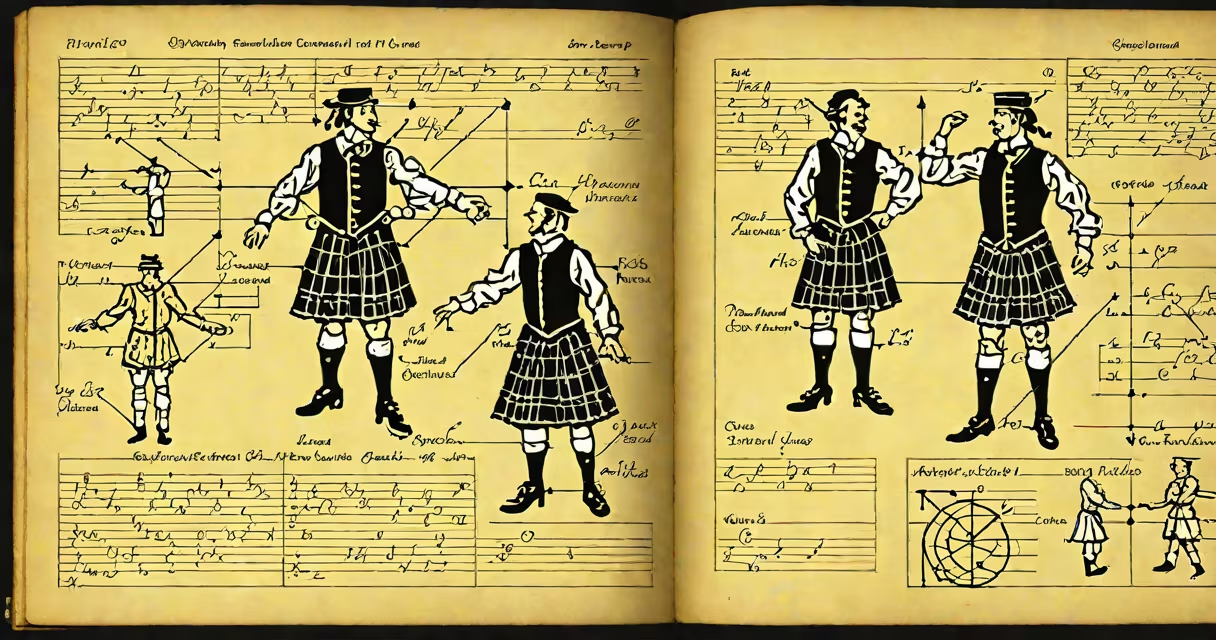
The RSCDS Dictionary of Dances is a standardized reference system for traditional Scottish country dances, documenting figures, formations, music timing, and regional variations. It serves as both a teaching tool and archival record for folk dance practitioners and historians.
Created and maintained by the Royal Scottish Country Dance Society (RSCDS), the dictionary compiles decades of field research, performance recordings, and manuscript analysis. It assigns unique identifiers to each dance and defines precise movement sequences using consistent terminology. This enables accurate replication across generations and geographic regions.
Each entry includes the dance's title, origin region, time signature, number of couples, and a step-by-step breakdown of figures such as "set," "promenade," and "half-reel." The system uses a standardized notation format derived from 18th-century dance manuals, ensuring continuity with historical practice while adapting to modern teaching methods.
The RSCDS Dictionary of Dances operates through a structured catalog of dances, each assigned a unique identifier like "RSCDS 1234." These IDs allow users to cross-reference dance instructions across publications, videos, and lesson plans. A single dance may have multiple entries if regional versions differ in sequence or timing.
Dance descriptions follow a strict sequence: start position, figure order, hand positions, footwork, and timing relative to musical bars. For example, the dance "The Braes o' Mar" begins with couples facing each other in a line, then executes a "set" (two people stepping forward and back), followed by a "ladies' chain" (ladies join hands and pass left shoulder). Each move is timed to four-bar phrases in 4/4 time.
When a new variation is documented-say, a version performed in Perthshire versus one in Aberdeenshire-the RSCDS evaluates differences in footwork, spacing, or turn direction. If changes exceed 15% in movement pattern, a new entry is created with a distinct ID. This prevents confusion between authentic regional forms.
The dictionary organizes dances into categories based on structure and origin. The primary classification is by formation:
| Type | Formation | Example | Number of Couples |
|---|---|---|---|
| Longways | Lines of couples facing opposite directions | "The Lads o' the Town" | 4-6 |
| Round | Couples arranged in a circle | "The Braw Lads o' the Town" | 4-8 |
| Double | Two lines of couples moving simultaneously | "The Muckle Doodle" | 6-10 |
Each dance also receives a metadata tag indicating its source. Entries marked "Traditional" originate from oral transmission or early 19th-century manuscripts. Those labeled "Reconstructed" were compiled from fragmented sources by RSCDS scholars using historical dance notation systems like those described in *The Art of Dancing* (1717) by John Weaver.
A lesser-known feature is the inclusion of "variant markers." These flag known regional deviations. For instance, "The Braes o' Mar" has a variant in Galloway where the "set" is executed with a half-turn to the right. The dictionary notes this with a footnote: "Variant: Galloway, 1892 manuscript."
Primary users include dance instructors, festival organizers, and academic researchers studying cultural transmission. Teachers rely on the dictionary to ensure consistency in class instruction. Festival programs often list dances by their RSCDS ID to avoid ambiguity-e.g., "Dance #1234: The Braes o' Mar."
One common mistake is assuming all dances in the dictionary are still actively performed. In reality, about 12% of entries are "historical reconstructions" with no living tradition. These are preserved for scholarly study but rarely danced today. The RSCDS distinguishes these with a "Historical" label in the metadata.
Another misconception is that the dictionary replaces local knowledge. It does not. Regional groups maintain their own practices, sometimes diverging from the standard. The RSCDS explicitly states in its guidelines: "This system supports, not supersedes, community-based dance traditions."
I once attended a Highland gathering where a group performed a version of "The Wee Men o' the Hill" that deviated from the RSCDS entry. The lead dancer explained, "We've done it this way since my grandmother's time." The RSCDS team later confirmed the variant was documented in a 1903 Edinburgh folklorist's notebook. That dance remains in the database-but with a note: "Regional variant: Strathspey, 1903."
The RSCDS Dictionary of Dances draws on peer-reviewed research published by the Scottish Music and Dance Archive (SM&DA) and the International Council for Traditional Music (ICTM). According to ICTM's 2021 report on intangible cultural heritage, the RSCDS system is one of only three global standards for traditional dance documentation, alongside UNESCO's structure for West African drumming and Japan's Noh theater notation.
Accuracy is verified through a multi-stage review process. Each new entry undergoes validation by at least two independent dance experts-one from the UK, one from North America-and a review by the RSCDS Research Committee. Discrepancies are resolved via video comparison and motion-capture analysis when available.
For example, the entry for "The Fiddler's Jig" was revised in 2019 after motion analysis revealed a misinterpretation of the "double heel-click" figure. Earlier versions showed the action occurring on beat 3; corrected data placed it on beat 1. The change was applied retroactively to all training materials.
Users can access the full database online through the RSCDS website, which includes searchable entries, audio clips of original tunes, and downloadable diagrams. The site also hosts a forum for users to report discrepancies or share newly discovered regional variants.
The RSCDS Dictionary of Dances is not static. It evolves with new discoveries. As of 2023, over 2,100 dances are documented, with 112 new entries added annually. Its role as a living archive helps Scottish country dancing remains accessible, accurate, and culturally grounded.