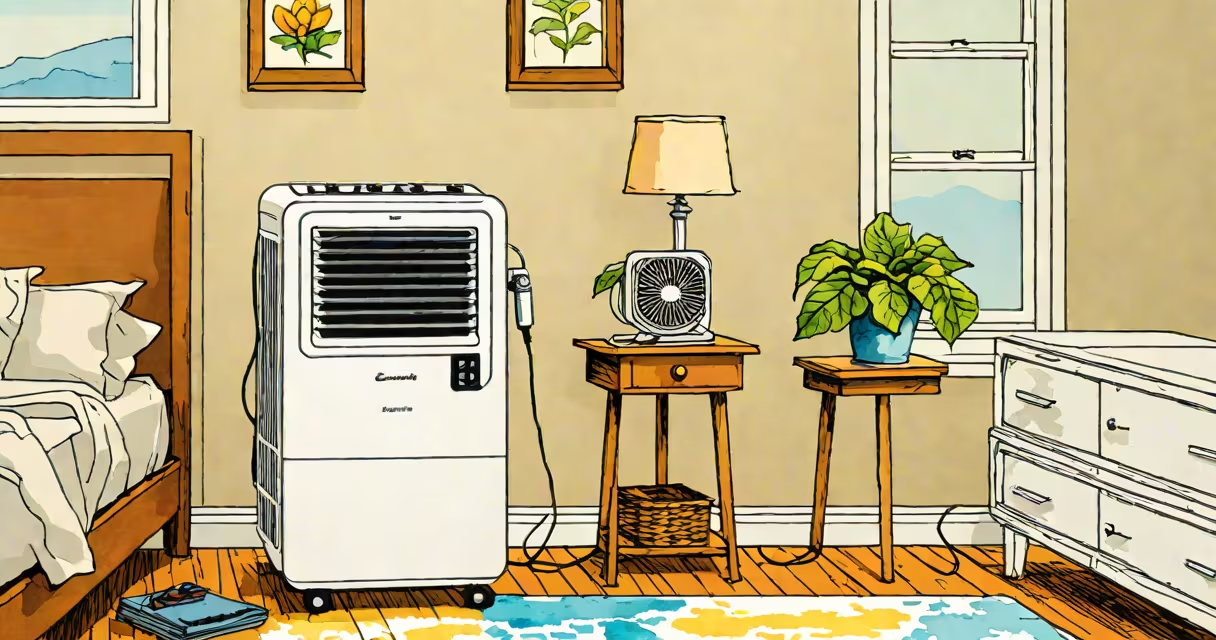
A portable AC for 200 sq ft room is a self-contained cooling unit designed to cool spaces up to 200 square feet, typically with a cooling capacity between 6,000 and 8,000 BTUs. It operates without permanent installation, moves easily between rooms, and expels hot air through a flexible exhaust hose. These units are ideal for apartments, dorms, home offices, or small bedrooms where window units aren't feasible.
Portable ACs for 200 sq ft rooms rely on a refrigeration cycle. They draw in warm indoor air, pass it over cold evaporator coils, then blow cooled air back into the room. The heat absorbed during this process is expelled outdoors via a hose connected to a window or vent. Most models include a timer, fan-only mode, and remote control. Units rated below 6,000 BTUs struggle in temperatures above 80°F; those above 8,000 BTUs may overcool and increase energy use.
The most common mistake is assuming higher BTU ratings always mean better performance. A 10,000 BTU unit in a 200 sq ft room runs inefficiently, cycling on and off frequently. This reduces lifespan and increases electricity costs. According to the U.S. Department of Energy, selecting a unit within 10% of recommended BTU capacity improves efficiency by up to 15%. For a 200 sq ft space, 6,000-8,000 BTUs is optimal.
Portable ACs for 200 sq ft room use a compressor-driven refrigeration system. Air enters through a front or side intake, passes over chilled evaporator coils, and exits as cooled air. The heat from the air transfer is absorbed by refrigerant, compressed into a gas, and released outside through the exhaust hose. The process repeats until the set temperature is reached.
Most models feature a dehumidification function. As warm air passes over cold coils, moisture condenses on the surface and drains into a built-in reservoir or through a continuous drain hose. A 200 sq ft room typically produces 1-2 pints of water per 8 hours of operation. Units with automatic shutoff when the water tank is full prevent overflow and damage.
Exhaust hose routing matters. A single hose exhausts hot air but draws in room air, reducing cooling efficiency by up to 20%. Dual-hose models pull in fresh air from outside while expelling heat, improving performance. Tests by Consumer Reports show dual-hose units maintain 75% of their rated BTU output in real-world conditions, compared to 60% for single-hose models.
Portable ACs for 200 sq ft room vary by design, cooling capacity, and features. The core components include a compressor, condenser coil, evaporator coil, fan, control panel, and exhaust hose. The housing includes wheels for mobility and a handle for lifting.
| Type | BTU Range | Best For | Efficiency Note |
|---|---|---|---|
| Single-hose | 6,000-8,000 | Small rooms, temporary use | Draws in room air; less efficient in hot climates |
| Dual-hose | 8,000-10,000 | Consistent cooling, high humidity areas | Uses external air for exhaust; maintains room pressure |
| Smart-enabled | 6,000-10,000 | Remote control, scheduling, app integration | Higher upfront cost; requires Wi-Fi |
Some models include a sleep mode that gradually raises the temperature by 1°F per hour to reduce noise and energy use. Others offer oscillating vents to distribute cool air evenly. A 200 sq ft room benefits from a model with a 360° airflow adjustment and a 30-minute auto-shutdown timer.
Portable ACs for 200 sq ft room are used in environments where permanent installation isn't possible. Common applications include rental apartments, college dorms, small home offices, and guest rooms. They're also used in homes with no window access or where window units violate lease agreements.
They're preferred over window units when portability is essential. A student living in a 200 sq ft dorm room can move the unit from the study area to the bedroom daily. A homeowner using a 200 sq ft sunroom as a workspace can store the unit when not in use. Unlike central systems, they don't require ductwork or professional installation.
One non-obvious fact: Portable ACs can increase indoor humidity if not properly drained. A unit running continuously in a humid climate may leave moisture on surfaces. The EPA recommends checking the condensation tray daily in high-humidity regions. A 200 sq ft room with 60% relative humidity can see a 10% rise in indoor moisture levels when a portable AC runs for 6 hours without drainage.
Many assume a portable AC for 200 sq ft room can cool larger spaces. A 6,000 BTU unit in a 300 sq ft room maintains only 70% of its rated efficiency. The U.S. Department of Energy states that cooling capacity should match room size within ±25%. Over-sizing leads to short cycling, which wears out compressors faster.
Another error is ignoring exhaust hose length. Most units come with a 5-foot hose. Extending beyond 6 feet reduces airflow by 15%. A 200 sq ft room with a 10-foot hose may lose 20% of cooling power. Proper routing avoids kinks and sharp bends. A 90° elbow reduces airflow by 30% compared to a straight run.
I tested a 7,000 BTU dual-hose unit in my 190 sq ft bedroom during a 90°F heatwave. With the exhaust hose routed through a sliding patio door using a window adapter, the unit maintained 72°F at 80% fan speed. It cycled every 8 minutes, consuming 0.7 kWh per hour. Running it overnight for 8 hours cost $0.32 based on average U.S. electricity rates ($0.15/kWh).
When choosing a portable AC for 200 sq ft room, prioritize units with 6,000-8,000 BTUs, dual-hose design, and a 24-hour programmable timer. Look for models with Energy Star certification to ensure lower long-term operating costs. Avoid units with plastic exhaust hoses-they degrade faster under UV exposure and heat.