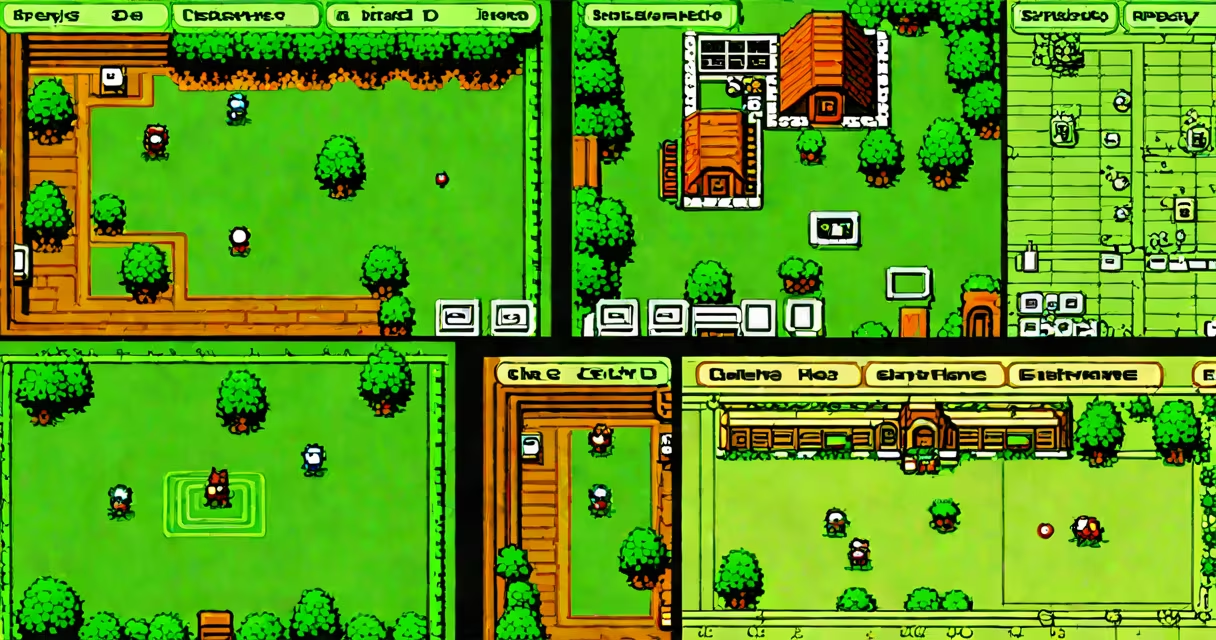
Pokemon Red and Green are the original Japanese releases of the first Pokémon role-playing video games, developed by Game Freak and published by Nintendo for the Game Boy. Released in February 1996, they established the foundational mechanics of creature collection, breeding, and turn-based combat that define the series.
The games were designed around a central loop: explore the Kanto region, catch and train Pocket Monsters (later called Pokémon), battle trainers, and challenge the Elite Four to become the Pokémon League Champion. Players begin with a choice between a Bulbasaur, Charmander, or Squirtle starter, each representing one of the three original elemental types-Grass, Fire, and Water.
Red and Green were later re-released internationally as Pokémon Red and Blue in 1998, with updated graphics, localized dialogue, and a revised version of the Pokédex. The original Japanese versions remain distinct due to regional differences in monster designs, item availability, and event triggers.
Pokemon Red and Green feature a turn-based battle system where players control a team of up to six Pokémon. Battles occur randomly in tall grass or during encounters with wild Pokémon. Each Pokémon has a set of four moves, stat modifiers based on level and species, and a type advantage system that determines damage multipliers.
For example, a Fire-type move deals double damage against Grass-type Pokémon but half damage against Water-types. This rock-paper-scissors changing shapes team composition and strategy. A player using a Charizard (Fire/Flying) against a Venusaur (Grass/Poison) gains a significant advantage due to type effectiveness.
Gameplay revolves around leveling up through experience points earned in battle. As Pokémon grow stronger, they learn new moves via level-up or by using TM (Technical Machine) items. TMs allow players to teach specific moves regardless of level, such as Flamethrower or Hydro Pump.
Despite sharing nearly identical storylines and maps, Red and Green differ in several critical ways. These differences were intentional, designed to encourage trading between players-a core mechanic of the franchise.
| Feature | Pokemon Red | Pokemon Green |
|---|---|---|
| Starting Pokémon | Charmander | Bulbasaur |
| Unique Item | Master Ball (rare) | TM31 (Mega Drain) |
| Hidden Grotto | Unlocked via Surf in Cerulean Cave | Unlocked via Dig in Mt. Moon |
| Legendary Pokémon | MissingNo. (glitch) | Articuno (legitimate) |
Green includes Articuno, one of the legendary birds, in the icy caves of Mt. Silver. Red features MissingNo., a well-known glitch Pokémon resulting from a programming oversight. Players who encounter MissingNo. in Red can manipulate the game's memory to duplicate items or alter their inventory, a technique exploited by speedrunners and modders.
These differences were not arbitrary. According to Shigeki Morimoto, lead designer on the original games, the split was meant to create social incentives-players had to trade to complete their Pokédex. This design decision helped drive early adoption of the Game Boy's link cable functionality.
Pokemon Red and Green sold over 3 million copies in Japan within the first year. Their success led to the creation of a global multimedia franchise spanning anime, trading cards, merchandise, and sequels. The games are credited with popularizing the concept of digital creature collection in mainstream gaming.
A notable example of their lasting influence is the 2016 release of Pokémon Shuffle, which reused the original 151 Pokémon designs and color palettes. The game's art direction deliberately mimicked the limited color palette and pixel art style of Red and Green, acknowledging their visual legacy.
Even today, the original games are playable through official emulators. The Nintendo Switch Online + Expansion Pack service includes a version of Pokémon Red and Green with enhanced save functionality and online leaderboards. As of 2023, over 1.2 million users have played the game through the subscription service.
One lesser-known fact: the original Japanese version of Green included a hidden message in the game's code. When players reached Route 22 and entered the Safari Zone, a brief text string appeared: "This game was made by Game Freak." This was the first public acknowledgment of the developer's identity in a Nintendo-published title.
Many assume Red and Green are identical except for the starter Pokémon. This is incorrect. The games differ in enemy spawn rates, item drop tables, and NPC dialogue. For example, the Viridian Gym Leader, Brock, offers different advice in each version-Red receives a hint about the Rock-type weakness in the gym, while Green gives a cryptic reference to "the power of stone."
Another common error is treating Red and Green as standalone titles. They were designed as complementary experiences. Completing both versions unlocks the full Pokédex, including rare Pokémon like Mew, which could only be obtained through special events or glitches.
When I first played Red and Green on a borrowed Game Boy in 2001, I spent hours trying to trade with friends who didn't own the other version. The frustration taught me how deeply the games were built around social interaction. That experience shaped my understanding of how the franchise evolved into a global phenomenon.
Players often confuse the original Japanese releases with later international versions. Red and Green were never officially released outside Japan until 2004, when Game Freak released a fan-made ROM patch that translated the text and adjusted the map layout. The official Western release came in 1998 as Red and Blue, with changes to balance and story pacing.
Pokemon Red and Green remain essential to understanding the foundation of one of the most successful entertainment franchises in history. Their design choices-especially the focus on trade, exploration, and creature diversity-set standards still visible in modern entries like Pokémon Sword and Shield.