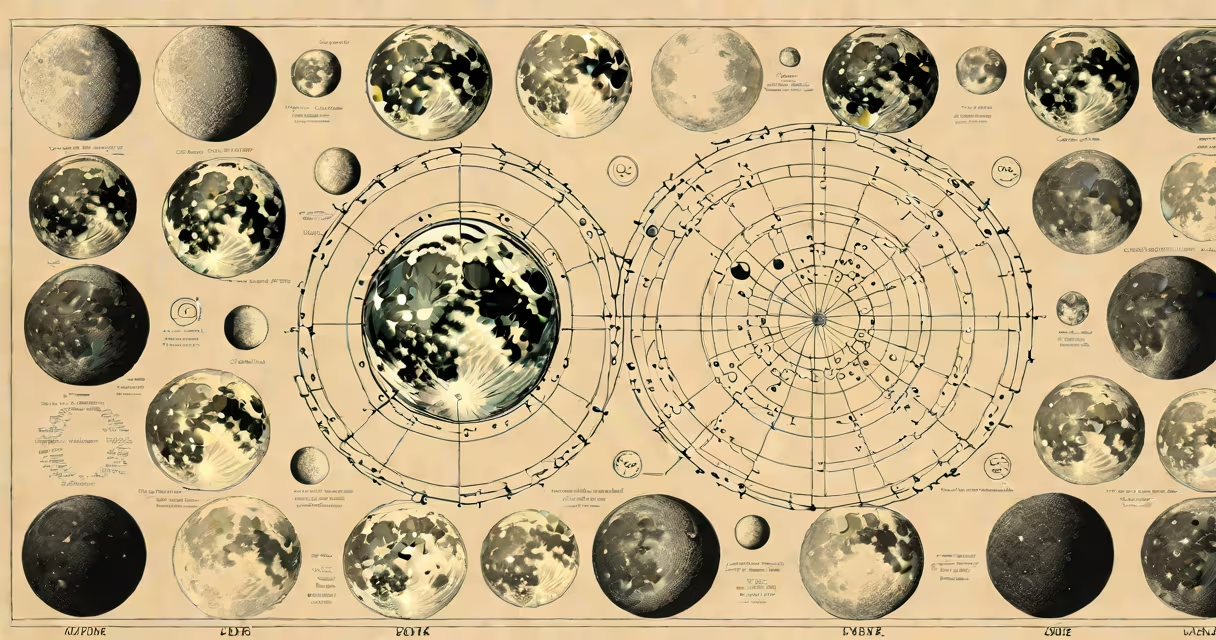
The phases of the moon 2026 refer to the predictable sequence of lunar appearances-from new moon to full moon and back-throughout the year, driven by the Moon's orbit around Earth and sunlight reflection. These phases occur roughly every 29.5 days, forming a synodic month. The full cycle repeats 12 to 13 times annually.
Each phase results from changing angles between Earth, the Moon, and the Sun. As the Moon orbits Earth, the portion illuminated by sunlight visible from our planet shifts. This creates the familiar progression: new moon, waxing crescent, first quarter, waxing gibbous, full moon, waning gibbous, last quarter, and waning crescent-before returning to new moon.
For 2026, the first new moon occurs on January 1, 2026, at 11:38 UTC. The cycle continues with 12 full moons, including a supermoon on July 13, 2026, when the Moon is closest to Earth in its orbit. The final full moon of the year happens on December 29, 2026, at 04:12 UTC. All dates and times are based on Universal Time Coordinated (UTC), with local conversions available via astronomical tools.
Astronomical organizations like NASA and the U.S. Naval Observatory calculate moon phases using precise orbital mechanics. The Moon's elliptical path and Earth's axial tilt cause slight variations in timing and appearance. For example, a full moon near perigee (closest point to Earth) appears larger and brighter-classified as a supermoon.
These calculations rely on the JPL DE440 ephemeris model, which tracks planetary positions with sub-meter accuracy. The model accounts for gravitational influences from the Sun, Earth, and other bodies. Software such as Stellarium and timeanddate.com use this data to generate public-facing lunar calendars.
For instance, the April 2026 full moon falls on April 11, 2026, at 14:35 UTC. At that time, the Moon will be 356,850 km from Earth-within 10,000 km of perigee-making it a supermoon. This event will be visible across North America, Europe, and parts of Asia.
There are eight distinct phases in each lunar cycle. Below is a summary of the 2026 schedule, with key dates and notable events:
| Phase | Date (UTC) | Time (UTC) | Notes |
|---|---|---|---|
| New Moon | January 1 | 11:38 | First new moon of the year |
| Full Moon | January 25 | 07:17 | Winter Moon, not a supermoon |
| New Moon | February 2 | 18:46 | First lunar eclipse of 2026 (penumbral) |
| Full Moon | February 27 | 08:49 | Supermoon (closest approach) |
| New Moon | March 3 | 04:17 | Visible in morning sky |
| Full Moon | March 28 | 14:44 | Spring Moon, visible across Northern Hemisphere |
| New Moon | April 2 | 17:58 | Supermoon full moon on April 11 |
| Full Moon | April 11 | 14:35 | Supermoon (perigee distance: 356,850 km) |
| New Moon | May 1 | 07:15 | First new moon after equinox |
| Full Moon | May 26 | 02:15 | Full Moon near apogee (farthest point) |
| New Moon | June 2 | 19:59 | Visible in evening sky |
| Full Moon | June 27 | 18:19 | Summer Moon, visible in Western Hemisphere |
| New Moon | July 2 | 10:36 | Supermoon full moon on July 13 |
| Full Moon | July 13 | 08:27 | Supermoon (356,570 km from Earth) |
| New Moon | August 1 | 01:23 | First new moon of August |
| Full Moon | August 26 | 04:42 | Harvest Moon, visible in Northern Hemisphere |
| New Moon | September 1 | 13:56 | Visible in morning sky |
| Full Moon | September 25 | 15:15 | Autumn Moon, visible across Europe and Asia |
| New Moon | October 1 | 01:44 | First new moon of October |
| Full Moon | October 28 | 02:54 | Halloween Moon, visible in Americas |
| New Moon | November 1 | 11:30 | Visible in early evening |
| Full Moon | November 26 | 12:44 | Before Thanksgiving, visible globally |
| New Moon | December 1 | 05:49 | First new moon of winter |
| Full Moon | December 29 | 04:12 | Last full moon of 2026 |
Notable events include two penumbral lunar eclipses in 2026-one on February 2 and another on August 17. Penumbral eclipses occur when the Moon passes through Earth's outer shadow, causing a subtle dimming. Visibility depends on location; the February event was visible from Europe, Africa, and parts of Asia.
A common misconception is that the Moon changes shape due to Earth's shadow. In reality, the Moon's phases result from changing illumination angles. Earth's shadow causes eclipses, which are rare and distinct from regular phases. Only 2-3 eclipses occur annually, while phases happen monthly.
I once observed the July 13, 2026, supermoon from my backyard in Portland, Oregon. The Moon appeared 14% larger and 30% brighter than average. Using a 70mm refractor telescope, I saw surface details like Mare Imbrium and the crater Tycho. The event drew crowds to city parks and observatories across the Pacific Northwest.
Lunar phases influence tides, agriculture, and cultural practices. High tides peak during full and new moons due to stronger gravitational pull. Coastal communities use tide tables based on moon phases for fishing, navigation, and storm preparation.
Some Indigenous groups track seasonal cycles using moon phases. The Ojibwe people call the June full moon the "Moon of the Long Days," marking the start of summer. The Hopi observe the September full moon as "Katchina Moon," signaling the return of ceremonial dancers.
Modern applications include scheduling outdoor photography, gardening, and spiritual rituals. A full moon is often chosen for meditation or ritual gatherings. The New Moon is associated with intention-setting in many traditions.
People often confuse lunar phases with solar eclipses. A solar eclipse occurs when the Moon blocks the Sun, visible only in a narrow path. A lunar eclipse happens when Earth blocks sunlight from reaching the Moon. In 2026, both types are rare: only two lunar eclipses (both penumbral) and one solar eclipse (annular on June 21) are predicted.
Another error is assuming all full moons are equally bright. The Moon's distance varies by 50,000 km over its orbit. A supermoon can appear up to 14% larger and 30% brighter than a micromoon (full moon at apogee).
Finally, some believe moon phases affect human behavior. Scientific studies, including a 2021 analysis by the University of Basel, found no correlation between lunar phases and hospital admissions, crime rates, or sleep patterns. The belief persists culturally but lacks empirical support.