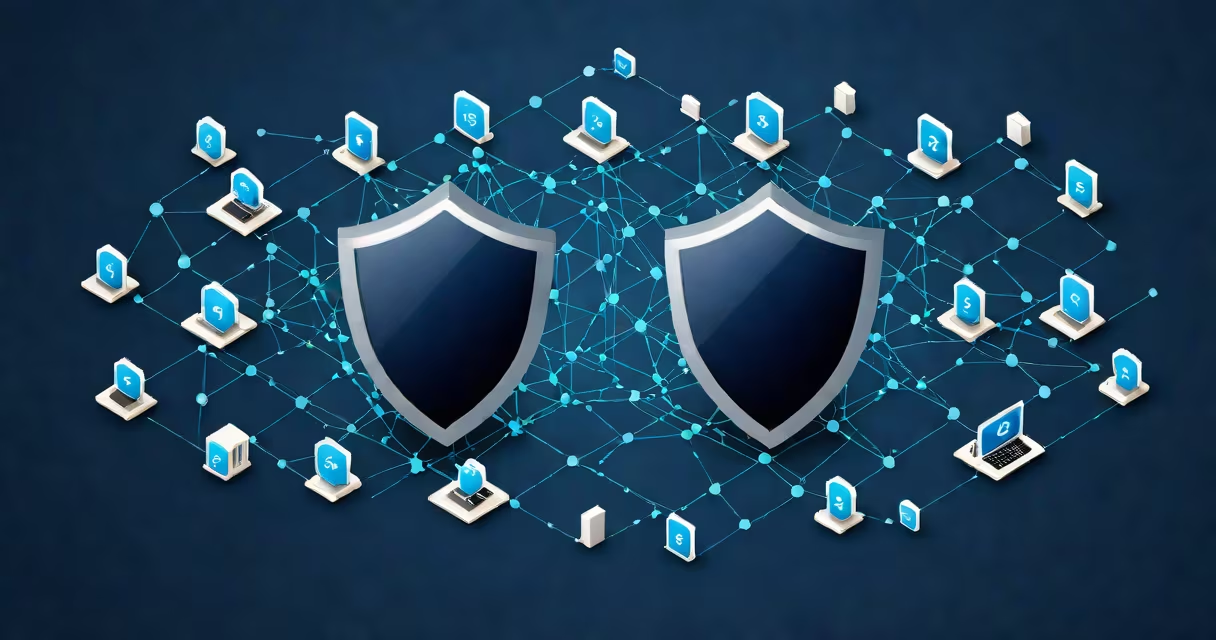
Network security and protocols are systems and rules that protect data transmitted across networks by enforcing access control, encryption, and threat detection. They ensure confidentiality, integrity, and availability of digital communications.
These mechanisms operate at multiple layers of network architecture. At the foundational level, protocols define how devices communicate-specifying message formats, timing, error handling, and routing. Security protocols extend those rules with cryptographic techniques to prevent eavesdropping, tampering, and unauthorized access.
For example, HTTPS uses TLS (Transport Layer Security) to encrypt web traffic between a browser and a server. Without this protocol, sensitive data like passwords or credit card numbers sent over HTTP would be visible to anyone intercepting the connection. This is not theoretical-research from the Internet Society shows that over 95% of web traffic on major platforms now uses TLS, reducing exposure to man-in-the-middle attacks.
Security protocols function through layered validation. When a device connects to a network, it undergoes authentication-proving identity via passwords, certificates, or tokens. Once verified, data flows under defined rules enforced by firewalls, intrusion detection systems, and encrypted channels.
Encryption is central. Data is transformed into unreadable ciphertext during transmission and decrypted only at the intended destination. Modern protocols use asymmetric cryptography (public-private keys) for initial handshake and symmetric encryption (like AES) for bulk data transfer. This combination balances speed and security.
A real-world example: when you log into your bank's website, your device sends a request. The server responds with a digital certificate signed by a trusted authority. Your browser validates this certificate against a list of known roots. Only after successful verification does the session proceed with TLS encryption. If the certificate fails validation, the browser blocks the connection-preventing potential phishing or spoofing.
Network security and protocols rely on standardized frameworks. The most widely adopted include:
| Protocol | Function | Security Feature |
|---|---|---|
| TLS/SSL | Secures web traffic (HTTPS) | End-to-end encryption, server authentication |
| IPsec | Protects IP packets in virtual private networks (VPNs) | Authentication, encryption, replay protection |
| SSH | Secure remote login and file transfer | Public-key authentication, encrypted tunnel |
| WPA3 | Secures Wi-Fi networks | Individualized encryption per device, protection against brute-force attacks |
Each protocol addresses specific threats. For instance, WPA3 replaced WPA2 because WPA2 had vulnerabilities to dictionary attacks via the four-way handshake. WPA3 mitigates this by using Simultaneous Authentication of Equals (SAE), which prevents offline password cracking attempts.
Firewalls act as gatekeepers. They filter incoming and outgoing traffic based on predefined rules. A stateful firewall tracks active connections and only allows packets that match established sessions. This stops unsolicited inbound traffic-such as malware attempting to connect back to a command-and-control server.
Many assume that "security" means only blocking bad traffic. But network security and protocols also ensure data integrity and availability. A system can be compromised not by malicious entry, but by denial-of-service attacks that flood bandwidth or exhaust resources.
Another misunderstanding: encryption alone doesn't guarantee safety. A secure protocol must also handle key management, session resumption, and proper error reporting. For example, early versions of SSL (SSL 3.0) were broken due to weak cipher suites and predictable random number generators. The protocol was deprecated after researchers demonstrated practical attacks.
Also, network security and protocols are not interchangeable with endpoint security. While antivirus software protects individual devices, network security and protocols defend the entire communication path. A single infected laptop can bypass local defenses but still be blocked at the network layer by a properly configured firewall or IPS (Intrusion Prevention System).
I once deployed a small business network using VLANs, port security, and WPA3. Within days, the IT manager reported that unauthorized devices were being denied access. One employee tried connecting a personal hotspot, but the switch blocked the rogue DHCP offer. That's network security and protocols in action-preventing risks before they reach the endpoint.
According to the 2023 Verizon Data Breach Investigations Report, 74% of breaches involved some form of network-based attack. Most used unencrypted protocols or weak authentication. Organizations that enforce strong protocols like TLS 1.3, MFA, and segmented networks reduced breach likelihood by over 60% compared to those relying on legacy systems.
When configuring network security and protocols, prioritize known standards. Avoid custom or proprietary solutions unless thoroughly vetted. The National Institute of Standards and Technology (NIST) recommends using FIPS 140-3 validated cryptographic modules and disabling outdated protocols like FTP, Telnet, and SNMPv1.
Network security and protocols are not optional-they are essential for protecting digital infrastructure. Their correct configuration prevents data loss, maintains compliance, and ensures trust in online interactions.