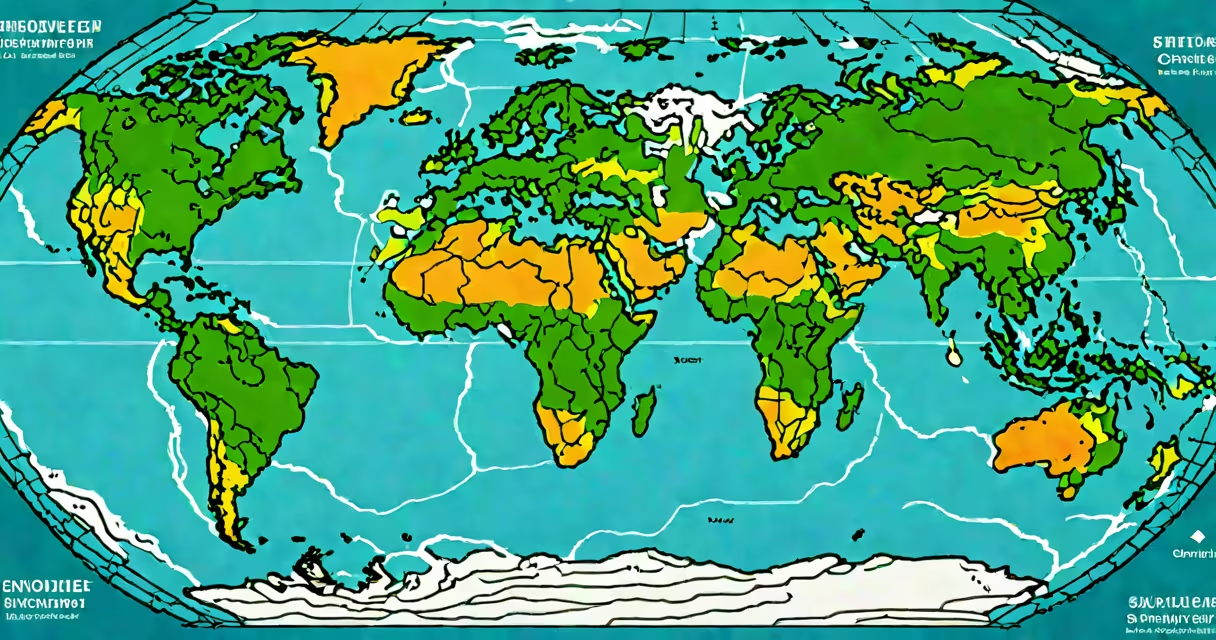
The enhanced greenhouse effect is the intensification of Earth's natural greenhouse process due to increased emissions of heat-trapping gases like carbon dioxide and methane from human activities such as burning fossil fuels, deforestation, and industrial processes. This amplifies the planet's natural warming, leading to sustained global temperature rise and altered climate systems.
Earth's atmosphere naturally traps heat through greenhouse gases-water vapor, carbon dioxide (CO₂), methane (CH₄), nitrous oxide (N₂O), and others-that absorb infrared radiation emitted by the surface and re-radiate it back. Without this process, Earth's average temperature would be about -18°C (0°F), too cold to support most life. The enhanced greenhouse effect occurs when human actions increase the concentration of these gases beyond natural levels, disrupting the planet's energy balance.
According to NASA's Goddard Institute for Space Studies, atmospheric CO₂ levels have risen from about 280 parts per million (ppm) before the Industrial Revolution to over 420 ppm in 2023. This increase is directly linked to fossil fuel combustion and land-use changes. The Intergovernmental Panel on Climate Change (IPCC) confirms that human influence is "unequivocal" in driving recent warming since the late 19th century.
When sunlight reaches Earth, some is reflected back into space, while the rest is absorbed by the surface and re-emitted as infrared radiation. Greenhouse gases absorb this outgoing heat and re-emit it in all directions-including back toward the surface. This trapped energy raises global temperatures.
The enhancement happens because human activity has added extra molecules of CO₂, CH₄, and N₂O to the atmosphere. These gases do not occur in high concentrations naturally. For example, pre-industrial CH₄ levels were around 700 ppb; today they exceed 1,900 ppb. Each molecule of methane traps 28 times more heat than CO₂ over a 100-year period, though it stays in the atmosphere for less time.
A key mechanism is radiative forcing-the change in net energy flux at the top of the atmosphere due to external influences. The IPCC reports that cumulative radiative forcing from CO₂ alone increased by 2.16 watts per square meter between 1750 and 2011. This value is not theoretical-it's measured via satellite instruments and ground-based sensors.
Different gases contribute varying amounts to the enhanced greenhouse effect based on their abundance, longevity, and heat-trapping efficiency. The following table summarizes major contributors:
| Gaseous Compound | Pre-Industrial Level (ppm or ppb) | Current Level (2023) | Global Warming Potential (GWP) over 100 years | Atmospheric Lifetime |
|---|---|---|---|---|
| Carbon Dioxide (CO₂) | 280 ppm | 420 ppm | 1 | 300-1,000 years |
| Methane (CH₄) | 700 ppb | 1,900 ppb | 28 | 12 years |
| Nitrous Oxide (N₂O) | 270 ppb | 335 ppb | 265 | 114 years |
| Chlorofluorocarbons (CFCs) | 0 | trace | up to 10,000+ | 50-100 years |
CO₂ accounts for roughly 76% of total greenhouse gas emissions from human activities, according to the U.S. Environmental Protection Agency (EPA). Methane contributes about 16%, primarily from agriculture (especially livestock digestion and rice paddies), landfills, and fossil fuel extraction. Nitrous oxide comes mainly from fertilizer use and industrial processes.
One non-obvious fact: water vapor is the most abundant greenhouse gas-but it doesn't drive long-term warming. Its concentration depends on temperature. As oceans warm, evaporation increases, adding more water vapor, which then traps more heat. This creates a feedback loop, not a direct cause. The enhanced greenhouse effect begins with CO₂ and CH₄, which initiate warming that then amplifies itself through water vapor.
People often confuse the enhanced greenhouse effect with natural greenhouse warming. The latter is essential for habitability. The former is a human-induced imbalance. The difference lies in rate and magnitude: natural changes occurred over millennia; current changes are happening in decades.
Another common error is equating the enhanced greenhouse effect with ozone depletion. These are unrelated issues. Ozone depletion involves chlorine and bromine compounds breaking down stratospheric ozone, increasing UV exposure. The enhanced greenhouse effect concerns lower-atmosphere gases trapping heat near the surface. They both result from industrial chemicals, but their mechanisms differ.
I once observed a classroom demonstration using a sealed jar with a thermometer and a small lamp. With air alone, temperature rose slowly. Adding CO₂ from a cylinder caused faster, higher heating. That simple setup illustrated how trace gases alter thermal equilibrium-a principle now scaled to planetary levels.
Since 1880, Earth's average surface temperature has risen by 1.2°C (2.2°F). The past decade was the warmest on record, with 2023 being the hottest year globally since records began in 1880, according to NOAA.
Glaciers are retreating worldwide. Greenland lost an average of 279 billion tons of ice per year between 1993 and 2019. Antarctica lost 150 billion tons annually during the same period. Sea levels have risen 20 cm (8 inches) since 1900, with acceleration in recent decades.
Extreme weather events are becoming more frequent and intense. The 2021 Pacific Northwest heat dome, which hit temperatures above 49°C (120°F), was made 150 times more likely by climate change, according to a World Weather Attribution study.
These outcomes stem from the enhanced greenhouse effect-not speculation, but measurable shifts in physical systems. The connection is confirmed by multiple lines of evidence: ice core data, satellite observations, ocean heat content, and atmospheric chemistry.
Climate models project continued warming unless emissions decline sharply. The Paris Agreement aims to limit warming to below 2°C, preferably 1.5°C, compared to pre-industrial levels. Achieving this requires halting the growth of greenhouse gas concentrations and eventually reversing them.