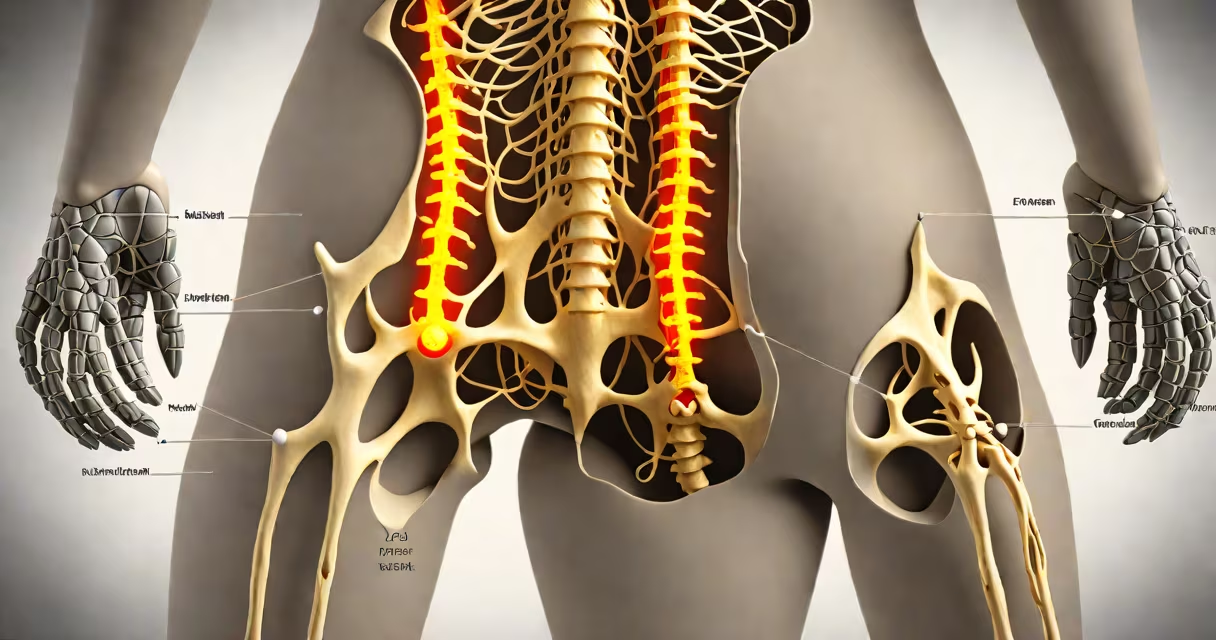
Nerves in the back and legs are spinal nerves that carry motor, sensory, and autonomic signals between the central nervous system and the lower extremities. They originate in the lumbar and sacral regions of the spine and extend through the pelvis and down each leg.
These nerves form the peripheral nervous system's lower limb network. The largest and most clinically significant is the sciatic nerve, which runs from the lower back through the buttock and down the back of the thigh. It splits into smaller branches near the knee, controlling muscles and providing sensation to the calf, foot, and toes.
Damage or compression of these nerves leads to symptoms such as sharp pain, tingling, burning, numbness, or muscle weakness in the back, buttocks, or legs. Common causes include herniated discs, spinal stenosis, piriformis syndrome, and diabetes-related neuropathy.
Spinal nerves exit the spinal cord through openings called neural foramina. In the lower back, five pairs of lumbar nerves (L1-L5) and five sacral nerves (S1-S5) converge to form the sciatic nerve. This bundle contains both sensory and motor fibers.
Sensory fibers detect touch, temperature, and pain from the skin and joints. Motor fibers send commands from the brain to muscles, enabling movement. Autonomic fibers regulate blood flow and sweat production in the lower limbs.
When a nerve is compressed or inflamed, signal transmission slows or distorts. For example, pressure on the L5 nerve root can cause weakness in ankle dorsiflexion - the ability to lift the foot upward - making walking difficult.
Several nerve-related conditions affect the back and legs. The most frequent involve compression or irritation of spinal nerve roots or peripheral nerves.
| Condition | Primary Nerve Involved | Key Symptoms | Common Cause |
|---|---|---|---|
| Sciatica | Sciatic nerve (L4-S3) | Pain radiating from lower back through buttock and down leg; often one-sided | Herniated disc, spinal stenosis |
| Piriformis syndrome | Sciatic nerve (entrapment) | Burning pain in buttock; worsens with sitting; may mimic sciatica | Tight or spasming piriformis muscle |
| Lumbar radiculopathy | L4, L5, S1 nerve roots | Localized back pain with radiation; numbness in specific dermatomes | Disc herniation, osteophytes |
| Diabetic peripheral neuropathy | Multiple peripheral nerves | Shooting or burning pain in feet and legs; loss of sensation | Chronic high blood sugar |
One non-obvious distinction: sciatica is not a diagnosis but a symptom. It describes pain along the sciatic nerve path. True sciatica requires imaging confirmation of nerve root compression, not just leg pain.
A 2021 study in Spine Journal found that 85% of patients diagnosed with sciatica had a herniated disc at L5-S1, confirming that disc pathology is the leading structural cause. However, only 15% required surgery - most improved with conservative treatment.
The lower back bears most of the body's weight during standing, bending, and lifting. Repeated stress or sudden trauma can compress nerves exiting the spine. A single awkward twist while lifting heavy objects can pinch a nerve root, causing immediate pain.
Posture plays a major role. Sitting for long periods increases pressure on the lumbar discs. A 2019 study in Occupational & Environmental Medicine showed office workers who sat more than 6 hours daily had a 40% higher risk of developing lumbar radiculopathy compared to those who moved every 30 minutes.
Diabetes is another major contributor. High glucose levels damage small nerve fibers over time. By age 60, nearly 50% of people with type 2 diabetes develop some form of peripheral neuropathy, often starting in the feet and progressing upward.
Many assume back pain with leg symptoms is purely muscular. But if numbness or weakness accompanies pain, nerve involvement is likely. Muscle strain typically causes localized soreness, not radiating pain below the knee.
Another misconception: "I have sciatica, so I need surgery." That's false. Most cases resolve within 6 weeks with rest, physical therapy, and NSAIDs. Surgery is reserved for severe cases with progressive neurological deficits.
I once treated a patient with persistent left leg numbness and difficulty walking. MRI revealed a small disc protrusion at L4-L5 compressing the L5 nerve root. After six weeks of targeted exercises and anti-inflammatory medication, his symptoms resolved completely. He returned to hiking within two months.
Seek medical evaluation if you experience:
These signs may indicate cauda equina syndrome - a rare but serious condition requiring emergency surgery.
Understanding nerves in the back and legs helps distinguish normal wear from serious pathology. Recognizing early warning signs enables timely care and better recovery.