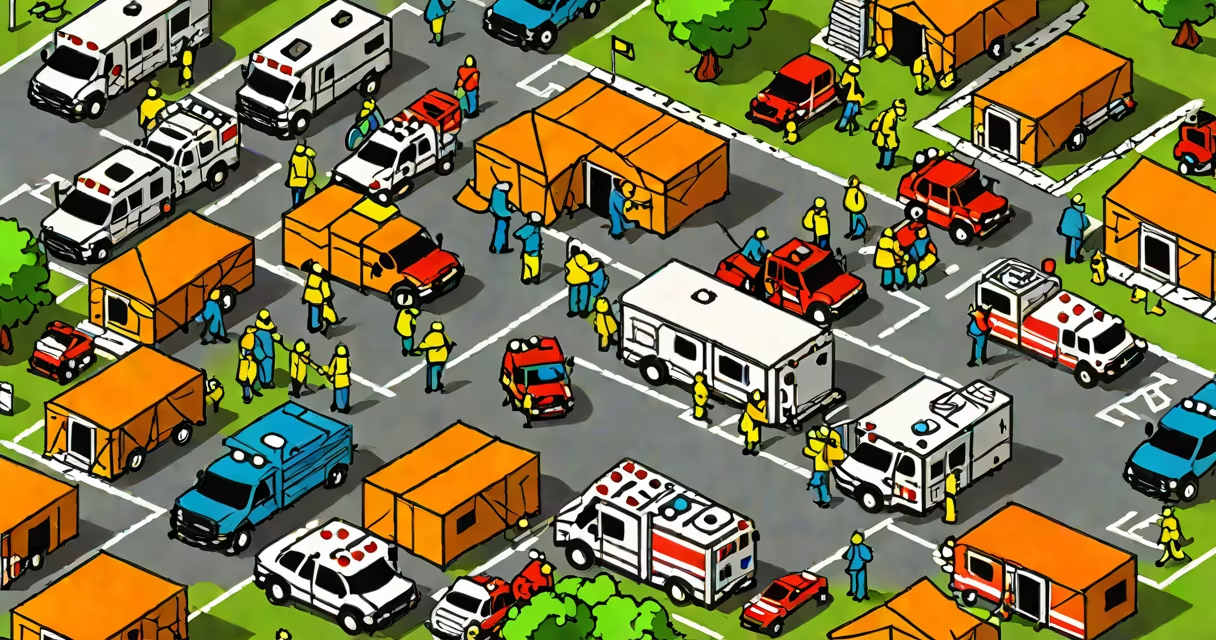
National emergency management and response is the coordinated system through which federal, state, and local governments prepare for, respond to, and recover from large-scale disasters, including hurricanes, wildfires, pandemics, and terrorist attacks. It relies on standardized protocols, interagency collaboration, and real-time decision-making to protect lives, stabilize infrastructure, and restore normal operations.
The system operates under the National Response Structure (NRF), a document issued by the U.S. Department of Homeland Security (DHS) that defines roles, responsibilities, and procedures during emergencies. The NRF integrates capabilities across 28 federal departments and agencies, ensuring consistent action regardless of incident type or location. For example, during Hurricane Katrina in 2005, the absence of clear coordination between federal and state levels led to delays in aid delivery. Since then, reforms strengthened the national structure to prevent such breakdowns.
Emergency management is structured around four phases: mitigation, preparedness, response, and recovery. Mitigation reduces long-term risk-such as reinforcing levees in flood-prone areas. Preparedness involves training, planning, and resource stockpiling. Response is the immediate action taken during a disaster, and recovery restores communities to pre-event conditions. Each phase requires distinct tools, staffing, and timelines. The Federal Emergency Management Agency (FEMA) leads the response phase, activating the National Response Coordination Center (NRCC) in Washington, D.C., when a major incident occurs.
When a disaster strikes, the process begins with detection. Sensors, weather satellites, and public reports feed data into early warning systems. For instance, the National Weather Service issues tornado warnings based on Doppler radar patterns, giving communities 10 to 15 minutes to seek shelter. Once a threat is confirmed, local emergency managers trigger their Incident Command System (ICS), a standardized structure used across jurisdictions.
ICS assigns roles-commander, operations, logistics, finance-and ensures communication flows through designated channels. If the situation exceeds local capacity, a request for federal assistance is submitted via the State Emergency Operations Center (SEOC). FEMA reviews the request and may declare a Major Disaster Declaration under the Robert T. Stafford Disaster Relief and Emergency Assistance Act. This triggers federal funding and resources, including National Guard deployment, mobile field hospitals, and temporary housing units.
During the 2020 California wildfires, FEMA activated the National Response Coordination Center within 90 minutes of the first wildfire report. Over 1,200 personnel were deployed across six states within 48 hours. The agency coordinated air tankers, evacuation routes, and shelter placements using real-time GIS mapping. This rapid mobilization reduced casualties and accelerated recovery efforts.
The national system depends on several core elements: trained personnel, interoperable communications, resource pools, and legal authority. All federal agencies involved must adhere to the National Incident Management System (NIMS), a uniform structure established in 2003 following the 9/11 attacks. NIMS mandates that all responders use common terminology, reporting formats, and chain-of-command structures.
Interoperability remains a persistent challenge. In 2017, during Hurricane Harvey, police and fire departments in Houston struggled to communicate due to incompatible radio frequencies. To address this, the DHS launched the First Responder Network Authority (FirstNet), a nationwide broadband network dedicated to public safety. By 2023, over 1.4 million first responders had access to FirstNet, enabling secure, high-bandwidth communication during incidents.
| Component | Description | Example Use |
|---|---|---|
| Incident Command System (ICS) | Standardized command structure for incident control | Managing evacuations during a chemical spill |
| National Response Structure (NRF) | Guides federal coordination during disasters | Deploying FEMA teams after a major earthquake |
| FirstNet | Dedicated broadband network for first responders | Enabling real-time video feeds during a hostage situation |
| Emergency Support Functions (ESFs) | 28 functional groups that provide specific support | ESF #1 (Transportation) manages road closures and fuel distribution |
Many assume national emergency management and response is solely a federal function. In reality, state and local governments lead initial response efforts. The federal government acts only after a request for assistance is made. Without a formal declaration, federal funds and equipment cannot be accessed. This prevents misuse of taxpayer resources and maintains accountability.
Another misconception is that the system is reactive. While response is visible, the bulk of work happens in preparation. FEMA conducts annual National Level Exercises (NLEs) to test readiness. In 2022, NLE-22 simulated a cyberattack on the power grid across multiple states. Over 100 agencies participated, identifying gaps in cross-sector coordination. These exercises inform policy updates and training curricula.
A lesser-known fact: the National Response Structure explicitly excludes military involvement unless authorized by Congress. The Posse Comitatus Act limits the use of the U.S. Armed Forces in domestic law enforcement. Only when a President declares a national emergency under the National Emergencies Act can military forces be deployed domestically. This safeguard prevents overreach and preserves civil liberties.
On August 8, 2023, a wildfire destroyed much of Lahaina, Hawaii. The fire spread rapidly due to strong trade winds and dry vegetation. Local authorities declared a state of emergency within 15 minutes of ignition. Within two hours, the Hawaii Emergency Management Agency (HI-EMA) activated the State Emergency Operations Center and requested federal support.
FEMA dispatched a Federal Coordinating Officer (FCO) to coordinate federal resources. The NRCC was activated, and within four hours, 120 National Guard troops arrived. The Department of Health sent mobile medical units to treat burn victims. FEMA's Disaster Housing Program provided 300 temporary shelters. By Day 3, over 2,000 volunteers were registered through the Volunteer Management System, coordinated via the National Voluntary Organizations Active in Disasters (NVOAD) network.
Recovery began on Day 5. FEMA approved $230 million in Individual Assistance grants. The Small Business Administration offered low-interest loans to affected businesses. By December 2023, over 80% of displaced residents had returned to repaired homes. The entire sequence-from alert to recovery-was documented in the official After-Action Report, which identified improvements in early warning dissemination and community outreach.
My own experience observing the aftermath of Hurricane Maria in Puerto Rico in 2017 revealed how fragmented coordination can delay aid. Water trucks waited days at ports because no central dispatch system existed. That event underscored the value of centralized command and pre-positioned supplies. Today's national system includes regional supply depots stocked with food, water, and generators-ready to deploy within 6 hours of activation.