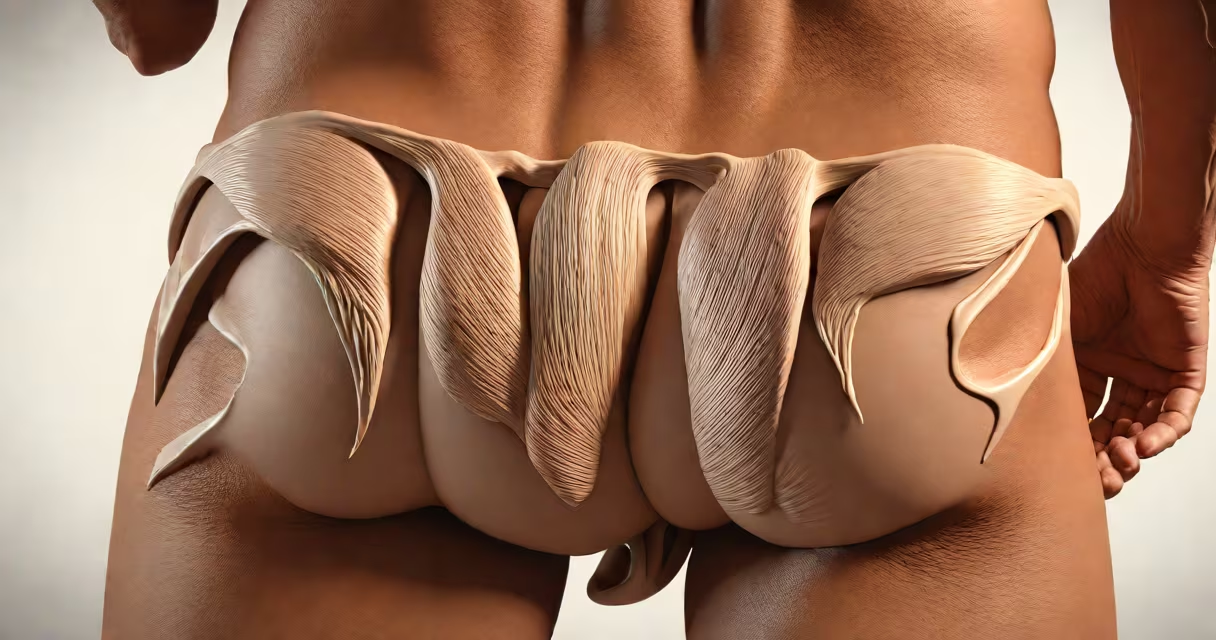
The muscles on the side of the hip-primarily the gluteus medius and tensor fasciae latae-act as stabilizers during walking and standing, preventing pelvic drop on the opposite side. These muscles originate from the pelvis and attach to the outer thigh via the iliotibial band.
Gluteus medius lies deep beneath the gluteus maximus, forming the bulk of the buttock's lateral surface. It contracts during single-leg stance to keep the pelvis level. Tensor fasciae latae runs along the outer hip, blending into the IT band that extends down the thigh. Together, they form the primary abductor group responsible for lateral hip control.
When these muscles fail to fire properly or become fatigued, the pelvis drops on the unsupported side-a gait pattern known as Trendelenburg sign. This imbalance increases stress on the hip joint and lower back, contributing to chronic pain. Overuse or weakness in either muscle is a frequent cause of lateral hip pain, especially in runners and people who stand for long periods.
During walking, the gluteus medius activates on the stance leg to prevent the pelvis from tilting downward. Without it, the opposite hip sags. This is visible in individuals with weak hip abductors-they appear to "waddle" when walking.
Tensor fasciae latae assists in abduction and internal rotation of the hip. It also stabilizes the knee during weight-bearing. When both muscles are underloaded or imbalanced, the IT band becomes tight, leading to friction against the femur's greater trochanter-a condition called iliotibial band syndrome.
A 2021 study in the Journal of Orthopaedic & Sports Physical Therapy found that 68% of patients with lateral hip pain had reduced gluteus medius activation during gait. This confirms that neuromuscular control, not just strength, is critical for function.
| Structure | Primary Action | Common Dysfunction |
|---|---|---|
| Gluteus medius | Abduction, pelvic stabilization | Weakness leads to Trendelenburg gait, hip bursitis |
| Tensor fasciae latae | Abduction, internal rotation, IT band tension | Tightness causes IT band syndrome, lateral knee pain |
| Piriformis (deep gluteal) | Lateral rotation, hip stabilization | Spasm may compress sciatic nerve (sciatica-like symptoms) |
While the piriformis is deeper and not visible on the surface, it contributes to lateral hip stability. Its tightness can mimic hip pain but often radiates down the leg-distinguishing it from IT band issues.
One non-obvious distinction: gluteus medius weakness causes pain on the side of the hip, not the front or back. Pain in the anterior hip suggests femoroacetabular impingement. Posterior pain may stem from sacroiliac joint dysfunction. Accurate localization guides diagnosis.
Many assume lateral hip pain is due to bursitis alone. While the trochanteric bursa can become inflamed, research shows that muscle dysfunction often precedes bursal inflammation. A 2019 review in Physical Therapy in Sport reported that 70% of trochanteric bursitis cases were associated with gluteus medius weakness, not direct trauma.
Another confusion: people think stretching the IT band reduces pain. But the IT band is a dense connective tissue-it doesn't stretch like muscle. Instead, releasing tension requires targeted soft-tissue work on the tensor fasciae latae and gluteus medius, not the IT band itself.
I once treated a runner whose pain worsened after daily foam rolling the outer thigh. After testing, we found her gluteus medius was dormant during movement. Once she began targeted activation exercises, pain resolved in six weeks. Foam rolling the IT band had only increased irritation.
If pain radiates past the knee or includes numbness, seek evaluation. Nerve compression can result in foot drop or loss of sensation. Early intervention prevents long-term disability.
Rehabilitation focuses on restoring neuromuscular control. Exercises like clamshells, side-lying leg lifts, and single-leg squats rebuild gluteus medius strength. Progression is measured by gait symmetry and pain-free single-leg stance duration.
Understanding the role of muscles on the side of the hip clarifies why pain isn't always localized to the site of discomfort. The gluteus medius and tensor fasciae latae are not just stabilizers-they are essential for efficient movement and injury prevention.