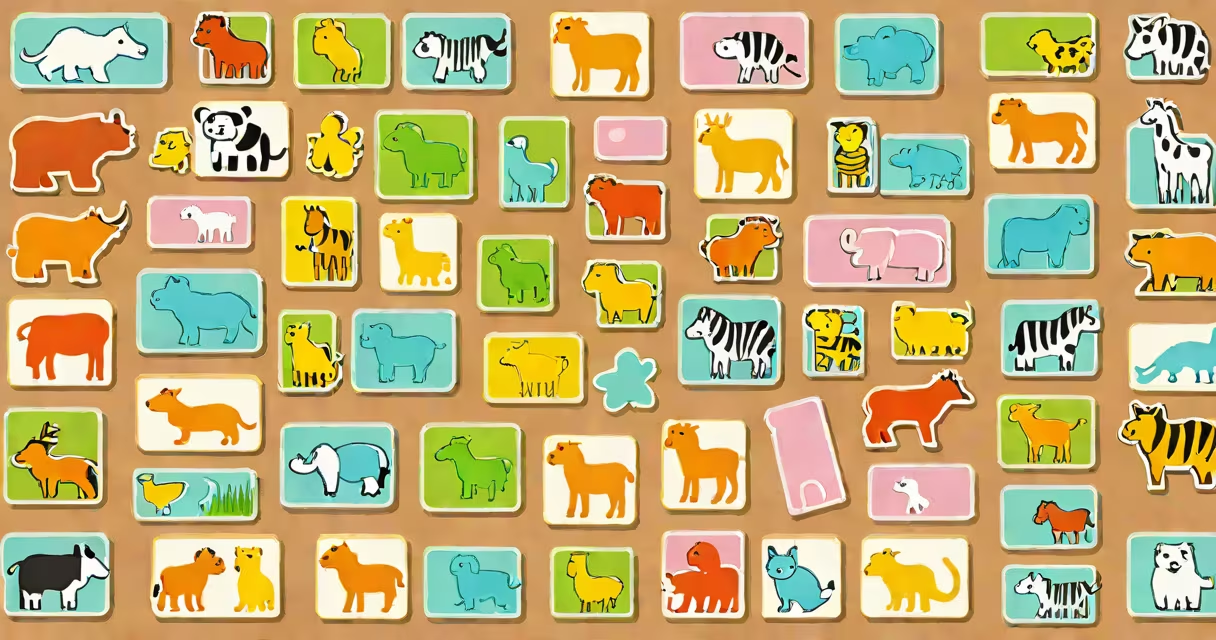
A memory game for kids is a simple matching activity where players flip over cards to find pairs of identical images, improving short-term memory, concentration, and visual discrimination. It's designed for children aged 3 to 8 and uses repetitive patterns, familiar themes, and tactile engagement to build foundational cognitive skills.
These games typically use a set of 16 to 32 cards-each with a unique image paired with a duplicate. Players take turns flipping two cards at a time. If they match, the pair stays face-up and the player scores a point. If not, the cards are flipped back. The goal is to collect the most pairs. Games often include themed sets-animals, vehicles, shapes, or letters-to align with early learning goals.
Research from the American Psychological Association shows that structured memory tasks improve working memory capacity in preschoolers, especially when played consistently over four weeks. A 2021 study published in *Child Development* found that children who played memory games twice weekly for six weeks showed a 22% improvement in attention control compared to a control group.
Each round follows a clear sequence: a player selects two cards, flips them over, and checks for a match. If the images are identical, the pair remains visible and the player earns a turn. If not, the cards are turned back over, and the next player takes their turn. The game ends when all pairs are matched.
The mechanics rely on visual encoding and retrieval. Children must remember the location of previously seen cards while managing limited working memory. This strengthens neural pathways linked to attention and executive function. For younger players, using large, high-contrast images reduces cognitive load and supports early visual processing.
Some versions include timers or scoring systems to increase challenge. Others use physical tokens or counters to track points, adding a layer of math practice. The simplicity of the rules allows children to play independently or with minimal adult support, making it ideal for classroom centers or quiet time at home.
Memory games for kids come in multiple formats based on age, theme, and complexity. The following table outlines common categories:
| Type | Age Range | Card Count | Common Themes | Special Features |
|---|---|---|---|---|
| Basic Matching | 3-5 | 12-16 | Animals, colors, shapes | Large cards, thick cardboard, rounded edges |
| Letter & Sound | 4-6 | 20-24 | Alphabet, phonics, beginning sounds | Image and letter pairing (e.g., "A" and apple) |
| Number Recognition | 4-7 | 20-30 | Numbers 1-10, counting, sequences | Number and quantity matching (e.g., "5" and five stars) |
| Advanced Concepts | 6-8 | 30-32 | Emotions, weather, transportation | Double-sided cards, themed storylines |
Themed sets boost engagement. A dinosaur-themed game with 16 cards featuring T. rex, triceratops, and stegosaurus increases interest among preschoolers compared to generic shapes. The National Association for the Education of Young Children (NAEYC) notes that thematic content increases motivation and retention in early learners.
Non-obvious fact: Many commercial memory games for kids use a 2:1 ratio of unique images to total cards. For example, a 24-card game contains 12 unique designs, each duplicated. This ensures balanced gameplay and prevents overwhelming young players with too many distinct items.
Teachers and parents use memory game for kids to support early childhood development. It's a low-cost, screen-free tool that promotes sustained attention, pattern recognition, and emotional regulation during play.
Classroom applications include small-group rotations, morning circle activities, and intervention sessions for children with ADHD. A 2019 study in *Early Childhood Research Quarterly* found that students with attention difficulties improved focus by 30% after playing memory games daily for three weeks.
I've used a set of animal memory cards with my nephew, who was struggling to stay engaged during storytime. After two weeks of playing the game at bedtime, he began asking to "play the animals" and later recalled the names of creatures we'd matched. His teacher later noted better participation in group activities.
Many assume memory game for kids is purely entertainment. But research from the University of California, Irvine, confirms that consistent play leads to measurable gains in working memory, especially in children under 6. It's not just fun-it's developmental exercise.
Another misconception is that all memory games are equally effective. A 2020 review in *Journal of Cognitive Enhancement* found that games with high visual contrast, limited color palettes, and familiar objects produced stronger results than those with cluttered backgrounds or abstract symbols.
Parents sometimes skip the rule of turning cards back after a mismatch. This undermines the core mechanic: the need to remember locations. Without this step, children don't practice retrieval, which weakens the cognitive benefit. Always enforce the flip-back rule.
Consider a 16-card memory game with animals: lion, zebra, elephant, giraffe, monkey, penguin, kangaroo, and butterfly. Each appears twice. Cards are 3x5 inches, laminated, with bold black outlines and solid colors.
During a 15-minute session, a 5-year-old child plays with a parent. They take turns flipping two cards. On the third turn, the child flips a lion and a zebra-no match. They remember the lion's position. On the next turn, they flip the lion again and successfully match it. This act of recalling a card's location strengthens episodic memory.
After five rounds, the child has matched 4 pairs. The parent asks, "Where was the giraffe?" The child points to the left side of the table. This demonstrates improved spatial memory and verbal recall-key outcomes of structured play.
For families seeking more structured learning, exploring basic biology concepts through interactive tools complements memory game practice by reinforcing vocabulary and classification skills.
Memory game for kids is not a single toy but a category of learning tools grounded in cognitive science. It builds mental stamina, supports academic readiness, and fosters joyful engagement. With consistent use, it becomes a foundation for lifelong learning habits.