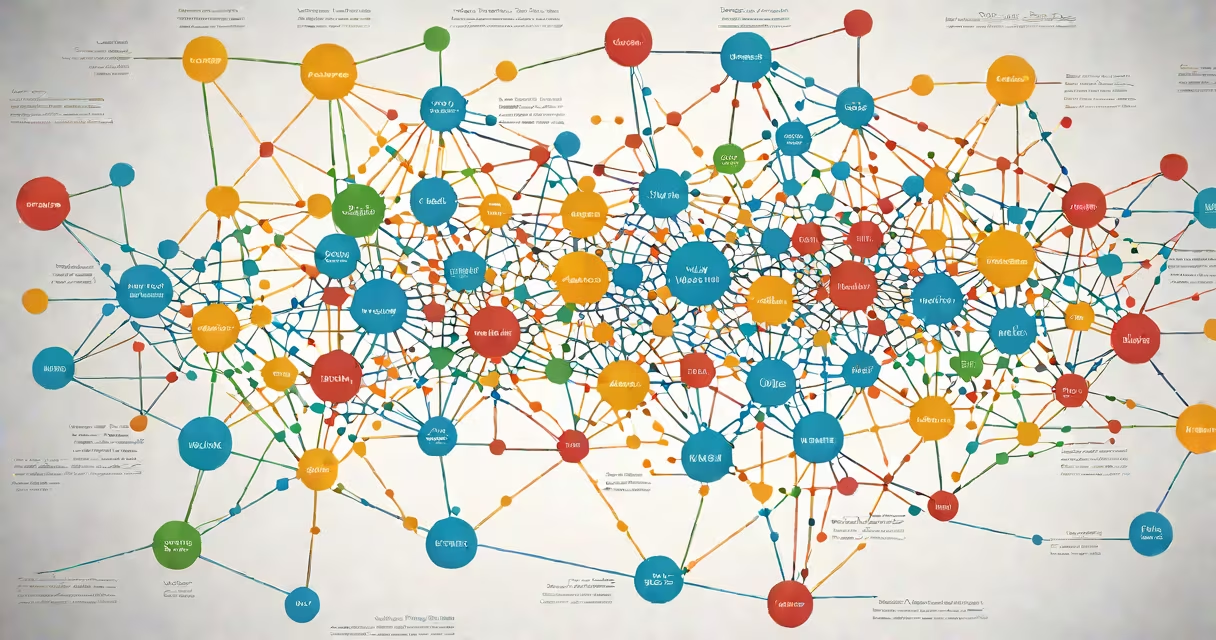
A map of the word is a visual representation of how vocabulary items relate to one another through meaning, usage, and context. It shows clusters of related terms, pathways between concepts, and structural patterns across language. This tool turns abstract linguistic connections into spatial relationships, making it easier to see how words function together in communication.
These maps are built using large collections of real-world language data-such as books, articles, and spoken transcripts-processed by algorithms that detect co-occurrence patterns. Words that frequently appear near each other in texts are assumed to share semantic proximity. For example, "ocean," "wave," "salmon," and "beach" often appear together in travel or nature writing, so they form a tight cluster on a map of the word.
Unlike traditional dictionaries that list words alphabetically or define them in isolation, a map of the word reveals structure. It shows that "dog" is closely linked to "pet," "bark," "leash," and "puppy," but farther from "car" or "computer." These spatial relationships reflect how people actually use language, not just how it's formally defined.
Mapping the word begins with collecting vast amounts of text-millions of sentences from sources like Wikipedia, news archives, and literary corpora. Researchers then apply computational techniques such as word embeddings (e.g., Word2Vec or GloVe) to assign each word a position in a multi-dimensional space based on its surrounding context.
Each word is represented as a point in this space. Words that are semantically similar-like "happy" and "joyful"-end up close together. Words that are used in different contexts-like "bank" (river bank) and "bank" (financial institution)-appear in distinct regions. After this step, dimensionality reduction tools like t-SNE or PCA project the high-dimensional data onto a 2D or 3D layout for human interpretation.
The result is a network where words are nodes and connections represent meaningful associations. Some links are strong (e.g., "sun" and "warm"), others weak (e.g., "sun" and "spoon"). The density of connections indicates how central a term is to a particular domain-"water" appears in many clusters because it relates to health, weather, biology, and recreation.
There are several kinds of maps of the word, each tailored to a specific purpose:
| Type | Focus | Use Case | Example |
|---|---|---|---|
| Thematic Map | Topic-based clusters | Education, research | Words grouped under "climate change": "emissions," "renewable," "melting," "carbon" |
| Lexical Network | Word-to-word relationships | Language learning, AI training | "Run" connects to "sprint," "race," "tired," "shoes," "track" |
| Emotional Valence Map | Positive/negative sentiment | Marketing, mental health analysis | "hope" near "heal," "light," "future"; "fear" near "danger," "dark," "panic" |
These maps are used in education to show students how vocabulary builds around core ideas. A teacher might display a map centered on "energy" to illustrate how "solar," "battery," "power," and "efficiency" interconnect. In cognitive science, researchers use them to study how the brain organizes concepts-showing that similar meanings activate nearby neural regions.
One non-obvious insight: words don't cluster purely by meaning. They also reflect cultural and historical bias. For example, early versions of word embedding models placed "doctor" closer to "man" and "nurse" closer to "woman," reflecting outdated gender roles in training data. Modern models correct for this using fairness-aware algorithms, but the original bias remains visible in older maps.
Many assume a map of the word is a synonym dictionary. It is not. While synonyms may appear close together, the map captures broader conceptual links. "Car" and "vehicle" are near each other, but so are "car" and "traffic," "car" and "repair," and "car" and "insurance." These aren't synonyms-they're associations shaped by real-world experience.
Another misconception: that these maps are static. They are not. As language evolves-through slang, tech terms, or regional dialects-the map shifts. The word "vibe" moved from music culture to general emotional state in less than a decade. A map built in 2010 would place "vibe" near "music" and "cool," while a 2023 version shows it connected to "mood," "energy," and "connection."
Some users expect precise boundaries between clusters. But the map reflects probability, not logic. There's no sharp line between "fruit" and "vegetable" in the map-instead, overlapping zones show that "tomato" appears in both, due to frequent co-occurrence in cooking and nutrition texts.
Consider a map of the word centered on "freedom." The algorithm analyzes millions of sentences from political speeches, literature, and social media. It finds that "freedom" appears most often with words like "rights," "choice," "democracy," "speech," "prison," "oppression," and "justice."
On the map, "freedom" sits at the center of a dense cluster. Nearby, "liberty" and "autonomy" are tightly packed. Further out, "escape" and "runaway" appear-linked by metaphorical use in poetry and protest songs. Words like "control" and "surveillance" lie in a contrasting cluster, showing oppositional meaning.
This pattern reveals something deeper: "freedom" is not a single concept. It has multiple dimensions-political, personal, spiritual-and the map makes those layers visible. A student studying civil rights movements can trace how "freedom" evolved from legal rights to social inclusion by following the shifting connections over time.
I once used a map of the word to analyze tweets during a national election. The word "change" appeared in two distinct areas: one tied to policy ("tax reform," "healthcare," "education"), the other to emotion ("hope," "excitement," "fear"). The separation showed how voters were framing the issue-not just as a platform, but as a psychological shift.
These resources go beyond basic lookup. They reveal how language grows-how a single word can carry dozens of meanings depending on context. A map of the word doesn't just tell you what a word means. It shows you how it lives in the world.