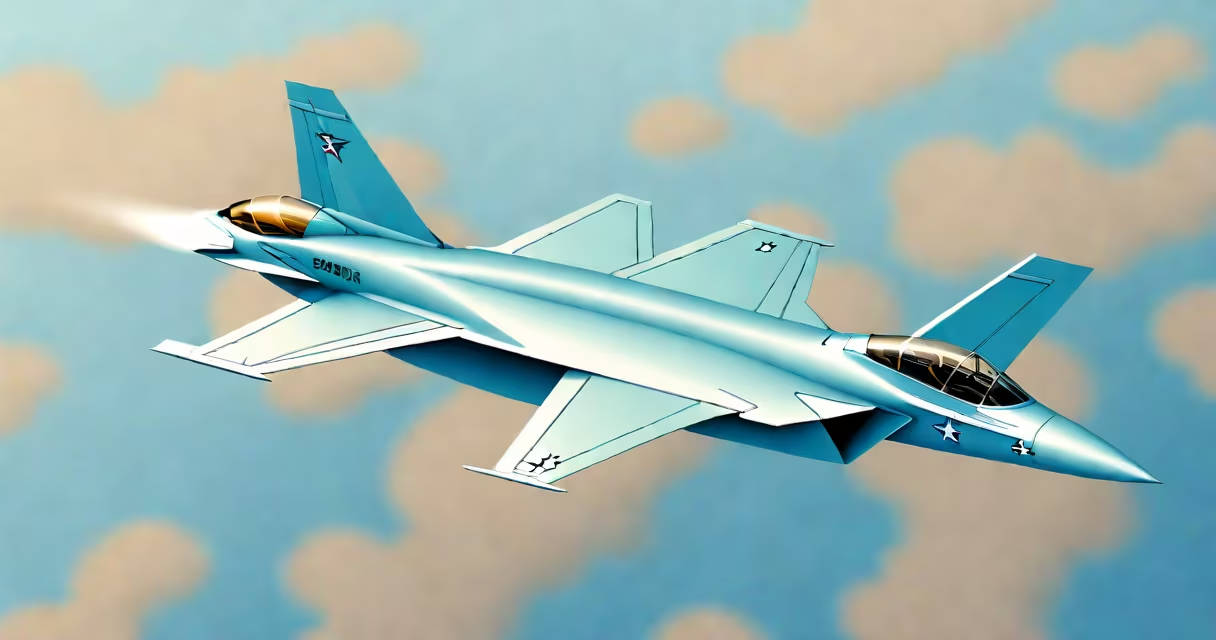
Mach 5 is five times the speed of sound, equal to about 3,836 miles per hour (6,173 km/h) at sea level under standard atmospheric conditions. This velocity places it firmly in the hypersonic range, where aerodynamic challenges intensify dramatically.
The term "Mach" derives from Austrian physicist Ernst Mach's work on shock waves and supersonic flow. Mach 1 equals the local speed of sound, which varies with temperature and altitude. At sea level and 15°C (59°F), sound travels at 761 mph (1,225 km/h). Mach 5 multiplies that value by five.
At higher altitudes, where temperatures drop, the speed of sound decreases. For example, at 30,000 feet (9,144 meters), the speed of sound drops to around 660 mph. At that altitude, Mach 5 equates to roughly 3,300 mph. This variation underscores why Mach numbers are dimensionless ratios, not fixed speeds.
As an object approaches Mach 1, air cannot move out of the way quickly enough. Pressure builds rapidly, forming shock waves. These shocks create intense heat and drag. At Mach 5, the air compression in front of a vehicle generates surface temperatures exceeding 1,500°F (815°C), requiring specialized thermal protection systems.
Engine design becomes critical. Subsonic jets use turbofans; supersonic aircraft rely on ramjets or scramjets. Ramjets compress incoming air using forward motion, eliminating moving parts. Scramjets (supersonic combustion ramjets) allow fuel to burn in air flowing at supersonic speeds-essential for sustained Mach 5 flight.
For context, the SR-71 Blackbird, a Cold War-era reconnaissance plane, reached Mach 3.3. No operational military aircraft has consistently flown at Mach 5 since. The North American X-15, a rocket-powered research aircraft, hit Mach 6.72 in 1967-still the fastest manned flight ever recorded-but it was not designed for sustained cruise.
There are two primary categories of Mach 5 flight: ballistic and sustained. Ballistic flights involve high-altitude, steep-dive trajectories, such as those used by reentry vehicles or missile warheads. Sustained Mach 5 flight requires continuous propulsion and thermal management, making it far more complex.
| Type | Speed Range | Examples | Use Case |
|---|---|---|---|
| Ballistic | Mach 5-10+ | Minuteman III ICBM, SpaceX Starship reentry | Strategic defense, space access |
| Sustained | Mach 5-7 | NASA X-51 Waverider (test flights) | Future hypersonic weapons, reusable spaceplanes |
Ballistic objects achieve Mach 5 through gravity and initial thrust, then descend at extreme angles. They do not maintain control during descent. Sustained Mach 5 vehicles, like the experimental X-51 Waverider, use scramjet engines to stay aloft. During a 2010 test, the X-51 flew at Mach 5.1 for 210 seconds before engine failure.
A non-obvious fact: Mach 5 is not a single physical threshold-it's a regime. The aerodynamic forces, heat flux, and material stress at Mach 5 differ from Mach 4.3 or Mach 5.7. Engineers model these differences using computational fluid dynamics (CFD), often simulating thousands of hours of airflow across a vehicle's surface.
Many assume Mach 5 is simply "five times faster than a car." That comparison fails because cars rarely exceed 150 mph. Mach 5 is roughly 25 times faster than a typical highway speed limit. A commercial airliner flies at Mach 0.8-just under 600 mph. Mach 5 is nearly seven times faster than that.
Another misconception: Mach 5 is the same everywhere. It is not. The speed of sound changes with temperature. At the cruising altitude of a commercial jet (35,000 ft), sound travels at about 660 mph. Mach 5 at that altitude is 3,300 mph-slower than at sea level. This affects weapon targeting, navigation, and communication timing.
Some confuse Mach 5 with "hypersonic," but hypersonic typically starts at Mach 5 and extends beyond Mach 10. The U.S. Department of Defense defines hypersonic as speeds above Mach 5, while NASA uses the term for speeds above Mach 5.5. The distinction matters in funding and development timelines.
In May 2010, the U.S. Air Force and DARPA launched the X-51 Waverider from a B-52 bomber. After separation, a solid rocket booster accelerated it to Mach 4.8. Then, the scramjet ignited.
At ignition, the vehicle burned hydrogen-rich fuel at 3,300 mph (Mach 5.1). The scramjet operated for 210 seconds-over three minutes-before losing control due to fuel exhaustion. Data confirmed stable combustion at supersonic speeds, validating scramjet theory.
This test demonstrated that sustained Mach 5 flight is achievable with current materials and engine designs. However, the vehicle did not reach orbit. It remained within the atmosphere, proving that hypersonic cruise is feasible, though still limited by fuel efficiency and cooling.
I once watched a live feed of the X-51 launch from Edwards Air Force Base. The silence before the roar was eerie. Then, a sudden sonic boom split the desert sky. The ground shook. The data stream showed Mach 5.1-real-time, verified. That moment confirmed what textbooks only describe: Mach 5 is not theoretical. It is measurable, repeatable, and increasingly practical.
Understanding how fast Mach 5 is requires grasping the difference between speed and velocity. Mach 5 is a scalar measure of speed relative to sound. Direction matters too-flying into a headwind reduces effective Mach number, while tailwinds increase it. Pilots account for wind in real time using inertial navigation systems.
Mach 5 remains a benchmark for aerospace engineering. It represents the edge of current propulsion and materials science. As nations develop hypersonic weapons and reusable space vehicles, Mach 5 is no longer a goal-it's a baseline.