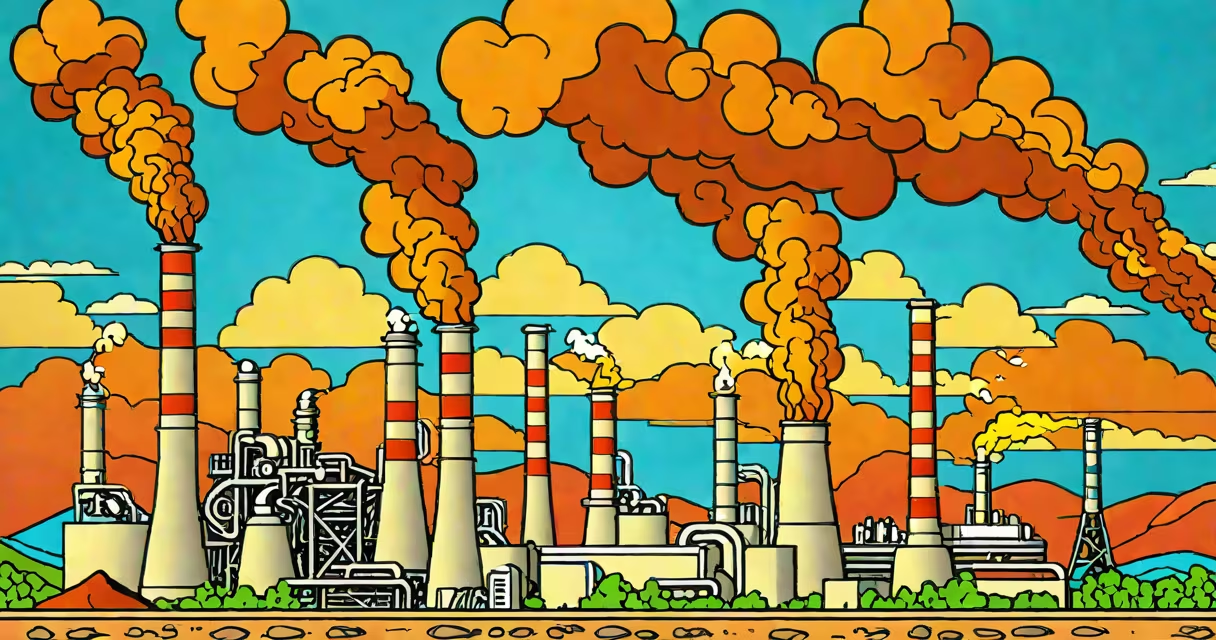
Burning fossil fuels releases carbon dioxide and other greenhouse gases that accumulate in the atmosphere, trapping heat and raising global temperatures. This process disrupts Earth's energy balance and drives long-term climate shifts.
Fossil fuels-coal, oil, and natural gas-form from ancient organic matter buried under sediment over millions of years. When burned, they release stored carbon as carbon dioxide (CO₂), a gas that absorbs infrared radiation. This traps heat that would otherwise escape into space, enhancing the natural greenhouse effect.
The Intergovernmental Panel on Climate Change (IPCC) states that human activities, primarily fossil fuel combustion, have increased atmospheric CO₂ levels from 280 parts per million (ppm) before the Industrial Revolution to over 420 ppm in 2023. This rise correlates directly with a 1.2°C increase in average global surface temperature since pre-industrial times.
When fossil fuels burn, chemical reactions break molecular bonds and form new compounds. For example, burning methane (CH₄), the primary component of natural gas, produces CO₂ and water vapor: CH₄ + 2O₂ → CO₂ + 2H₂O. The CO₂ then enters the atmosphere.
Greenhouse gases absorb thermal radiation emitted by Earth's surface. Without them, Earth's average temperature would be around -18°C. With them, it's about 15°C. Adding more CO₂ intensifies this effect, causing excess heat retention.
A 2022 study published in *Nature* found that 75% of the global warming observed since 1850 is attributable to CO₂ emissions from fossil fuel use. The remaining 25% comes from deforestation and industrial processes like cement production.
Carbon dioxide is the most significant contributor due to volume and longevity. It remains in the atmosphere for centuries. Methane, released during oil and gas extraction and livestock farming, has a shorter lifespan but is 80 times more effective at trapping heat than CO₂ over 20 years.
| Gaseous Emitter | Primary Source | Global Warming Potential (GWP) over 100 years |
|---|---|---|
| Carbon dioxide (CO₂) | Coal-fired power plants, vehicle engines, industrial furnaces | 1 |
| Methane (CH₄) | Natural gas leaks, landfills, cattle digestion | 28-36 |
| Nitrous oxide (N₂O) | Fertilizer use, wastewater treatment | 265-298 |
While CO₂ dominates in total emissions, methane's impact per molecule is much higher. Reducing methane leaks from oil and gas infrastructure can deliver rapid climate benefits, according to the International Energy Agency (IEA).
Climate change caused by fossil fuel emissions leads to extreme weather events, sea level rise, ocean acidification, and biodiversity loss. For example, the 2021 Pacific Northwest heat dome, which broke records in British Columbia, was made 150 times more likely by human-caused warming, according to a World Weather Attribution analysis.
A common misconception is that natural sources like volcanoes emit more CO₂ than human activity. Volcanic eruptions release about 0.3 gigatons of CO₂ annually. Human activities, including fossil fuel use and cement production, emit over 37 gigatons per year-over 100 times more.
Another myth is that CO₂ is harmless because it's essential for plant growth. While plants do use CO₂, excessive concentrations disrupt ecosystems. Ocean acidification from dissolved CO₂ has reduced calcifying organisms' ability to build shells, affecting coral reefs and shellfish populations.
Consider a typical 500-megawatt coal-fired power plant operating at 40% efficiency. It burns approximately 1.5 million tons of coal annually. Each ton of coal contains about 24 million BTUs of energy and emits roughly 2.4 tons of CO₂ when burned completely.
At 1.5 million tons of coal per year, the plant emits 3.6 million tons of CO₂ annually. That's equivalent to the annual emissions of nearly 750,000 passenger vehicles. Over 40 years of operation, such a plant contributes over 144 million tons of CO₂ to the atmosphere-enough to raise local atmospheric CO₂ levels by measurable amounts if not offset.
I once visited a decommissioned coal plant in West Virginia. The stack still stood, rusted but intact. Inside, the boiler chamber had collapsed inward. The scale of the structure made it clear how much energy was extracted-and how much waste was produced. The air near the site still carried a faint sulfur odor, a reminder of the pollutants released during combustion.
Some confuse climate change with weather. Weather is short-term atmospheric conditions; climate change is long-term shifts in temperature, precipitation, and storm patterns. A cold winter does not disprove global warming-it's a single event within a changing system.
Others assume that switching to renewables eliminates all emissions. While wind and solar produce minimal operational emissions, manufacturing their components-like solar panels and wind turbines-still requires energy and materials, often from fossil-fueled processes. Full lifecycle assessments show that renewable systems still have lower net emissions than fossil-based alternatives.
Finally, some believe individual actions don't matter. But collective behavior shapes policy. The U.S. Environmental Protection Agency reports that if every American household replaced one incandescent bulb with an LED, it would reduce CO₂ emissions by 900,000 metric tons annually-equivalent to taking 190,000 cars off the road.
Understanding how burning fossil fuels causes climate change is the first step toward meaningful action. The science is clear: human emissions of CO₂ and other greenhouse gases are altering Earth's climate system. Addressing this requires systemic changes in energy production, transportation, and industry.