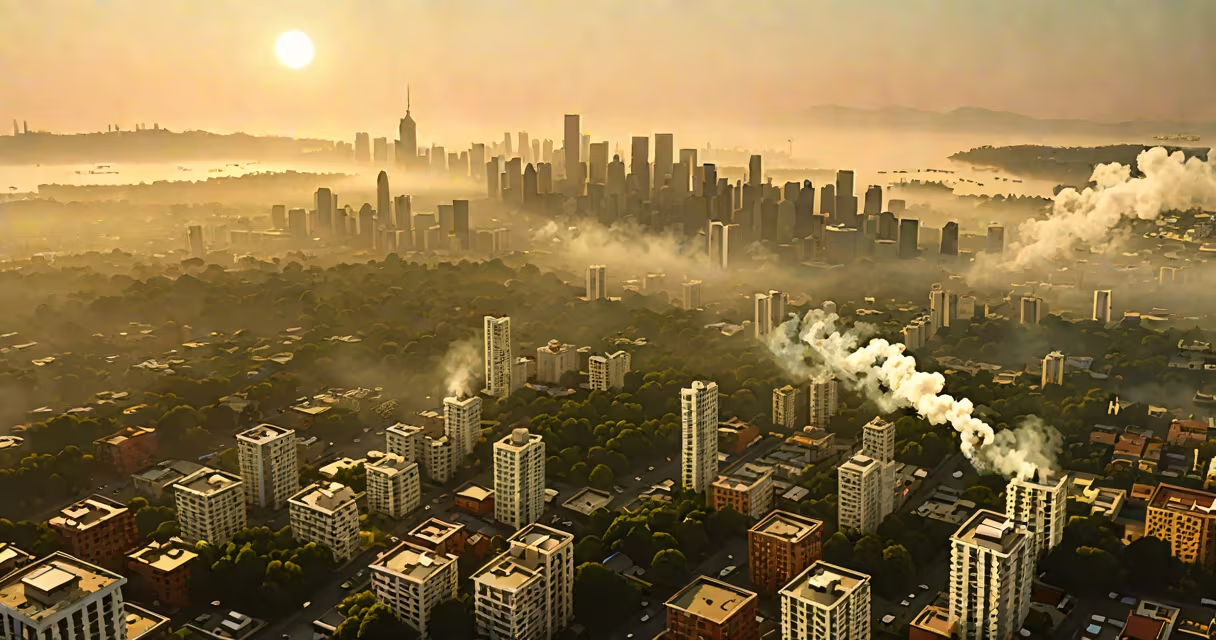
Air pollution alters atmospheric chemistry, damages ecosystems, and drives climate change by increasing greenhouse gas concentrations and reducing planetary albedo through particulate deposition. This occurs via direct chemical reactions, long-range transport of toxins, and feedback loops in natural systems.
Atmospheric pollutants originate from industrial emissions, vehicle exhaust, agricultural burning, and fossil fuel combustion. These release nitrogen oxides (NOx), sulfur dioxide (SO₂), volatile organic compounds (VOCs), and fine particulate matter (PM2.5). Once airborne, they trigger photochemical smog formation, contribute to stratospheric ozone depletion, and alter cloud microphysics. The World Health Organization (WHO) estimates that 99% of the global population breathes air exceeding safe pollutant levels, with urban centers in South Asia and Sub-Saharan Africa experiencing PM2.5 concentrations above 50 µg/m³-over five times the WHO guideline.
When emitted, pollutants undergo complex transformations. Sulfur dioxide converts to sulfuric acid aerosols, which fall as acid rain. Nitrogen oxides form nitric acid and ground-level ozone. These acids lower soil pH, leach essential nutrients like calcium and magnesium, and mobilize toxic metals such as aluminum. In the Adirondack Mountains of New York, acid rain reduced fish populations in over 200 lakes between 1960 and 1990 due to aluminum toxicity and disrupted reproductive cycles.
Greenhouse gases like carbon dioxide (CO₂), methane (CH₄), and nitrous oxide (N₂O) accumulate in the atmosphere, trapping infrared radiation and raising global temperatures. CO₂ levels reached 420 parts per million (ppm) in 2023-higher than any point in at least 800,000 years, according to ice core data from the National Oceanic and Atmospheric Administration (NOAA).
Particulates have dual roles. Black carbon (soot) absorbs sunlight, warming the atmosphere and accelerating snow and ice melt. When deposited on glaciers, it reduces albedo-the reflectivity of surfaces-causing faster melting. Glaciers in the Himalayas lost 13% of their mass between 2000 and 2020, with black carbon contributing to this decline. Conversely, sulfate aerosols scatter sunlight and cool surface temperatures, masking some warming. However, this cooling effect is temporary and uneven, leading to regional climate instability.
Climate models show that air pollution contributes to shifts in precipitation patterns. Increased atmospheric aerosols reduce evaporation rates and suppress rainfall in certain regions while enhancing convective storms elsewhere. In Southeast Asia, changes in monsoon timing correlate with rising aerosol loading from biomass burning during dry seasons.
Plants absorb pollutants through stomata, disrupting photosynthesis and growth. Ozone exposure reduces crop yields by 10-20% globally, according to the United Nations Environment Programme (UNEP). Wheat grown near industrial zones in India shows stunted leaf development and decreased grain size due to chronic ozone exposure.
Forests suffer from both direct toxicity and indirect stress. In Germany's Black Forest, decades of acid rain caused widespread tree mortality, particularly in spruce stands. Trees weakened by nutrient leaching became vulnerable to bark beetles, leading to large-scale die-offs. Repeated exposure to pollutants reduces resilience to drought, heat, and pests.
Marine ecosystems face contamination through atmospheric deposition. Mercury released from coal-fired power plants travels globally and accumulates in ocean food chains. Predatory fish like tuna and swordfish contain mercury levels exceeding safety thresholds set by the U.S. Food and Drug Administration (FDA). This bioaccumulation threatens marine predators and human consumers alike.
People often assume air pollution only affects cities. In reality, pollutants travel thousands of kilometers. A study published in *Nature Geoscience* tracked Asian dust plumes carrying heavy metals and pesticides across the Pacific Ocean, depositing them in North American forests and watersheds.
Another misconception is that indoor air quality is unrelated to outdoor pollution. Indoor environments can exceed outdoor concentrations for certain pollutants. Cooking with solid fuels in developing nations produces indoor PM2.5 levels up to 10 times higher than WHO limits, causing respiratory illness and premature death.
Some believe planting trees offsets all air pollution. While trees sequester carbon and filter particles, they do not neutralize gaseous pollutants like ozone or nitrogen oxides. In fact, certain tree species emit VOCs that react with NOx to form ground-level ozone-a major component of smog.
The collapse of the Aral Sea in Central Asia illustrates how air pollution interacts with environmental degradation. As the sea shrank due to Soviet-era irrigation projects, exposed lakebeds released salt and pesticide-laden dust into the atmosphere. Winds carried this material across Kazakhstan and Uzbekistan, contaminating farmland and drinking water.
Local residents developed high rates of respiratory disease, cancer, and birth defects. Soil salinity increased, rendering land unsuitable for agriculture. Satellite imagery from NASA shows the region's albedo dropped by 15% between 1980 and 2000 due to dust accumulation on surrounding snowfields, further accelerating regional warming.
This case demonstrates that air pollution is not isolated-it is embedded in larger environmental crises. It results from poor resource management, industrial activity, and policy failure. Addressing it requires integrated solutions across sectors.
Not all air pollution is anthropogenic. Volcanic eruptions emit SO₂ and ash, influencing climate for months. The 1991 eruption of Mount Pinatubo injected 20 million tons of sulfur dioxide into the stratosphere, cooling Earth's surface by 0.5°C for two years. However, human-caused emissions are persistent and cumulative, unlike episodic natural events.
Another overlooked factor: air pollution influences cloud formation. Aerosols act as cloud condensation nuclei. More particles mean more, smaller droplets, increasing cloud reflectivity. This leads to brighter clouds that reflect more sunlight-potentially cooling the planet. But this effect is highly variable and difficult to model accurately.
Finally, air pollution disproportionately impacts low-income communities. In the U.S., census tracts with higher poverty rates have 20% higher average PM2.5 levels than affluent areas, according to EPA data. This creates environmental injustice, where marginalized groups bear greater health risks despite contributing less to emissions.
Reducing air pollution requires coordinated action. Transitioning to renewable energy cuts CO₂ and particulate emissions simultaneously. Cities like Oslo and Copenhagen have reduced urban traffic emissions by expanding electric public transit and pedestrian zones.
Regulatory frameworks matter. The U.S. Clean Air Act of 1970 led to a 70% reduction in national emissions of six major pollutants between 1970 and 2020, despite economic growth. Similar policies in the EU have driven down NOx and SO₂ levels across member states.
Individual actions also help. Using public transportation, reducing meat consumption (which lowers agricultural emissions), and supporting clean energy policies collectively reduce demand for fossil fuels. For example, switching from a gasoline car to an electric vehicle reduces lifecycle emissions by 60% on average, according to the International Council on Clean Transportation.