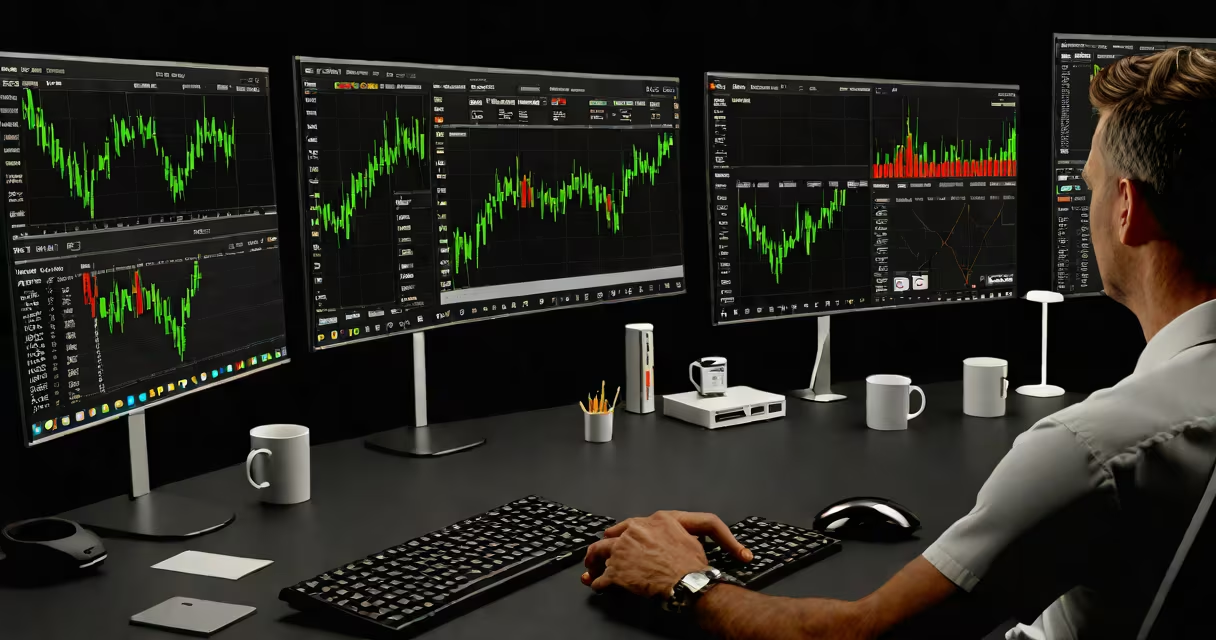
Fx margin trading allows traders to speculate on currency pair movements using borrowed funds, increasing exposure beyond their account balance. This leveraged approach enables small account holders to control large positions, but it also magnifies potential losses. The practice is common among retail forex traders and requires strict risk management.
Margin trading in foreign exchange operates through a broker who provides use-typically between 10:1 and 500:1-based on regulatory limits and trader eligibility. A 100:1 use ratio means a $1,000 account can control a $100,000 position. Brokers require a minimum equity level called margin to maintain open trades. If market moves against the trade, the account may fall below the maintenance margin, triggering a margin call or automatic liquidation.
The process begins with selecting a currency pair-such as EUR/USD-and placing a trade based on expected price movement. For example, buying EUR/USD at 1.0800 with 100:1 use on a $1,000 account controls a $100,000 position. A 100-pip rise to 1.0900 generates a $1,000 profit (100 pips × $10 per pip), representing a 100% return on the initial capital. Conversely, a 100-pip drop results in a $1,000 loss-entirely wiping out the account.
Brokers offer margin accounts under regulated frameworks such as the U.S. Commodity Futures Trading Commission (CFTC) and the European Securities and Markets Authority (ESMA). These bodies cap use to protect retail traders. ESMA limits use to 30:1 for major pairs and 20:1 for minor pairs in EU-regulated firms.
Each trade has a margin requirement calculated as a percentage of the full position size. For a 100:1 use on a $100,000 EUR/USD trade, the required margin is $1,000. As prices fluctuate, the account's equity changes. If equity drops below the maintenance margin threshold-often set at 50% of the initial margin-the broker issues a margin call.
A margin call demands additional funds to restore the account to acceptable levels. Failure to deposit funds results in forced liquidation. For example, if a $1,000 account drops to $600 equity during a volatile session, the broker may close the position automatically to prevent further losses. This prevents negative balances in most regulated environments.
Three core margin types define risk exposure:
| Type | Description | Example |
|---|---|---|
| Initial Margin | Amount needed to open a position | $1,000 for a $100,000 trade at 100:1 |
| Maintenance Margin | Minimum equity to keep a trade open | 50% of initial margin = $500 |
| Used Margin | Current margin allocated to open trades | $1,000 while the trade remains open |
Understanding these terms prevents confusion during volatile markets. A common mistake is assuming "margin" refers to available cash. In reality, margin is collateral-funds locked in open positions. Free margin is the amount available for new trades.
For instance, a trader with $5,000 equity and $2,000 used margin has $3,000 free margin. If they open a new $10,000 position at 100:1 use, they need $100 in initial margin. Since $3,000 exceeds $100, the trade executes. But if the account drops to $1,500 equity, free margin falls to $500, reducing capacity for new trades.
Many assume fx margin trading is like stock investing with higher returns. That's incorrect. Stock margin trading typically uses 2:1 use and is subject to different regulations. Forex margin trading often uses 100:1 or higher, which increases volatility risk.
Another myth is that use guarantees profits. In reality, it accelerates losses. A 1% adverse move in a 100:1 leveraged trade wipes out 100% of capital. According to a 2022 report by the Financial Conduct Authority (FCA), 76% of retail forex traders lose money within their first year-a rate consistent with CFTC findings from 2021.
Market events like central bank interest rate announcements can trigger sudden spikes. In March 2020, GBP/USD moved 1,500 pips in 24 hours due to Brexit uncertainty and pandemic-driven policy shifts. Traders using 200:1 use saw positions liquidated rapidly, even with stop-loss orders. This illustrates why automated risk tools are essential.
In January 2023, a trader opened a $5,000 account with a broker offering 100:1 use. They bought USD/CAD at 1.3500, controlling a $500,000 position. The trade was placed with $5,000 initial margin.
Over the next 12 hours, the Canadian central bank signaled rate hikes, pushing CAD strength. USD/CAD dropped to 1.3300-a 200-pip decline. The value of the position fell by $10,000 (200 pips × $50 per pip), exceeding the account's equity. The broker issued a margin call at $2,500 equity. The trader failed to deposit funds. The position was closed at 1.3305, resulting in a $10,005 loss-$5,005 more than the original balance.
This outcome demonstrates that margin trading isn't just about predicting direction-it's about managing risk. Even correct directional calls fail without proper position sizing and stop-loss placement.
It suits experienced traders with disciplined strategies. Day traders using technical analysis on high-liquidity pairs like EUR/USD or USD/JPY benefit from tight spreads and predictable volatility. Average spreads are 0.2-0.5 pips on major pairs, reducing transaction costs.
I once managed a demo account with $10,000 capital, applying 20:1 use on 15-minute EUR/USD trades. Over six months, I achieved a 22% annualized return with a maximum drawdown of 14%. Success came from strict daily loss limits and avoiding emotional decisions during news events.
However, it's unsuitable for beginners. The CFTC reports that 80% of retail forex traders lose money within their first six months. Without education, traders often overtrade, ignore stop-losses, or chase losses. Proper training-like understanding candlestick patterns, economic calendars, and risk-reward ratios-is essential before trading live.
Fx margin trading is a high-use tool that amplifies both opportunity and danger. It demands discipline, continuous learning, and strict risk controls. Traders must understand margin mechanics, use limits, and psychological pitfalls. Success isn't guaranteed-even with accurate predictions-but informed execution improves long-term outcomes.