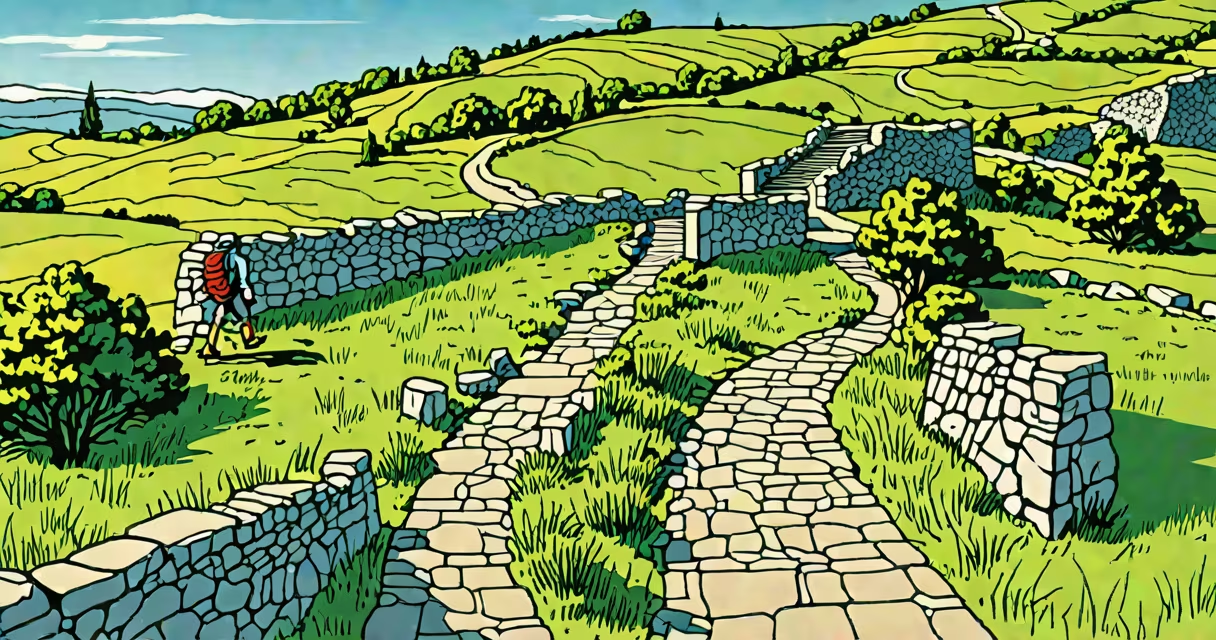
El Camino Spain is a network of ancient pilgrimage routes converging on Santiago de Compostela in northwestern Spain, where tradition holds that the remains of Saint James the Greater are interred. Pilgrims walk between 80 and 1,200 kilometers depending on the route, often completing the process on foot over several weeks.
The most traveled path, the Camino Francés, stretches 775 kilometers from Saint-Jean-Pied-de-Port in France through the Pyrenees and into northern Spain. It follows well-marked stone paths, Roman roads, and medieval trade routes. The Camino Portugués, originating in Lisbon or Porto, covers approximately 600 kilometers and enters Spain via the Douro River valley. Both routes are designated UNESCO World Heritage Sites.
Pilgrimage to Santiago de Compostela began in the 9th century after the discovery of Saint James's tomb. By the 12th century, the route attracted thousands of travelers from across Europe. Today, over 200,000 people complete at least part of El Camino each year, including many non-religious walkers seeking personal transformation. The Spanish government maintains official pilgrim credentials (credencial) that allow access to hostels and shelters along the way.
Each route is divided into daily stages averaging 20 to 30 kilometers. Most pilgrims walk 15 to 25 kilometers per day, adjusting pace based on terrain and weather. The path is marked with scallop shells-Saint James's symbol-on signs, posts, and pavement. These markers appear every few hundred meters, ensuring navigability even in remote areas.
Pilgrims receive a credencial at their starting point, which is stamped at each overnight stop. To qualify for the Compostela certificate-the official document proving completion of at least 100 kilometers on foot or 200 kilometers by bicycle-the credential must be stamped at least once per day during the process. This requirement prevents fraud and verifies actual travel.
Shelters (albergues) offer basic dormitory-style accommodations, typically costing €5 to €10 per night. Private hostels and hotels are available in towns, but many pilgrims choose albergues for affordability and community. Meals are usually eaten at local restaurants or cafeterías, with regional dishes such as empanadas, pulpo a la gallega (Galician octopus), and caldo gallego (herb soup) common along the way.
El Camino Spain includes multiple distinct routes, each with unique landscapes, difficulty levels, and cultural experiences. The table below compares the five most popular paths:
| Route Name | Starting Point | Distance (km) | Duration (days) | Primary Terrain |
|---|---|---|---|---|
| Camino Francés | Saint-Jean-Pied-de-Port, France | 775 | 30-35 | Pyrenees, rolling hills, farmland |
| Camino Portugués (Coimbra Route) | Coimbra, Portugal | 620 | 25-30 | Forest trails, river valleys, vineyards |
| Camino del Norte | Irun, Basque Country | 800 | 35-40 | Coastal cliffs, fishing villages, green hills |
| Costa da Morte | Finisterre, Galicia | 100 | 5-7 | Cliffs, sea views, rugged coastline |
| Camino Primitivo | Oviedo, Asturias | 400 | 18-22 | Mountain passes, dense forests, high altitude |
While the Camino Francés is the most famous, the Camino Primitivo offers steeper ascents and fewer crowds. The Costa da Morte route, though shorter, features dramatic coastal scenery and is often walked as a final leg before reaching Santiago.
El Camino Spain is not exclusively a religious process. According to the Spanish Ministry of Culture, nearly 60% of pilgrims in 2023 reported no formal religious affiliation. Many walk for mental clarity, physical challenge, or personal growth. The term "pilgrim" refers to anyone who walks the route with intention, regardless of belief.
A common error is assuming all routes lead directly to Santiago. The Camino Portugués splits into two branches: the Coastal Route (via Viana do Castelo) and the inland route (via Coimbra). Only the Coimbra branch connects to the main Camino Francés near Burgos. Pilgrims must plan carefully to avoid detours.
Another misconception is that the process requires extreme fitness. Most participants are aged 40 to 65, with average daily walking times under four hours. A 2022 study by the University of Santiago de Compostela found that 87% of walkers completed the full Camino Francés without injury, thanks to gradual acclimatization and proper footwear.
In July 2023, a 54-year-old teacher from Toronto walked the Camino Francés over 34 days. She started in Saint-Jean-Pied-de-Port and averaged 22 kilometers per day. Her itinerary included:
She received her Compostela certificate at the Cathedral of Santiago de Compostela after walking 775 kilometers. Her journal entry from Day 34 read: "I didn't come for God. I came to see if I could still move forward."
El Camino Spain remains a living tradition. Its routes are maintained by local governments, religious groups, and volunteer networks. The Spanish National Tourism Office reports that 180,000 pilgrims completed at least 100 kilometers in 2023, with 42% coming from outside Europe. The process continues not as a relic, but as a changing path shaped by each walker's purpose.