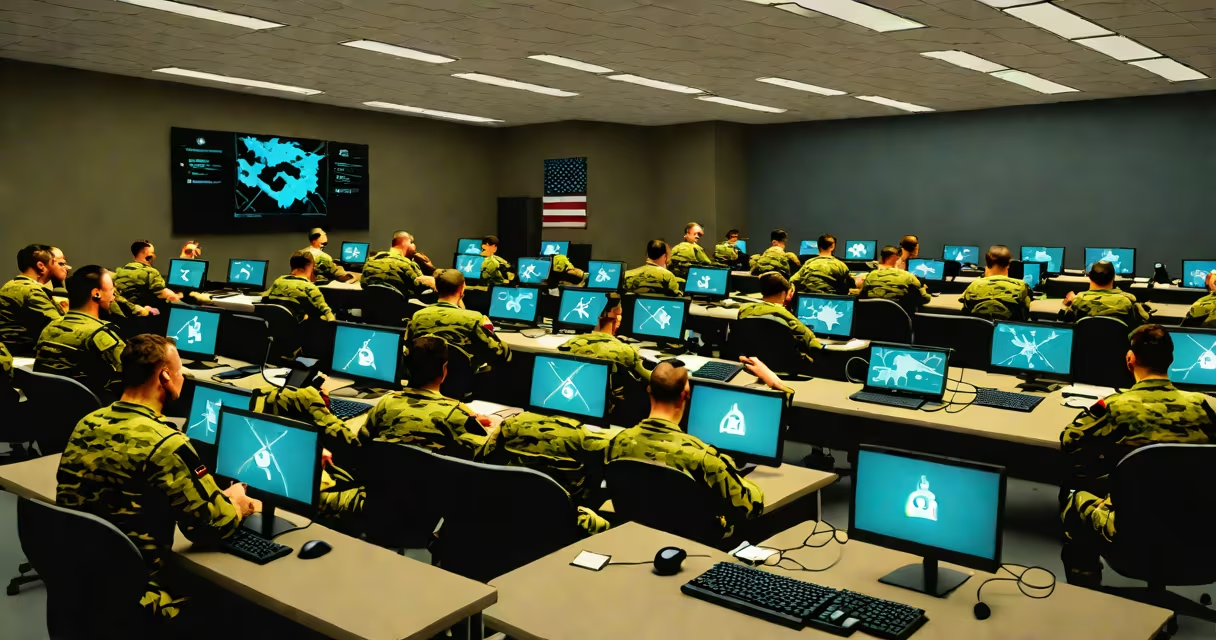
The U.S. Army's cyber security awareness training program is a mandatory, standardized curriculum designed to educate military personnel on identifying and responding to cyber threats. It covers phishing, social engineering, data handling, and secure communication protocols to protect classified systems and personal information.
This training is not optional. All active-duty soldiers, reservists, and Department of the Army civilians must complete it annually. The program uses interactive modules, scenario-based assessments, and real-world incident simulations to reinforce learning. It aligns with Department of Defense Directive 8500.01 and the National Institute of Standards and Technology (NIST) Special Publication 800-53.
Unlike generic online courses, the Army's version integrates military-specific contexts-such as handling battlefield communications under cyber attack or securing logistics networks during deployment. It includes role-based modules for different ranks and specialties, ensuring relevance across units from intelligence to supply chains.
Cyber security awareness training army operates through the Army Learning Management System (ALMS). Soldiers access training via secure military networks, completing modules on assigned schedules. Each session lasts between 30 and 60 minutes and ends with a quiz based on realistic threat scenarios.
For example, a soldier receives a fake email purporting to be from the base command center, asking to verify their login credentials. The training requires them to recognize red flags-such as mismatched sender addresses, urgent language, and suspicious attachments-before clicking. Correct responses earn completion points; failures trigger follow-up briefings.
Training data is logged and reported to unit commanders. Failure rates above 15% in a unit prompt leadership review and additional remedial sessions. This accountability ensures consistent readiness across all echelons.
The curriculum divides into five core domains:
| Domain | Key Topics | Examples |
|---|---|---|
| Threat Recognition | Phishing, spear phishing, malware | Identifying emails with forged sender domains |
| Data Protection | Classified information handling, encryption | Proper use of encrypted messaging apps in combat zones |
| Secure Communication | Using approved channels, avoiding public Wi-Fi | Reporting unauthorized use of personal devices on base |
| Physical Security | Securing workstations, preventing shoulder surfing | Locking screens during briefings |
| Incident Response | Reporting procedures, chain of custody | Documenting a suspected breach within 15 minutes |
Each domain includes micro-learning videos, animated scenarios, and interactive decision trees. For instance, a module on data protection shows a soldier receiving a USB drive from a foreign national during a joint exercise. The correct action-declining the transfer and reporting it-is highlighted with immediate feedback.
Training updates quarterly to reflect emerging threats. In 2023, the Army added modules on AI-generated deepfakes targeting military leaders and ransomware tactics used against defense contractors.
Many assume cyber security awareness training army is just a compliance checkbox. That's incorrect. A 2022 report by the Cybersecurity and Infrastructure Security Agency (CISA) found that 74% of successful breaches in federal agencies originated from human error. The Army's training directly targets this gap.
Another misconception is that it's identical to civilian IT security training. While both cover password hygiene and email safety, the Army version emphasizes operational security (OPSEC) and mission impact. For example, a soldier in Afghanistan cannot afford to lose a drone control system due to a single click on a malicious link.
A critical difference lies in enforcement. Civilian training often lacks consequences for failure. In contrast, the Army tracks performance and ties it to fitness reports. Repeated failures can delay promotions or affect security clearance eligibility.
I observed a live training drill during a rotation at Fort Bragg in 2022. A simulated attack mimicked a real-world incident where a contractor's laptop was compromised via a malicious update. The trainees had to identify the anomaly-a slight delay in software verification-and isolate the device before data exfiltration occurred.
One junior officer hesitated, thinking the update was legitimate because it came from a known vendor. He failed the simulation. After debriefing, he admitted he'd never seen such a tactic before. The trainer corrected him: "The enemy doesn't always use flashy attacks. Sometimes they hide in plain sight."
That moment underscored the training's purpose-not just to teach, but to instill vigilance under pressure.
Every U.S. Army installation worldwide runs this training. It's integrated into basic training, advanced individual training, and annual professional military education cycles. Units deploying overseas must complete it before departure.
Its value is measurable. Since 2019, the Army has reduced insider threat incidents by 38%, according to the Defense Information Systems Agency (DISA). This decline correlates with increased training frequency and improved assessment tools.
When a cyberattack targeted the Pentagon's internal network in 2021, investigators traced the initial access to a soldier who opened a phishing email. The incident led to a policy change requiring biannual refresher training for all personnel with system access.
Civilian IT security awareness training often focuses on corporate policies and compliance with standards like HIPAA or PCI-DSS. The Army's program prioritizes mission assurance and national security. It assumes hostile actors are actively probing for weaknesses.
While commercial platforms may offer gamified quizzes, the Army's training uses real military scenarios. A soldier isn't asked to choose between "safe" and "risky" actions-they're shown how a single mistake can compromise a brigade's movement plan.
The Army trains en masse with centralized oversight. A company of 100 soldiers completes the same module simultaneously, allowing for synchronized response drills. Civilian programs typically run on individual schedules with no coordinated timing.
Cyber security awareness training army is not just education-it's a frontline defense. It prepares soldiers to act decisively when seconds count, protecting lives, missions, and national interests.