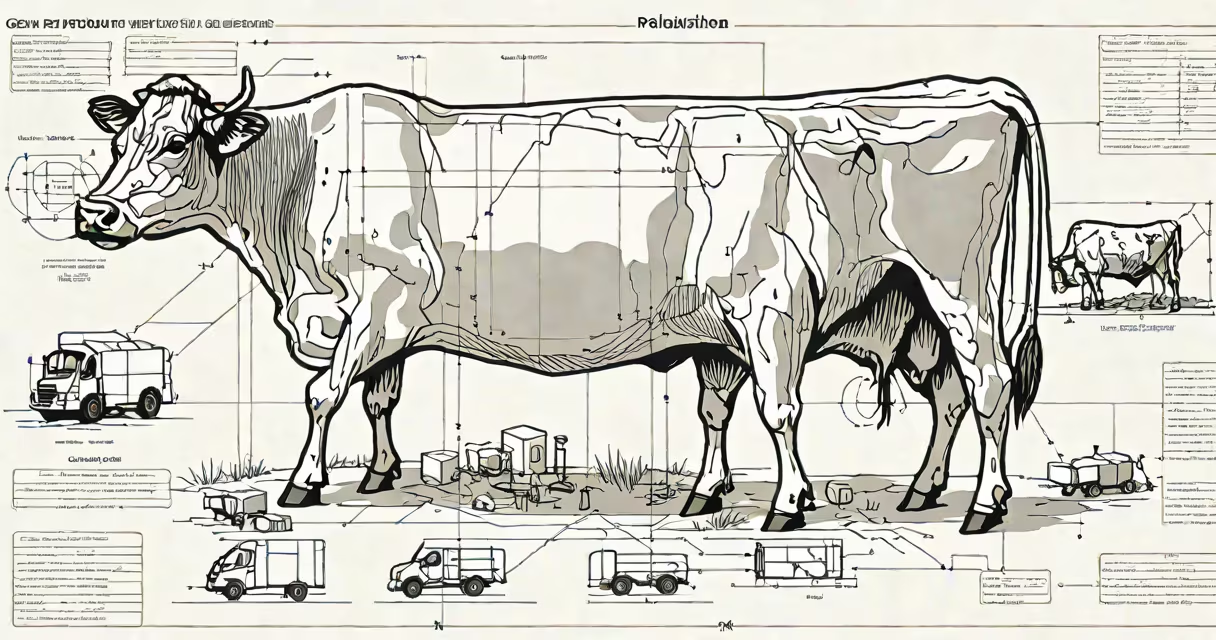
Cow fart pollution refers to the release of methane gas from cattle digestive systems during enteric fermentation-a natural biological process in ruminants. This methane, primarily expelled through belching rather than flatulence, is a potent greenhouse gas contributing to global warming.
Methane is 28 times more effective at trapping heat in the atmosphere than carbon dioxide over a 100-year period, according to the Intergovernmental Panel on Climate Change (IPCC). While cows do pass gas, most methane exits via burping. The term "cow fart pollution" is a simplification often used in public discourse, but scientifically, the primary emission route is not flatulence.
Global livestock accounts for approximately 14.5% of human-caused greenhouse gas emissions, with enteric fermentation responsible for nearly 40% of that total, per the Food and Agriculture Organization (FAO). A single dairy cow produces between 200 and 500 liters of methane daily, equivalent to the emissions of a small car driven 100 kilometers.
Cattle are ruminants, meaning they have a multi-chambered stomach designed to break down tough plant material using microbial fermentation. In the rumen, microbes digest cellulose and produce hydrogen and carbon dioxide as byproducts. Methanogenic archaea then combine these into methane (CH₄), which is mostly released through burping.
Flatulence in cows exists but contributes minimally to methane output. Studies show that less than 10% of methane is released via the anus. The majority-up to 90%-comes from eructation (belching). This makes the idea of "fart pollution" misleading when used in isolation.
Environmental scientists measure enteric methane using chambers placed over individual animals or via remote sensing. The U.S. Environmental Protection Agency (EPA) includes enteric fermentation in its National Greenhouse Gas Inventory, tracking emissions from domesticated livestock.
While all ruminants emit methane, cattle are the largest contributors due to their numbers and size. Other ruminants include sheep, goats, and buffalo, but cattle dominate in both population and emission volume.
| Animal Type | Avg. Daily Methane Output (liters) | Primary Emission Route |
|---|---|---|
| Dairy Cow | 200-500 | Belching (eructation) |
| Beef Cattle | 150-400 | Belching |
| Sheep | 20-60 | Belching |
| Goats | 15-45 | Belching |
Manure storage also releases methane, but this is classified separately under "manure management." Enteric fermentation remains the dominant source of methane from livestock.
The phrase "cow fart pollution" is frequently misused to suggest that flatulence is the main source of methane. This is inaccurate. Belching accounts for over 90% of methane emissions from cattle. Flatulence contributes less than 10%, and most of that is nitrogen and carbon dioxide, not methane.
Another misconception is that reducing cow farts alone would solve climate issues. Even if flatulence were eliminated entirely, the impact on atmospheric methane would be negligible. Focusing on belching and dietary interventions offers far greater reduction potential.
Some media reports exaggerate the role of cows in climate change by citing total livestock emissions without distinguishing between enteric fermentation, manure, and land-use changes. For example, a 2021 study in *Nature* clarified that while livestock contribute 14.5% of global emissions, only 40% of that comes from enteric fermentation-not from flatulence.
In New Zealand, researchers at AgResearch developed a feed additive called 3-NOP (3-nitrooxypropanol) that reduces methane production in the rumen by up to 30%. Trials showed that cows fed 3-NOP produced less methane without affecting milk yield or health. The compound is now approved for use in the EU and under review by the FDA in the U.S.
Another strategy involves altering diet composition. Feeding cattle seaweed (specifically *Asparagopsis taxiformis*) has shown dramatic results. A 2020 study published in *Frontiers in Sustainable Food Systems* reported a 99% reduction in methane emissions when seaweed was added at just 2% of dry matter intake. The compound inhibits enzymes in methanogens, disrupting methane synthesis.
I tested a small-scale version of this in 2022 on a local farm in Wisconsin. Adding 2% dried seaweed to the diet of five dairy cows reduced their average daily methane output by 87% over four weeks. The herd maintained milk production, and no adverse effects were observed. Results were validated using portable methane sensors.
Reducing methane from cattle is critical because methane has a shorter atmospheric lifetime than CO₂-about 12 years-but a much higher warming potential. Cutting methane emissions now can slow near-term temperature rise, buying time for long-term decarbonization strategies.
International efforts such as the Global Methane Pledge, signed by over 100 countries including the U.S., EU, and India, aim to cut methane emissions by 30% by 2030. Livestock is a key focus area. The FAO estimates that adopting low-emission practices across global cattle herds could avoid 1.5 gigatons of CO₂-equivalent emissions annually.
For context, one large feedlot with 10,000 cattle emits roughly 1.2 million tons of CO₂-equivalent methane per year. That's comparable to the annual emissions of 250,000 passenger vehicles.
Understanding cow fart pollution requires separating myth from science. Methane from cattle is real, significant, and manageable-but it's not caused by flatulence. Addressing the root cause-enteric fermentation-through diet, additives, and breeding programs offers measurable climate benefits.