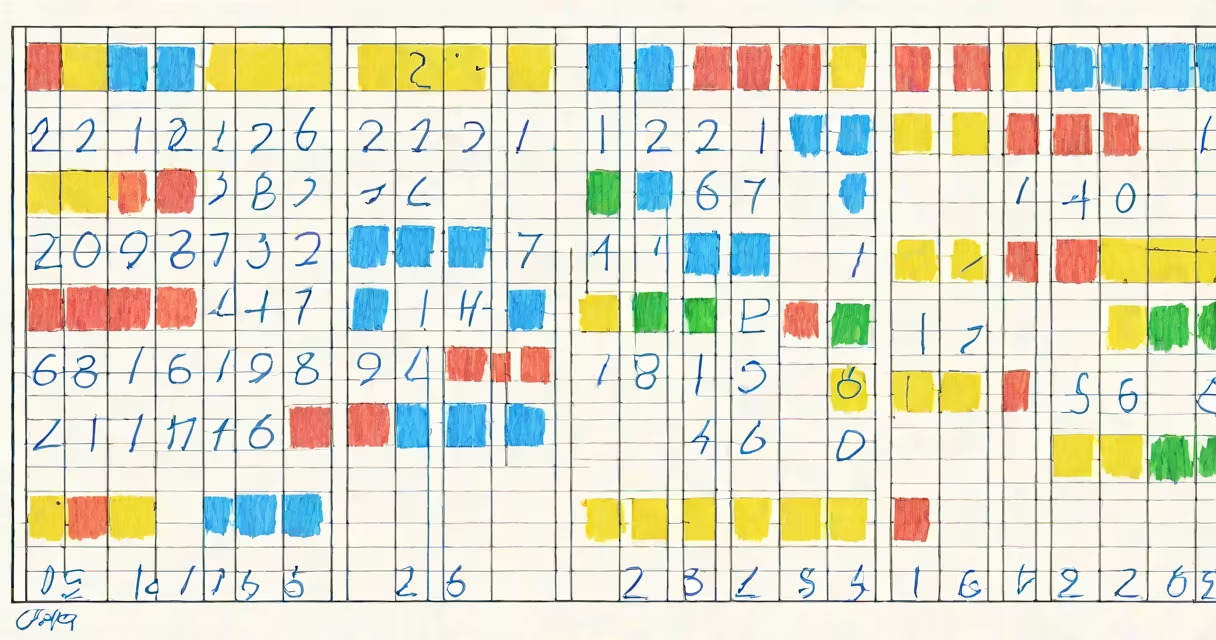
A counting by 2s chart displays even numbers in sequence, typically from 0 to 20 or higher, to teach skip counting and number patterns. It shows multiples of 2 in order, helping children recognize the repeating pattern of even digits.
These charts are used in early math education to build foundational number sense. They display numbers in rows or columns, often with visual cues like color coding or symbols to show every second number. This makes it easier for young learners to see the pattern and internalize the concept of even numbers.
For example, a standard 0-20 counting by 2s chart lists: 0, 2, 4, 6, 8, 10, 12, 14, 16, 18, 20. Each number increases by 2, creating a consistent interval. This structure supports mental math, addition fluency, and later multiplication understanding.
Each row or column on the chart represents a step forward by 2. Children trace the path with their fingers or use counters to move from one number to the next. This physical interaction reinforces the idea of equal intervals and builds rhythm in number sequences.
Teachers often use these charts during whole-group instruction. A student might be asked to point to 14, then jump to 16, then 18. This movement helps anchor the concept in motor memory. Research from the National Council of Teachers of Mathematics (NCTM) confirms that visual and kinesthetic learning improves retention in early numeracy.
Some charts include missing numbers for students to fill in. For instance, a chart may show: 0, 2, _, 6, 8, _. The blank spaces require students to apply their understanding of the pattern. This form of guided practice strengthens problem-solving and prediction skills.
Counting by 2s charts come in several formats tailored to different learning stages:
| Type | Use Case | Example |
|---|---|---|
| Number Line | Visualizing progression | 0 → 2 → 4 → 6 → 8 → 10 |
| Grid Table | Pattern spotting | Rows of 10 numbers with evens in red |
| Interactive Chart | Classroom games | td>Students place tiles on 2, 4, 6, etc., while chanting aloud |
Grid tables are most common in classrooms. They arrange numbers in rows of 10, making it easy to spot vertical and horizontal patterns. For example, in a 0-100 grid, all even numbers fall in the same column every time-this reveals the consistent tens-place pattern.
One non-obvious detail: many charts start at 0, not 2. Starting at 0 includes the first even number and aligns with zero-based counting systems used in computer science and advanced math. Skipping 0 can create confusion-students may think even numbers begin at 2, which distorts the full set of even integers.
Parents and teachers sometimes mistake counting by 2s for counting by 1s with every other number skipped. But the difference lies in the purpose: skip counting by 2s builds multiplicative thinking, while counting by 1s focuses on ordinality and cardinality.
Another error is assuming that the chart itself teaches the concept. The chart is a tool, not a lesson. Without guided questioning-"What do you notice?" "Can you predict the next number?"-students may memorize without understanding. According to the U.S. Department of Education's What Works Clearinghouse, effective math instruction requires teacher-led discussion to deepen conceptual understanding.
Some versions include odd numbers in the same row, which confuses the pattern. A correct chart isolates even numbers. For example, a well-designed 0-20 chart shows only: 0, 2, 4, 6, 8, 10, 12, 14, 16, 18, 20. Odd numbers are omitted or grayed out to avoid distraction.
Consider a classroom activity using a 0-30 counting by 2s chart. Students are given small colored blocks. They place one block on each even number: blue for 0, green for 2, red for 4, and so on. After placing all blocks, they count how many blocks were used. That's 16 blocks (from 0 to 30 inclusive, step 2).
This exercise connects counting by 2s to measurement and grouping. It shows that 30 ÷ 2 = 15 steps, but since we start at 0, there are 16 values. This subtle point-off-by-one error-is a common stumbling block in math. The chart makes it visible.
I once observed a kindergarten class using a large floor mat with a counting by 2s chart. Children walked forward two steps each time they said a number. After reaching 20, they turned around and counted backward by 2s. This reinforced directionality and symmetry in number sequences. The physical motion helped students retain the pattern better than passive viewing.
Counting by 2s charts also support early multiplication. When students see that 2 × 1 = 2, 2 × 2 = 4, 2 × 3 = 6, they begin to recognize multiplication as repeated addition. This foundation is critical for mastering times tables later.
Counting by 2s charts are introduced in kindergarten and first grade. They align with Common Core State Standards (CCSS) for mathematics, specifically CCSS.MATH.CONTENT.K.CC.A.2, which requires students to "count forward beginning from a given number."
They're especially useful for students with dyscalculia or ADHD. Visual structure reduces cognitive load. A study published in *Learning Disabilities Research & Practice* found that students with learning differences improved number pattern recognition by 40% when using structured charts compared to freeform exercises.
These charts are not limited to primary school. Middle school teachers use them to introduce algebraic sequences. For example, the sequence 2, 4, 6, 8... can be written as 2n, where n starts at 1. The chart provides a concrete bridge between arithmetic and symbolic representation.
For home use, parents can print a 0-50 counting by 2s chart and hang it near a child's desk. Encourage daily practice: "Point to 18. Now jump to 20. What's next?" Consistent repetition builds automaticity.
When teaching, avoid calling the chart "even number flashcards." That mislabels the function. The chart is not for rote recall-it's for pattern discovery. Flashcards are for memorization. The chart is for understanding.
Understanding counting by 2s charts helps children progress to more complex math. It's not just about saying numbers-it's about seeing relationships. Once a student recognizes that every second number follows a rule, they begin to think like a mathematician.