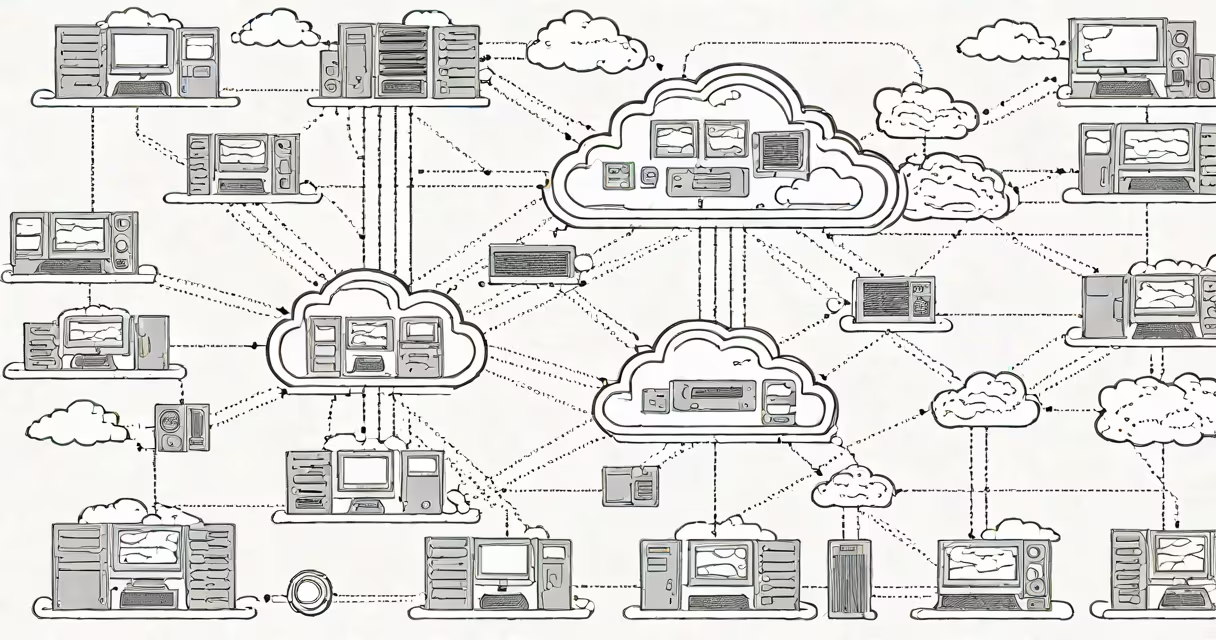
Cloud computing architecture is the structural design of distributed systems that deliver computing resources-including servers, storage, networking, and software-over the internet on demand. It enables organizations to scale workloads dynamically, access services globally, and reduce upfront hardware costs.
This architecture relies on virtualized infrastructure hosted in geographically dispersed data centers. Resources are pooled, automated, and allocated based on workload requirements. The model supports multi-tenancy, where multiple users share physical hardware while maintaining isolation and security.
According to AWS's official documentation, cloud architecture "aims to provide high availability, fault tolerance, and elasticity." Gartner notes that effective cloud architecture reduces operational overhead by up to 60% compared to traditional on-premises setups, primarily through automated scaling and centralized management.
At its foundation, cloud computing architecture operates through abstraction layers. Physical servers in data centers are abstracted into virtual machines (VMs), containers, or serverless functions. These abstractions allow software to run without direct dependency on specific hardware.
When a user requests a service-such as launching a web application-the cloud platform automatically provisions compute instances, assigns IP addresses, configures firewalls, and connects to databases. This process happens in seconds, often without human intervention.
For example, Netflix uses Amazon Web Services (AWS) to handle over 250 million hours of video streaming daily. Their architecture includes auto-scaling groups that launch additional VMs during peak viewing times. When demand drops, idle instances are terminated, reducing costs. This changing allocation is managed entirely through cloud-native tools like AWS Auto Scaling and Elastic Load Balancing.
Cloud architecture consists of several interdependent elements:
There are three primary deployment models:
| Model | Description | Use Case |
|---|---|---|
| Public Cloud | Resources owned and operated by third-party providers (e.g., AWS, Azure, Google Cloud). | Startups needing rapid deployment; global applications. |
| Private Cloud | Dedicated infrastructure for a single organization, hosted on-premises or in a third-party data center. | Regulated industries like healthcare or finance requiring strict compliance. |
| Hybrid Cloud | Combines public and private environments, allowing data and applications to move between them. | Enterprises migrating legacy systems gradually; disaster recovery planning. |
A common misconception is that hybrid cloud means equal use of both environments. In practice, most hybrid setups use public cloud for burst capacity and private cloud for sensitive data. For example, a bank may store customer records in a private cloud but use AWS for seasonal transaction processing during holidays.
Many confuse cloud computing architecture with simply using cloud services. The architecture is the underlying blueprint-not the act of uploading files to Dropbox or running a website on Heroku. It involves system design decisions such as redundancy, failover mechanisms, and data locality.
Another frequent error is assuming all cloud solutions are equally secure. The shared responsibility model clarifies that while the provider secures the infrastructure (e.g., physical servers, hypervisors), the customer is responsible for securing their data, configurations, and access controls. A misconfigured S3 bucket led to a major breach at Capital One in 2019, exposing 106 million records-despite AWS securing the underlying storage layer.
One non-obvious fact: cloud architectures are not inherently green. While providers like Google Cloud have committed to carbon-free operations by 2025, energy consumption depends heavily on workload placement and cooling efficiency. A study by the University of Massachusetts found that poorly optimized cloud workloads can consume up to 30% more energy than equivalent on-premises systems due to inefficient resource allocation.
Consider a retail company expanding to Europe. They need low-latency access for customers in Germany, France, and Spain. Their cloud computing architecture includes:
This setup ensures faster response times, complies with GDPR data residency laws, and scales automatically during holiday sales. The entire system was provisioned using Infrastructure-as-Code (IaC) via AWS CloudFormation templates, enabling consistent replication across environments.
During Black Friday, traffic spiked from 10,000 to 150,000 concurrent users. The auto-scaling group launched 200 new EC2 instances within 90 seconds. After the event, instances were terminated automatically. Total cost for the peak period was $1,200-far less than maintaining enough on-premises hardware to handle the surge.
As workloads grow more complex, modern cloud computing architecture increasingly integrates AI-driven optimization. Tools like AWS Compute Optimizer analyze usage patterns and recommend right-sized instances, reducing waste. This evolution marks a shift from static configuration to adaptive, intelligent systems.