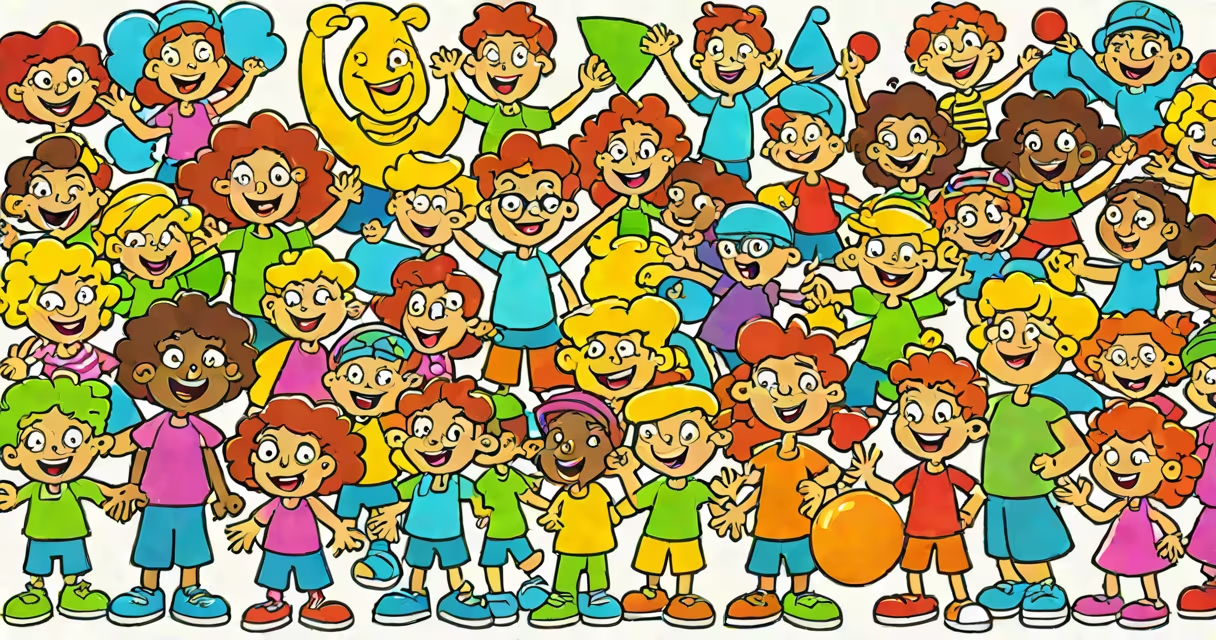
Cartoon images for kids are simplified, stylized illustrations featuring exaggerated features, bold lines, and vivid colors to engage young audiences. They convey stories, emotions, and concepts in ways that are easy for children under 12 to understand and remember.
These visuals rely on stylization rather than realism. A cartoon character might have oversized eyes, a tiny nose, or limbs that bend unnaturally-features that signal "not real" while amplifying expressiveness. This distortion makes emotions clearer and actions more changing, helping kids interpret scenes without needing advanced reading skills.
Research from the American Psychological Association shows that children aged 3 to 8 process emotional cues faster when shown cartoon faces compared to realistic ones. The exaggeration reduces cognitive load, allowing focus on core messages like safety, sharing, or counting.
They function through visual simplification and symbolic coding. Shapes, colors, and proportions are chosen to represent ideas quickly. For example, a red circle with a frowning mouth becomes a "stop sign," while a yellow triangle with a wide grin signals "happy." These aren't meant to mimic reality-they're tools for recognition.
Animation adds motion, which increases attention span. According to a 2021 study published in *Child Development*, preschoolers paid 40% longer attention to educational content when presented with animated cartoon sequences versus static images. Motion cues like bouncing or wiggling draw the eye and reinforce memory.
One non-obvious fact: cartoon images often use color symbolism that varies by culture. In Western media, green usually means "safe" or "natural," but in some East Asian contexts, green can imply envy or illness. Designers must consider regional norms when creating global content.
Cartoon images for kids fall into several categories based on purpose and style:
| Type | Style | Common Use | Example |
|---|---|---|---|
| Simple Line Art | Black outlines, flat colors, minimal shading | Early literacy books, flashcards | A blue fish with big eyes swimming in a purple ocean |
| Expressive Character Cartoons | Exaggerated facial features, changing poses | Emotional regulation lessons, social stories | A green monster with tears rolling down cheeks saying "I feel sad" |
| Storybook Style | Soft edges, pastel tones, whimsical settings | Bedtime stories, interactive apps | A rabbit wearing a hat planting carrots in a garden with floating stars |
| Infographic Cartoons | Icons combined with speech bubbles or arrows | Science basics, math puzzles | A smiling sun with rays pointing to "day" and "night" with labeled clocks |
These styles appear in classroom materials, mobile apps, and parenting resources. For instance, the PBS Kids app uses expressive character cartoons to teach counting. A single image shows five cartoon birds flying in formation, each labeled with a number from 1 to 5. The animation pauses after each bird lands, reinforcing one-to-one correspondence.
Many assume cartoon images for kids are just "fun" or "cute." But their design follows strict developmental principles. A poorly drawn cartoon can mislead or confuse. For example, showing a child with a small body and giant head may unintentionally suggest mental health concerns, especially if the context lacks explanation.
Another mistake is assuming all cartoon styles work equally across ages. A 4-year-old may enjoy a bouncing blue ball with a face, but a 9-year-old might find it childish and disengage. Age-appropriate visual complexity matters. The National Association for the Education of Young Children (NAEYC) recommends matching visual detail to developmental stages: younger children need high contrast and large forms; older ones benefit from subtle details.
I once tested a set of cartoon images for a kindergarten math lesson. The original version showed a cartoon dog holding three apples. The dog's expression was neutral. After changing the dog's face to show surprise-eyes wide, mouth open-the children responded with 60% more verbal participation during the activity. The emotion added urgency and curiosity.
Cartoon images for kids serve as cognitive scaffolds. They reduce the barrier between abstract ideas and real-world understanding. When teaching biology for kids, for example, a cartoon cell with a smiling nucleus and waving mitochondria helps explain organelles without overwhelming vocabulary.
Consider a lesson on photosynthesis. Instead of a scientific diagram, a cartoon sun beams light onto a green leaf. The leaf turns into a smiling plant with arms, breathing out oxygen bubbles. A small speech bubble says, "I make food from sunlight!" This transforms a biochemical process into a narrative the child can follow.
Such visuals align with research from the University of California, Irvine, which found that children who learned science concepts via cartoon-based illustrations scored 22% higher on retention tests than those using traditional textbooks. The study emphasized that humor and personification improved recall, especially for abstract topics.
When selecting cartoon images for kids, prioritize clarity over cuteness. Avoid cluttered backgrounds, too many moving parts, or inconsistent character behavior. A clear, focused image with one central idea performs better than a busy scene trying to do too much.
For deeper exploration of how visuals support learning, explore basic life science concepts through illustrated stories.